The 11pm Ice, the Dressing Room, and the Friendships That Keep Us Lacing Up
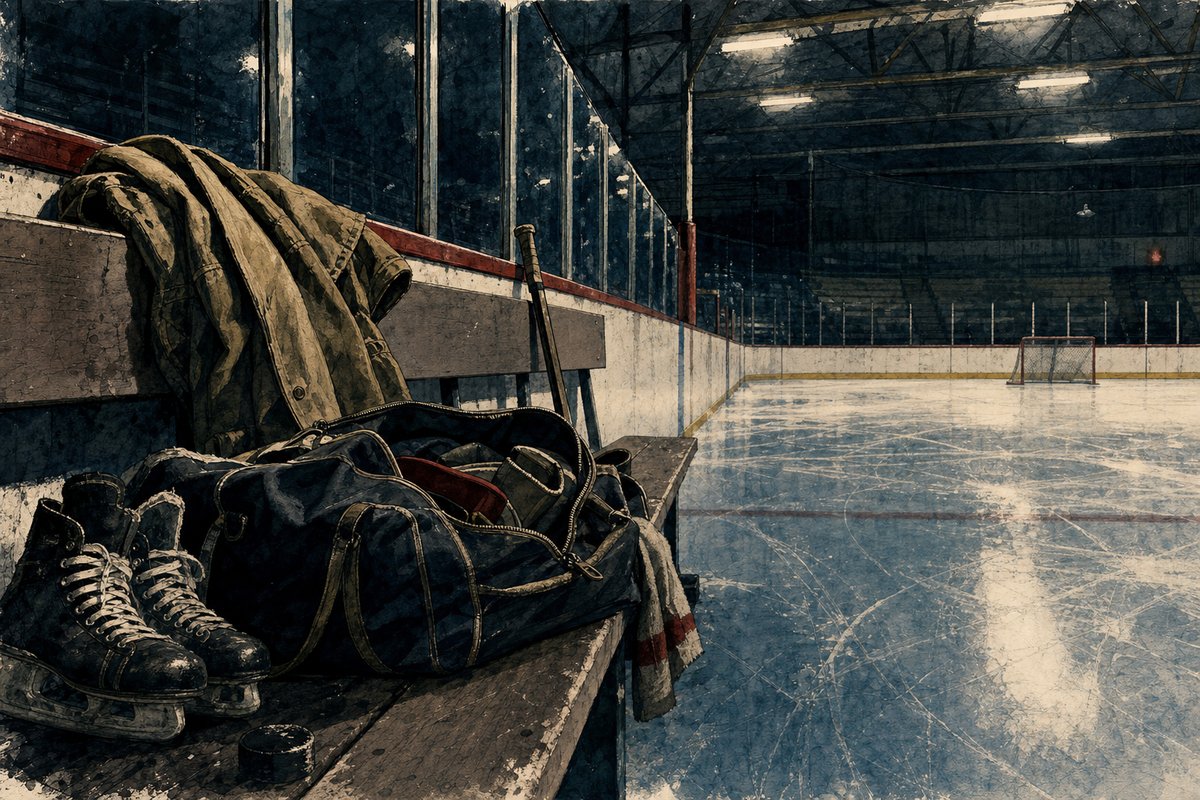
There is a particular kind of cold that only exists at eleven o'clock at night, when the parking lot of a small-town rink is half-empty and your breath hangs in the air like cigarette smoke. You can see it from the road — the one set of fluorescent tubes still humming over Sheet B, the family minivans nosed in at angles, frost creeping up the windshields. Everybody else in town is asleep. And here you are, hauling a bag that weighs more than it should, your stick over your shoulder, walking toward the only warm yellow light for a kilometre in any direction. This is beer league hockey. This is the game after the game. And there is nowhere on earth we would rather be.
It is not glamorous. Nobody is watching. There are no scouts in the stands and no stands to speak of, just a couple of rows of cold aluminium and a guy named Dave who shows up to watch his buddy and falls asleep by the second period. But ask anyone who plays it, and they will tell you the same thing in slightly different words: this is the truest hockey there is. The kind you play for no reason at all except that you cannot imagine your life without it.
Let us be honest about where beer league lives. It lives at the end of the night. The good ice — the seven o'clock, the eight o'clock — goes to the kids, to minor hockey, to figure skating, to the programs with parents and registration fees and a future. We get the leftovers. The 10:15. The 11:30. The infamous midnight slot, where you take your first stride at 12:01 and you have to count back the hours and realize you have to be at work in seven of them, and you do not care, because the puck just dropped.
There is a strange romance to the late ice that you only understand once you have lived it. The rink is quieter then. The Zamboni has just laid down a fresh sheet and the surface is glass, untouched, gleaming under those buzzing lights, and for about ninety seconds it is the most perfect thing you have ever seen — before twelve grown men carve it to ribbons. The cold feels cleaner at midnight. The sound is bigger. A puck off the boards in an empty arena at half past eleven rings like a bell in a cathedral.
You learn the rhythms. You learn which rink has the good showers and which one has the heater in the room that actually works. You learn that the team before you always runs five minutes over, so you stand in the bench doorway with your gloves on, stick tapping, waiting for the ref to wave them off. You learn the drive home — the empty highway, the radio low, the particular tired-but-wired feeling of a body that has just been emptied out and a mind that is finally, blessedly quiet. For a lot of us, that drive home at one in the morning is the most peaceful half-hour of the entire week. There is a reason hockey shows up in so many of the small rituals of an ordinary life; we wrote a whole love letter to that idea in the games people play, and beer league is the purest version of it.
You can keep your incense and your scented candles. The true perfume of a life in hockey is a beer league dressing room at midnight, and anyone who has ever sat in one is, against all reason, fond of it. It is a smell built up over decades and never fully scrubbed out: old sweat in cinder-block walls, the sweet rot of gear that never quite dries, rubber matting, tape, liniment, and underneath it all a faint, eternal tang of stale beer soaked into the wooden benches.
It should be revolting. Somehow it is the smell of belonging. You walk into that room after a long week — a bad day at work, a fight with your spouse, a bill you cannot pay — and the door swings shut behind you and the smell hits you and your shoulders come down two inches. You are home. None of the outside stuff comes through that door. In here you are not your job title or your mortgage or your worries. In here you are just the left winger, third line, the guy who can't backcheck but has a decent wrister.
The room has a geography. Everyone has a spot. Nobody assigns the spots and nobody remembers when they were assigned, but they are as fixed as the stars. The same guy sits in the corner by the door and tapes his socks the same way he has for fifteen years. The same guy shows up last, every week, half-dressed in the parking lot. The room fills with the slap of tape being torn, the click of buckles, the low rumble of men talking about nothing in particular — work, the playoffs, whose turn it is to bring the beer — and slowly, sock by sock and pad by pad, a dozen tired adults turn back into hockey players.
Every beer league team is the same team. The names change, the cities change, the jerseys change, but the cast of characters is universal. You know them already.
There is the Guy Who Thinks He's Still Junior. He was good once — genuinely good, maybe drafted, maybe a cup of coffee in the minors — and he has never fully made peace with the fact that it is over. He takes the no-hit league a little too seriously. He coasts through the regular season and then turns it on in the third period of a meaningless Tuesday game like the scouts are back. We love him and we want to strangle him in equal measure, usually within the same shift.
There is the Goalie, who is a different species entirely, who plays for free because nobody will play net for money, and who therefore can do whatever he wants and knows it. There is the Old Timer, sixty-something, who can barely skate anymore but has a stick like a magic wand and hands that remember everything his legs forgot. There is the Young Guy who is faster than all of us and apologizes when he scores. There is the Enforcer Who Never Fights, the biggest man on the ice, gentle as a lamb, whose entire job is to skate near opponents and exist. And there is at least one guy whose name you have genuinely never learned in three years of playing together, and it is now far, far too late to ask.
These are not teammates so much as a found family that meets once a week on a frozen surface. Some of these friendships go back to childhood; some are the kind of fast, deep, unlikely bonds that hockey seems to manufacture out of nowhere. We have told a lot of those stories — the year a celebrity put his name on the sweaters in our John Candy year, the tavern that became a clubhouse in the ballad of Wolski's Tavern. The details differ. The shape of the thing never does.
The name of the game is not an accident. The beer is not incidental to beer league; it is the whole second period of the night, the one played sitting down. The final buzzer goes, you shake hands — and in beer league you actually mean the handshake, because you'll see these guys at the grocery store on Saturday — and then you clomp back to the room, peel off the sweat-soaked gear, and someone, blessedly, has remembered the cooler.
That first cold one, half-dressed, sweat still cooling on your back, skates off but shin pads still on — there is no drink in the world quite like it. It is not about drinking. Half the room nurses one beer for forty-five minutes and a good number drink nothing at all anymore. It is about the sitting. It is about the staying. It is about not being in a hurry to leave the warm room and go back out into the cold and the week. The game is the excuse. The room afterward is the point.
And then there is the beer coat — the great mythical garment of recreational hockey. The beer coat is the layer of warmth and courage and invincibility that descends after a couple of pints, the one that convinces you that the walk to the car in minus-twenty needs no jacket, that your knee feels great actually, that you could absolutely have gone pro if life had broken differently. We have a soft spot for the legend; if you want the full anatomy of it, we devoted an entire piece to the beer coat and the men who wore it best. The beer coat is a lie, of course. It is a beautiful, harmless, recurring lie that hockey players tell themselves once a week, and it is one of the warmest things in the game.
There is an honesty to a beer league sweater. No name on the back. No retired number hanging in any rafters. Maybe a local plumbing company on the front if you are lucky enough to have a sponsor, maybe just a plain colour from a bin of mismatched practice jerseys, light and dark, so the two pickup sides can tell each other apart. The jersey does not make you anybody. You are not buying the dream of being a star. You showed up; you get a colour; you play.
The gear tells the same story. Sticks held together with tape and faith. Helmets a decade out of date. A pair of gloves with the palms worn through so you can feel the cold of the shaft on your bare fingers, and you keep wearing them because they are broken in just right and a new pair feels like wearing somebody else's hands. A skate sharpening from three months ago. Shin pads that smell like a swamp. None of it matters. The puck does not know what you paid for your stick.
This is the great democratic secret of beer league hockey: once the puck drops, the lawyer and the roofer and the schoolteacher and the retired cop are exactly the same. The ice does not care about your salary. It cares whether you can chip it off the glass and get to the bench. Out there, stripped down to a colour and a number that means nothing, everyone is equal in a way the rest of life almost never allows. It is the closest thing a lot of grown men have to a level playing field, and they feel it every single week without ever saying it out loud.
At some point you have to ask yourself the obvious question. Why? Why do this? You are forty-five years old. Your knees ache. You have to be up at six. You will be sore until Thursday. You are paying good money for the privilege of being checked into the boards by a guy named Greg who sells insurance. Nobody is making you. Why do we keep lacing up?
Part of it is the simple, animal joy of the thing. There is no feeling in adult life quite like a clean stride on fresh ice, the cold air in your lungs, the puck flat on your blade. For most of us, sports ended when we were teenagers. Beer league is the rare gift of getting to keep playing — actually playing, competing, sweating, trying — into our forties and fifties and beyond, long after every other game from our childhood has been packed away. We never had to give it up. We just changed the ice times.
Part of it is what it does to a week. Everyone needs one thing on the calendar that is theirs, that has nothing to do with being useful or productive or responsible. Beer league is that thing. It is two hours where the only problem you have to solve is what to do with the puck, and the only person who needs anything from you is the guy yelling for a pass on the far wing. We have always believed hockey is wired into something deeper than sport — we said as much in our look at pond hockey and the backyard rinks where every Canadian story begins — and beer league is just where that wiring lives once you are too old for the pond and too stubborn to quit.
And part of it is the soundtrack. Not the music exactly, though there is always music — somebody's playlist on a phone in the corner of the room, the same songs that were playing when you were nineteen. We have written before about the soundtrack of hockey, the way certain sounds get welded permanently to the feeling of the game. In beer league it is the small sounds: the scrape of a stop, the clack of a faceoff, the thunk of the bench door, the laugh that echoes off cinder block. You could play me that loop in a dark room with no picture and I would be twelve years old and forty-five years old at the same time, and I would smell that dressing room, and I would be happy.
If you ask a beer leaguer in an honest moment what the game is really about, eventually, past the joy of the stride and the romance of the late ice, they will land on the truth of it: the friends. The hockey is the reason we gather. The friendships are what we built while we were pretending the hockey was the reason.
These are not always the friends you would have picked. A beer league roster scrambles together men who would otherwise never meet — different jobs, different ages, different parts of town, men twenty years apart who would have nothing to talk about anywhere but a dressing room. And yet some of the deepest, most durable friendships of a man's adult life get forged on those benches. You see each other every week for years. You know whose marriage is shaky and whose kid got into university and who just lost a parent, and you know it because there is something about sitting half-dressed in a warm room at one in the morning that makes men talk who would never talk anywhere else.
And you stick together when it matters. When one of the guys gets sick, the team is there. When someone loses a job, somebody quietly knows a guy. When the worst happens — and over enough years, in any group of men who have skated together for decades, the worst eventually happens — the team shows up to the funeral in their good clothes, and afterward they go to the rink, because they do not know what else to do with the grief, and they play, and they leave a stall open, and they have a beer for the guy who is not there. That is beer league too. That is maybe the most important part of it.
That is the part the highlight reels never show and the box scores never record. Recreational hockey is not really about hockey at all. It is a once-a-week excuse for friendship, dressed up in shin pads and tape, smuggled into the calendar of busy adult lives under the cover of a game.
Here is the simple truth at the bottom of all of it. The kids who fill the prime-time ice will mostly stop one day. They will play their last competitive game at sixteen or eighteen or twenty-two, and most of them will not know it is the last one while it is happening, and that is the saddest thing in sport. Beer league hockey is the answer to that sadness. It is the game you never have to stop playing.
You will play it badly, eventually. You will get slower. The Old Timer in your room right now, the one who can barely skate but whose hands remember everything, is showing you your own future, and it is not a tragedy — it is a promise. You get to keep coming. You get to keep the room, the smell, the beer coat, the friends, the fresh sheet under the buzzing lights at eleven o'clock at night, for as long as your body will carry you out the bench door. And when it finally won't, you will come and sit in the cold aluminium seats and watch, and fall asleep by the second period, and that will count too.
So tonight, somewhere across this country, the good ice is going dark and the leftover ice is coming on. A Zamboni is laying down a fresh sheet for a midnight game nobody will remember in a week. A dozen tired adults are pulling into a half-empty lot, hauling bags too heavy, walking toward the only warm light for a kilometre. They are not chasing anything. They arrived a long time ago. This is beer league hockey. This is the game after the game. And it is, quietly, one of the best things we ever did.
Beer league hockey is recreational adult hockey — the men's and women's leagues and drop-in pickup games played purely for the love of it, with no money or scouts involved. The name comes from the long tradition of cracking a beer in the dressing room after the final buzzer. The skill level ranges from former junior players to weekend warriors who learned to skate as adults.
Rinks reserve the prime evening hours for minor hockey, figure skating and youth programs, so adult recreational leagues get whatever ice is left over — often the 10pm, 11pm and midnight slots. Late ice is cheaper to book, and for working adults it is frequently the only time the rink is free, which is how the graveyard shift became the natural home of beer league.
No. Beer leagues are tiered by ability, from competitive divisions full of ex-junior talent down to true beginner levels where the only requirement is being able to stop, more or less. The point of recreational hockey is the game, the exercise and the friendships, not the scoreboard.
The "beer coat" is the friendly bit of folklore around the warmth and invincibility you feel after a couple of post-game pints — the sense that you do not need a jacket for the walk to the car, that your knee feels fine, that you could have gone pro. It is a harmless, recurring exaggeration that has become part of the culture of the post-game room.
More stories from beyond the bench live in our Away From The Rink collection, and the lighter side of the life sits over in the Beer archive.