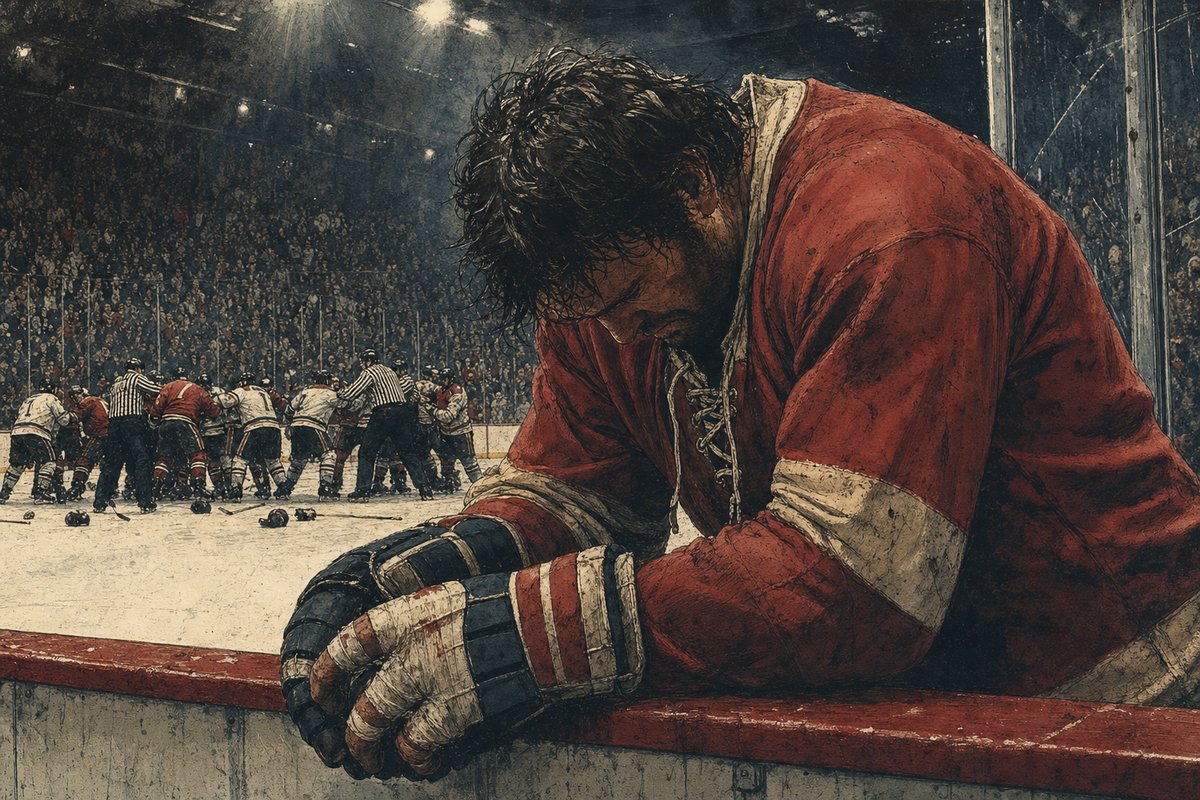
The Life, Fights & Tragic Death of an NHL Legend
Updated April 2026 — Expanded with the Bruise Brothers statistical comparison, the final Sandy McCarthy fight in March 1995, and the Boston University CTE findings that redefined the hockey concussion debate.
Bob Probert wasn't just the toughest man in hockey—he was a contradiction wrapped in tape and blood. A man who could score 29 goals in a season and then pummel anyone who looked at his teammates wrong. He was beloved in Detroit, feared everywhere else, and haunted by demons that eventually caught up with him.
This is his story, told through the memories of those who played with him, fought him, and loved him.
Robert Alan Probert was born on June 5, 1965, in Windsor, Ontario—just across the river from Detroit, the city that would eventually adopt him as their favorite son. Growing up, Bobby wasn't the biggest kid, but he had something that couldn't be taught: he simply refused to back down.
"I remember playing against Bobby in junior," recalled one former teammate. "Even then, you could see it. Most guys, when things got rough, they'd find a way out. Bobby? He'd find a way in. Deeper. Harder. He wanted it more than anyone I'd ever seen."
Probert came up through the Brantford Alexanders of the OHL, where he started developing his reputation. By the time the Detroit Red Wings selected him in the third round of the 1983 NHL Draft—46th overall—scouts knew they were getting a player who could fight. What they didn't know was that they were getting a hockey player who happened to be the best fighter of his generation.
When Bob Probert arrived in Detroit full-time in 1985, the Red Wings were a franchise desperate for an identity. They'd missed the playoffs for years. The Joe Louis Arena faithful were hungry for something—someone—to believe in.
They found it in Probert.
"Bobby wasn't just an enforcer," explained a former Red Wings equipment manager. "That's what people who didn't watch him don't understand. He could play. Really play. The year he scored 29 goals? That wasn't a fluke. He had hands. He had vision. He just also happened to be able to beat the hell out of anyone in the league."
The numbers tell one story: 29 goals, 33 assists, 62 points, and 398 penalty minutes. No player in NHL history had ever put up those kinds of offensive numbers while also leading the league in fighting. Bob Probert wasn't just good at two things—he was elite at both.
"That year, teams didn't know what to do with him," said a former opponent. "You couldn't put a skill guy on him because he'd run them over. You couldn't put your tough guy on him because he'd score on them. And if you tried to take liberties with Yzerman or anyone else on that team? Probie would find you. Always."
The Red Wings reached the conference finals that year, and Probert was a major reason why. His presence gave Steve Yzerman room to breathe. His fists gave the whole team confidence.
Any discussion of the greatest hockey enforcers must include Bob Probert's legendary bouts. With 246 career fights, Probert built a resume that may never be matched.
When people talk about Bob Probert fights, one name comes up more than any other: Tie Domi. Their rivalry defined an era of hockey violence.
"The Probert-Domi thing was personal," one witness recalled. "They genuinely didn't like each other. It wasn't theater. When they dropped the gloves, both guys knew they were in for a war."
Their most famous encounter came on December 2, 1992, when Domi—then with the Rangers—knocked Probert down with a series of uppercuts. It was one of the few times anyone had gotten the better of Probert so decisively. The hockey world was stunned.
"After that fight, Bobby was different for a few weeks," a teammate observed. "Not scared—Bobby was never scared of anyone. But focused. He wanted Domi again. And eventually, he got him."
The list of men who faced Probert reads like a who's who of hockey tough guys:
"Fighting Probert was different than fighting anyone else," admitted one former enforcer. "Most guys, you could find a rhythm. You'd trade punches, look for an opening. With Bobby, there was no rhythm. It was just violence. Pure, relentless violence. And he could take a punch like no one I've ever seen. You'd land one that would drop most guys, and he'd just smile at you."
For all his success on the ice, Bob Probert fought a harder battle off it. His struggles with cocaine and alcohol were well-documented, and they nearly destroyed everything he'd built.
In March 1989, Probert was arrested at the U.S.-Canada border with 14 grams of cocaine in his underwear. The arrest led to a three-month prison sentence and a lengthy suspension from the NHL. Many thought his career was over.
"The addiction stuff—that was the real fight," said a close friend. "The guys on the ice? Bobby could handle them. But this disease, it doesn't care how tough you are. It finds your weaknesses and exploits them."
Probert missed most of the 1989-90 season but returned to the Red Wings in 1990-91. The league had banned him from traveling to Canada—a stunning punishment that meant he couldn't play in Toronto, Montreal, Vancouver, or any other Canadian city. For four years, Probert played only home games and road games in American cities.
Despite the restrictions, Probert continued to produce. He remained one of the league's most feared fighters, and he still contributed offensively when called upon. The Red Wings stuck by him, and the fans never wavered.
"Detroit loved Bobby through all of it," recalled a longtime observer. "Most cities would have turned on a guy with those problems. Not Detroit. He was one of them—flawed, fighting, but never giving up."
In 1994, Probert's time in Detroit came to an end. The Red Wings, now building a championship team around a different identity, let him go. The Chicago Blackhawks signed him, and Probert found a second hockey home.
The Blackhawks years were different. Probert was older, slower, battling injuries and the accumulated damage of thousands of punches given and received. But he could still fight. He could still protect his teammates. And Chicago fans embraced him the same way Detroit had.
"Bobby was a warrior until the end," said a Blackhawks teammate. "Even when his body was breaking down, he'd go out there and do his job. Never complained. Never made excuses."
Probert retired in 2002 after 16 NHL seasons. His final statistics: 163 goals, 221 assists, 384 points, and 3,300 penalty minutes across 935 regular season games. The penalty minutes ranked among the highest in league history.
Retirement brought new challenges. Probert continued to struggle with addiction, though he worked hard at recovery. He became involved in charity work, particularly efforts to help young people avoid the mistakes he'd made.
"Bobby was honest about what he'd been through," said a friend. "He'd talk to kids, tell them his story without sugarcoating it. He wasn't proud of the addiction stuff, but he thought if his experience could help someone else, it was worth sharing."
He also dealt with the physical toll of his career. His hands were gnarled from years of bare-knuckle fighting. He had trouble with memory, with mood swings, with the little things that most people take for granted.
On July 5, 2010, Bob Probert collapsed while boating with his family on Lake St. Clair. He was 45 years old. The cause of death was later determined to be heart failure.
The hockey world mourned. Tributes poured in from teammates, opponents, and fans who remembered the enforcer who had defined an era.
"Bobby was the best fighter I ever saw," said one rival. "But he was also a good guy. Funny, loyal to his friends, loved his family. The fighting stuff—that was his job. Outside the rink, he was just Bobby."
After his death, Probert's family made the courageous decision to donate his brain to research. Scientists at Boston University's CTE Center examined the tissue and found evidence of chronic traumatic encephalopathy—the degenerative brain disease caused by repeated head trauma.
Bob Probert became one of the first NHL players posthumously diagnosed with CTE, joining a growing list of athletes whose brains showed the damage of their violent professions. His diagnosis helped raise awareness about the long-term consequences of fighting in hockey and contributed to ongoing debates about the role of enforcers in the modern game.
For more on this issue, see our piece on Bryan Fogarty's tragic story and the toll hockey takes on its players.
What do we make of Bob Probert's life? He was the best at something many people wish didn't exist. He brought joy to millions of fans while suffering through addiction and, ultimately, brain damage that likely contributed to his early death.
The role of the hockey enforcer has changed dramatically since Probert's prime. Fighting is down across the league. The heavyweight specialists who once filled rosters have largely disappeared. Some see this as progress. Others mourn the loss of an era.
But no one who saw Bob Probert play will ever forget him. The way he could shift from skilled playmaker to terrifying fighter in an instant. The loyalty he showed to teammates. The courage he demonstrated every night he stepped on the ice, knowing that someone would want to test him.
"He was one of a kind," said a former teammate. "There will never be another Bob Probert. The game won't allow it anymore. But those of us who were there, who saw it—we know what he was. The toughest man to ever play hockey. And somehow, underneath all that, a good person trying to do his best."
The nickname "Bruise Brothers" first appeared in Detroit newspapers in the late 1980s to describe the two most feared forwards on the Red Wings roster: Bob Probert and Joey Kocur. The pair played together in Detroit from 1985 to 1991, and their combined presence gave Steve Yzerman more room to breathe than any captain had a right to expect.
The statistical comparison, however, shows just how different the two players actually were when you broke them down. Probert finished his career with 163 goals and 221 assists across 935 games. Kocur finished with 80 goals and 102 assists across 821 games. Probert was, by a meaningful margin, the better hockey player - his 1987-88 season of 29 goals, 62 points, and 398 penalty minutes is one of the most unique statistical lines in NHL history.
The penalty-minute comparison is similarly lopsided but in the opposite direction you might expect. Probert finished with 3,300 career PIM - fifth on the all-time list at his retirement. Kocur finished with 2,519 PIM, also inside the top-30 all-time but a clear step below his linemate. Probert fought more often (246 documented fights vs. Kocur's 200-plus). Probert fought harder opponents more frequently. Probert also drew more instigator penalties, because he was the one opposing teams challenged first.
The styles were genuinely complementary. Kocur was a pure right-hand puncher - his right was one of the most feared single punches in the history of the sport, the kind of punch that ended fights in a single connection. Kocur damaged people. Broke noses. Broke hands (his own, including the legendary right hand that required multiple reconstructive surgeries). Probert, by contrast, was a long-range, high-volume fighter. He took punches, absorbed them, and kept throwing until his opponent tired. Kocur was an execution. Probert was attrition.
"Joey would knock you out in eight seconds," a former opposing enforcer recalled. "Bobby would beat you up for two minutes. Neither way was a good time, but they were very different experiences. And if you drew Detroit on a back-to-back and you had to fight both of them, you were going home sore."
The Bruise Brothers era ended when Kocur was traded to the New York Rangers in March 1991. Kocur went on to win Stanley Cups with New York in 1994 and then with Detroit in 1997 and 1998 after being reacquired. Probert, meanwhile, was traded to Chicago in 1994 and never won a Cup. For more on the Kocur side of the partnership, see our full Bruise Brothers story.
By 1995, Bob Probert was 29 years old and in his first season with the Chicago Blackhawks. The body had started to catch up with him - the hands were slower, the knees creakier, the reflexes a half-second off the peak of a few years earlier. He was still an enforcer, still drawing matchups against opposing heavyweights every night. But the shape of his fights was changing.
In a March 1995 game against the Calgary Flames, Probert matched up with Sandy McCarthy - the big, young Calgary enforcer who was several inches taller and several years younger. McCarthy was the kind of opponent who, earlier in Probert's career, would have been a routine dispatch. Not this time. The fight was extended, closely contested, and by the end of it, Probert was clearly tired in a way that enforcer watchers had rarely seen.
The bout became, in retrospect, a hinge moment. It was not quite Probert's last fight - he would drop the gloves dozens more times across his remaining seasons in Chicago - but it was one of the last against a genuine top-tier heavyweight. From that point forward, Probert's matchups increasingly came against younger, less established opponents trying to make their bones. He was now the veteran they wanted to catch at the right moment.
"You could see it was different that night," a Hawks teammate said years later. "Bobby still gave it everything. But the recovery, the second punches, the way he reset his feet - it was a guy who was 29 going on 40. Those fights take years off you faster than anybody understands until they stop happening."
McCarthy himself became a journeyman NHL enforcer for another decade. Probert soldiered on until 2002. But the Sandy McCarthy fight in March 1995 is worth remembering as one of the markers of the Probert story - the moment the peak was clearly past.
When Bob Probert died of heart failure on July 5, 2010, his family made a decision that would alter the trajectory of every concussion discussion in professional hockey for the next decade. They donated his brain to Boston University's Center for the Study of Traumatic Encephalopathy - the leading CTE research institution in North America. It was not an easy decision. It was not a decision any family should have had to make. But Dani Probert, Bob's widow, has since spoken publicly about knowing it was the right one.
In March 2011, eight months after his death, Dr. Ann McKee and her team at BU published their findings. Bob Probert's brain showed clear evidence of chronic traumatic encephalopathy. It was the second diagnosed NHL case, after Reggie Fleming and preceding a long, growing list of other former players. Probert's specific findings - the pattern of tau protein accumulation in the frontal lobes, the cortical damage consistent with repeated head impacts - were consistent with what researchers had been finding in NFL players for years.
The diagnosis landed hard. Probert was not a marginal player. He was one of the most famous enforcers of his generation, a folk hero in Detroit, a guy whose fights were on every highlight reel in the sport. To have the Boston University team confirm that the man everybody had watched fight for 16 years had sustained measurable, progressive brain damage from that fighting - it was a conversation the NHL had successfully avoided for decades, and it was now impossible to avoid.
The Probert family went further. They partnered with the Concussion Legacy Foundation - the advocacy arm of the BU CTE Center - to raise awareness and encourage other hockey families to consider brain donation. Dani Probert became a public voice for concussion research, speaking at events, giving interviews, and pushing the NHL to take head trauma more seriously. Her work, alongside the advocacy from other affected families, has contributed directly to rule changes, including Rule 48 on hits to the head and the creation of the Department of Player Safety.
The Probert CTE finding also fed into the policy debate around fighting itself. Advocates for removing fighting from hockey cited Probert's case repeatedly. Defenders of the enforcer tradition - including Don Cherry - pushed back, arguing that fighting was not the cause but one of many contributors. The science, as of 2026, continues to evolve. What has not evolved is the fact that the Probert brain donation is now considered the foundational NHL case in the CTE research literature. Everything that came after it built on what the BU team learned from his brain tissue.
"Bobby would have wanted the donation to matter," a friend of the family said. "He always said the fighting stuff was his job, and he wasn't ashamed of it. But he also worried about what it was doing to him in the last years. If the research helps the next generation avoid what happened to him, that's the legacy he'd be proud of."
| Full Name | Robert Alan Probert |
| Born | June 5, 1965 - Windsor, Ontario, Canada |
| Died | July 5, 2010 (age 45) - Lake St. Clair, Michigan |
| Position | Left Wing |
| Height/Weight | 6'3" / 225 lbs |
| NHL Teams | Detroit Red Wings (1985-1994), Chicago Blackhawks (1994-2002) |
| NHL Draft | 1983, Round 3, 46th overall (Detroit) |
| Career Stats | 935 GP, 163 G, 221 A, 384 PTS |
| Penalty Minutes | 3,300 (5th all-time) |
| Career Fights | 246 documented |
Bob Probert died on July 5, 2010, at age 45 from heart failure while boating with his family on Lake St. Clair in Michigan. After his death, researchers discovered he had CTE (chronic traumatic encephalopathy), making him one of the first hockey players diagnosed with the brain disease linked to repeated head trauma.
Bob Probert had 246 documented fights during his NHL career, making him one of the most prolific fighters in league history. He accumulated 3,300 penalty minutes across 935 regular season games with the Detroit Red Wings and Chicago Blackhawks.
Bob Probert's most famous rivalry was with Tie Domi. The two fought multiple times throughout their careers, with their battles becoming legendary in NHL history. Other notable opponents included Craig Coxe, Donald Brashear, Marty McSorley, and Stu Grimson.
Yes. After Bob Probert's death in 2010, his family donated his brain to research at Boston University. Scientists found evidence of chronic traumatic encephalopathy (CTE), a degenerative brain disease caused by repeated head trauma. Probert was among the first NHL players to be posthumously diagnosed with CTE.
Bob Probert played for two NHL teams: the Detroit Red Wings (1985-1994) and the Chicago Blackhawks (1994-2002). He was drafted by Detroit in the third round of the 1983 NHL Draft.
Bob Probert was a legitimate hockey player who happened to also be the best fighter in the league. In 1987-88, he scored 29 goals and 62 points while leading the NHL in penalty minutes—a combination that has never been replicated. He finished his career with 163 goals and 384 points.
In 1989, Bob Probert was arrested at the U.S.-Canada border with cocaine. He served three months in federal prison and was subsequently barred from entering Canada by immigration authorities. This ban lasted until 1992, meaning he could not play in Canadian NHL cities during that period.
Probert's legacy grows with each passing year. The family's advocacy work with the Concussion Legacy Foundation continues, and the landmark CTE research using Probert's donated brain tissue has directly informed current NHL policy on fighting and head injuries. In 2026, Bob Probert remains one of the most-searched names in hockey history — a measure of how deeply his story resonates with fans who remember the enforcer era.
Think you know the game better than the oddsmakers? Put your hockey knowledge to work with Canada's best sportsbooks.