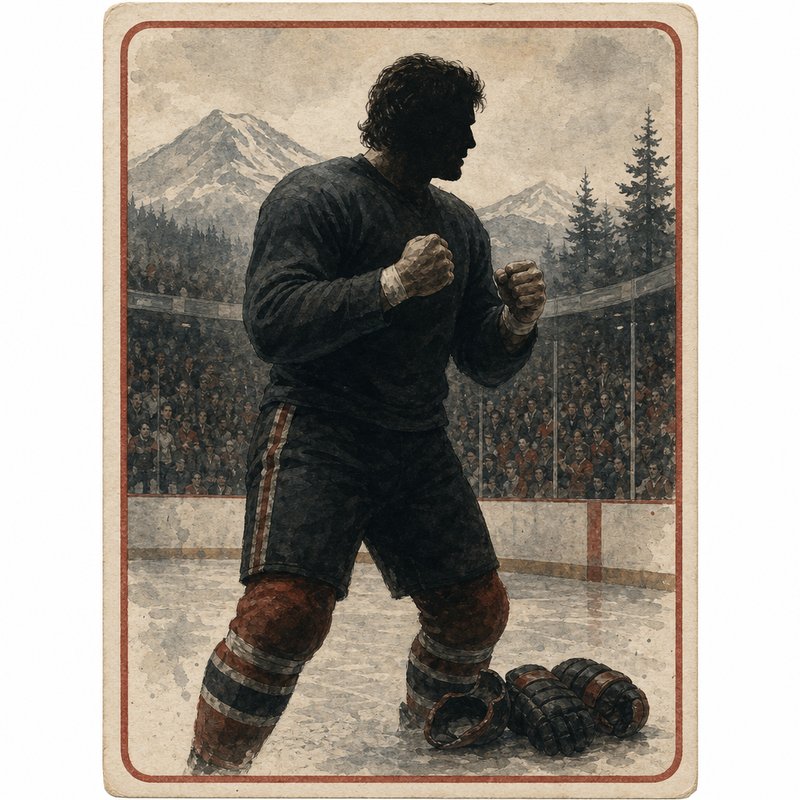
Donald Brashear: Hockey's Toughest Fighter
The Haitian-Canadian Who Fought His Way From Foster Care to the NHL
There are players who fight because they love it. There are players who fight because they're told to. And then there was Donald Brashear, who fought because fighting was the only language a world that had abandoned him as a child ever bothered to teach. Born in Indiana to a Haitian father, shuffled through the foster care system in Quebec, and dismissed by every scout who ever watched him skate—Brashear had no business being in the NHL. He had no connections, no pedigree, no safety net. What he had was 6'2" and 237 pounds of rage, resilience, and an iron jaw that absorbed punishment the way the rest of us absorb oxygen.
For sixteen seasons, Donald Brashear was the most feared man in professional hockey. Not the most talented. Not the most celebrated. The most feared. There is a difference, and every player who ever had to line up against him understood it intimately.
Growing Up in the System
Donald Brashear was born on January 7, 1972, in Bedford, Indiana—a small town in the limestone belt of the American Midwest that has precisely nothing to do with hockey. His father, Ira Brashear, was a Haitian immigrant. His mother was American. The marriage didn't last, and when it fell apart, so did any semblance of a normal childhood for young Donald.
By the time he was a toddler, Brashear's mother had taken him to Quebec, where he was placed into the foster care system. He bounced between homes, never settling, never belonging. A Black child in rural Quebec in the 1970s—he stood out in every way a child doesn't want to stand out. The other kids noticed. And they let him know about it.
"I learned to fight before I learned to skate," Brashear once said in a rare interview about his childhood. "When you're the only Black kid in town, you don't have a choice. You either learn to defend yourself or you get eaten alive."
He found a foster family that stuck—the Brashears of the Abitibi region in northern Quebec, who gave him their name and something resembling stability. It was there, in the frozen reaches of northern Quebec, that Donald first stepped onto the ice. He was a late starter by Canadian standards, well behind kids who'd been skating since they could walk. But what he lacked in finesse, he made up for in raw physicality. He was bigger than everyone else, stronger than everyone else, and angrier than everyone else.
Hockey gave him something the foster system never could: a place where his aggression was an asset instead of a problem.
The Making of an Enforcer
Brashear's junior hockey career was not the stuff of scouting reports and draft projections. He played in the QMJHL for the Longueuil Collége Français, where he was a marginal player with extraordinary fists. His skating was rough. His puck-handling was basic. But when the gloves dropped, there wasn't a junior player in Quebec who wanted any part of him.
He went undrafted. In the NHL's endless hunger for talent, Donald Brashear was considered too raw, too unskilled, too much of a project. The Montreal Canadiens eventually signed him as a free agent in 1992, but it wasn't because they saw a future NHLer. It was because they needed someone for their AHL affiliate who could protect the prospects and handle the rough stuff in the minor leagues.
"Nobody thought Brash was going to play in the NHL," recalled a former minor-league teammate. "He couldn't skate. I mean, he really couldn't skate. But he could fight like nothing I'd ever seen. And he worked—God, did he work. Every day, extra ice time, skating drills, working on his edges. Most guys with his fighting ability would have coasted. Donald never coasted a day in his life."
That work ethic transformed him. Over two seasons in the AHL, Brashear improved his skating from liability to functional. He'd never be graceful, but he became competent enough to play a regular shift in the NHL. Combined with his fighting ability—which was already elite—he became something teams needed desperately: a heavyweight enforcer who could actually play hockey.
Montreal Canadiens: The Beginning
Brashear made his NHL debut with the Montreal Canadiens during the 1993-94 season, and he made an immediate impression. Not with goals or assists, but with a willingness to fight anyone, anywhere, at any time. In a league full of tough men, Brashear was different. He wasn't just tough—he was technically proficient. He'd clearly studied boxing, and it showed.
In Montreal, he was a bit player—a fourth-liner who dressed some nights and sat in the press box others. The Canadiens had won the Stanley Cup in 1993, and their roster was built around speed and goaltending, not intimidation. There wasn't much room for a player whose primary skill set was beating people unconscious.
But the few times he fought, the hockey world took notice. Here was a Black player—still a rarity in the NHL in the mid-1990s—who was built like a linebacker and fought like a middleweight champion. Word spread quickly through the league's enforcer grapevine: don't mess with the kid in Montreal.
"I fought him once in my first year," said one retired enforcer. "Once. That was enough. He hit me with a right hand that I felt for three weeks. I'd fought everyone—Probert, Domi, Grimson—and none of them hit as hard as Brashear. Not even close."
Vancouver Canucks: Peak Brashear
In January 1996, the Canadiens traded Brashear to the Vancouver Canucks, and it was in Vancouver that Donald Brashear became Donald Brashear. The Canucks were a team in transition, rebuilding after their heartbreaking run to the 1994 Stanley Cup Finals, and they needed someone who could provide physical presence and protection for their skilled players.
Brashear delivered beyond anyone's expectations.
For five seasons on the West Coast, Brashear was the undisputed heavyweight champion of the NHL. He fought everyone—Bob Probert, Tie Domi, Rob Ray, Georges Laraque, Peter Worrell—and he rarely lost. His fighting style was a devastating combination of size, reach, wrestling ability, and genuine boxing technique. Unlike most hockey fighters, who relied on grabbing the jersey and throwing wild haymakers, Brashear fought with structure. He established distance. He threw combinations. He used his left jab to set up his devastating right cross.
"Donald studied boxing," explained a former Vancouver teammate. "He trained with boxers in the off-season. He understood angles, leverage, timing. Most hockey fights are bar brawls on ice. Donald's fights were different. They were clinical. He'd take guys apart systematically."
What made Brashear truly terrifying wasn't just his punching power—it was his jaw. The man could absorb punishment that would have put other fighters on the ice. He'd take shots that wobbled his opponents and barely blink. In the enforcer world, where the ability to take a punch is as valued as the ability to throw one, Brashear's durability was legendary.
During his Vancouver years, Brashear also improved as a hockey player. He became a reliable fourth-liner who could forecheck aggressively, kill penalties in a pinch, and contribute the occasional goal. In 1998-99, he scored 8 goals and 12 assists in 77 games—respectable numbers for a player whose primary job was punching people. The Canucks' skilled players loved having him in the lineup. With Brashear on the bench, opponents thought twice about taking liberties.
The Marty McSorley Incident
And then came February 21, 2000. The night that changed everything.
The Vancouver Canucks were hosting the Boston Bruins at GM Place. Marty McSorley, the veteran enforcer who'd spent years as Wayne Gretzky's bodyguard, was in the Bruins' lineup. Earlier in the game, Brashear and McSorley had fought. Brashear won decisively, as he usually did. McSorley wanted a rematch. Brashear, ahead on the scoreboard and with nothing to prove, declined.
This refusal ate at McSorley. In the enforcer code, declining a fight was within your rights, but it was also a statement—a way of saying you'd already beaten the other man and saw no reason to waste your time doing it again. For a proud veteran like McSorley, it was an insult he couldn't swallow.
With 2.7 seconds remaining in the game, McSorley skated up behind Brashear and swung his stick at Brashear's head. The blow landed on the right temple. Brashear crumpled instantly, falling backward. His helmeted head hit the ice with a sickening crack. He lay motionless on the ice, then began convulsing. He was having a grand mal seizure.
The arena went silent. Players from both teams stood frozen, watching in horror as medical staff rushed to the ice. Brashear was stretchered off and taken to the hospital, where he was diagnosed with a grade three concussion.
McSorley was immediately suspended and later charged with assault with a weapon by the Vancouver Police Department. He was found guilty in a British Columbia court—only the second NHL player in history to be convicted of assault for on-ice conduct, after Dino Ciccarelli in 1988. McSorley received an 18-month conditional discharge and a 23-game NHL suspension that effectively ended his career.
"That night changed hockey," said one veteran who was in the arena. "It wasn't a fight. It wasn't even a cheap shot in the traditional sense. It was an attack. It was a man with a weapon striking another man from behind. And it forced everyone—players, coaches, the league—to confront the ugly reality of what this culture of violence could produce."
Brashear recovered physically, but the incident followed him for the rest of his career. Every interview, every profile, every mention of his name came with the same footnote: the guy McSorley hit with his stick. It was a label Brashear resented deeply.
"I don't want to be remembered for what someone else did to me," Brashear said years later. "I want to be remembered for what I did. For 16 years in the NHL. For over 2,600 penalty minutes. For never backing down from anyone. That's who I am."
Philadelphia and Washington: The Later Years
In 2001, Brashear was traded to the Philadelphia Flyers, joining a team that had a long tradition of toughness dating back to the Broad Street Bullies era. In Philadelphia, Brashear found kindred spirits—a franchise that understood and valued what he brought to the ice.
He spent five productive seasons with the Flyers, continuing to serve as the team's primary enforcer while contributing as a physical fourth-liner. His numbers were modest—he never scored more than 10 goals in a season—but his impact couldn't be measured in statistics. When Brashear was in the lineup, opposing players gave the Flyers' skilled forwards an extra inch of space. That inch was the difference between a scoring chance and a missed opportunity.
"Having Brash on the bench was like having an insurance policy," said a former Flyers teammate. "You knew that if anyone took a run at your star player, Donald would be over the boards in a heartbeat. And nobody—nobody—wanted to fight Donald Brashear."
In 2006, Brashear signed with the Washington Capitals as a free agent. He was 34 years old now, and the NHL was changing around him. The enforcer role was beginning to fade. Fighting was declining. The young players coming into the league were faster and more skilled, and there was less demand for the kind of heavyweight intimidation that Brashear provided.
But he was still Donald Brashear. He still fought. He still won. And at an age when most enforcers had long since retired, Brashear was still drawing a paycheque and making opponents think twice. He played three seasons in Washington before finishing his career with a brief stint with the New York Rangers in 2009-10.
Brashear's Fighting Style: What Made Him So Feared
To understand why Donald Brashear was the most feared fighter of his generation, you need to understand the mechanics of what he did. Most hockey fights are sloppy, chaotic affairs—two men grabbing each other's jerseys and throwing wild overhands until someone falls down or the linesmen step in. Brashear's fights were different.
First, there was his size. At 6'2" and 237 pounds, Brashear was one of the biggest enforcers in the league. He had long arms and massive hands—the hands of a man who'd been throwing punches since childhood. His reach advantage over most opponents was significant.
Second, there was his technique. Brashear had trained with actual boxers. He understood footwork, which is almost unheard of in hockey fighting. While most players stand flat-footed on their skates and throw haymakers, Brashear would angle his body, establish distance with his left jab, and then unload right crosses and uppercuts with devastating accuracy.
Third—and this is what truly set him apart—was his wrestling. In hockey fights, the tie-up is crucial. If your opponent grabs your jersey and pulls you off balance, it doesn't matter how hard you can punch. Brashear was nearly impossible to tie up. His upper-body strength was enormous, and he had an uncanny ability to shrug off grabs and maintain his fighting position. When he got a grip on your jersey, you weren't going anywhere.
"The thing about fighting Brashear was that there was no good strategy," said one retired enforcer who fought him three times. "If you tried to stay at range, his jab would chop you up. If you tried to get inside, he'd tie you up and throw uppercuts. If you tried to wrestle, he was too strong. He had an answer for everything. Most guys, you could find a weakness. With Brashear, there was no weakness."
And then there was the jaw. The legendary, apparently indestructible jaw. Brashear took clean shots from Bob Probert, Tie Domi, and every other heavyweight of his era, and he simply didn't go down. His ability to absorb punishment was almost supernatural. Opponents would land their best shot and watch in disbelief as Brashear shook it off and came back with combinations that ended the fight.
Life After Hockey
Donald Brashear retired from professional hockey after the 2009-10 season with the Rangers. His final career stat line read: 1,025 games, 85 goals, 120 assists, 205 points, and 2,634 penalty minutes. He'd earned approximately $18 million over his career—not bad for an undrafted kid from the foster system who couldn't skate when he was eight years old.
But retirement, as it does for so many enforcers, proved more challenging than the fights themselves. The structure of professional hockey—the daily practices, the road trips, the purpose that comes with knowing exactly what your job is—was gone. And in its place was a silence that Brashear found unsettling.
He turned to boxing, the sport that had always been his secret weapon on the ice. Brashear competed in several amateur and professional bouts after retirement, channelling the same discipline and work ethic that had carried him from the QMJHL to the NHL. His boxing career was modest but respectable—and it gave him something to train for, something to compete in, something to fill the void.
"Hockey players—especially enforcers—we retire and we don't know who we are anymore," Brashear said in a 2015 interview. "For 20 years, my identity was being the toughest guy on the ice. When that's gone, you have to figure out who you are without it. That's the hardest fight of all."
Brashear has spoken publicly about his difficult childhood, the racism he experienced as one of the few Black players in the NHL, and the physical toll that hundreds of fights took on his body. He's been candid about the headaches, the memory issues, and the joint pain that are the permanent souvenirs of a career spent absorbing and delivering violence.
But there's no bitterness. Not about the foster care. Not about the racism. Not even about McSorley. When asked about the man who hit him with a stick from behind, Brashear is remarkably measured.
"It happened. It was wrong. The courts dealt with it. I moved on," he said simply. "I'm not going to let one moment define sixteen years of work."
Donald Brashear: Quick Facts
| Full Name | Donald Brashear |
| Born | January 7, 1972 - Bedford, Indiana, United States |
| Position | Left Wing |
| Height/Weight | 6'2" / 237 lbs |
| NHL Teams | Montreal Canadiens (1993-96), Vancouver Canucks (1996-2001), Philadelphia Flyers (2001-06), Washington Capitals (2006-09), New York Rangers (2009-10) |
| NHL Draft | Undrafted |
| Career Stats | 1,025 GP, 85 G, 120 A, 205 PTS |
| Penalty Minutes | 2,634 (12th all-time) |
| Career Fights (est.) | ~255 documented |
| Known For | Most feared fighter of his era, McSorley incident survivor |
Frequently Asked Questions About Donald Brashear
What happened between Marty McSorley and Donald Brashear?
On February 21, 2000, Marty McSorley slashed Donald Brashear in the head from behind during a game between the Boston Bruins and Vancouver Canucks. Brashear fell backward, hit his head on the ice, and suffered a grand mal seizure and a grade three concussion. McSorley was charged with assault with a weapon, found guilty in a British Columbia court, and suspended for 23 games—effectively ending his career.
Where was Donald Brashear born?
Brashear was born on January 7, 1972, in Bedford, Indiana. His father was a Haitian immigrant and his mother was American. After his parents separated, he was raised in foster care in Quebec, Canada, where he learned French and took up hockey.
How many fights did Donald Brashear have in the NHL?
Brashear had approximately 255 documented fights during his 16-season NHL career. He accumulated 2,634 penalty minutes across 1,025 games, placing him among the all-time penalty minutes leaders.
Was Donald Brashear the toughest fighter in NHL history?
Many players and analysts from the late 1990s and early 2000s consider Brashear the toughest pound-for-pound fighter the NHL has seen. His combination of size, boxing technique, wrestling ability, and an iron chin made him exceptionally difficult to beat. He regularly defeated other top heavyweights including Bob Probert, Tie Domi, and Georges Laraque.
What is Donald Brashear doing now?
After retiring from hockey in 2010, Brashear pursued a career in boxing, competing in amateur and professional bouts. He has remained connected to the hockey community through appearances and charity events, and has spoken openly about his difficult childhood, the challenges of life after professional sports, and the long-term physical toll of being an enforcer.
Did Donald Brashear experience racism in the NHL?
Yes. As one of the few Black players in the NHL during his career, Brashear faced racial slurs from fans, opponents, and even some teammates. He has spoken publicly about these experiences, noting that the racism he faced in hockey was a continuation of what he'd experienced growing up as the only Black child in a rural Quebec community.
Related Stories
- NHL Penalty Minutes: The All-Time Leaders
- Bob Probert: The Life, Fights & Tragic Death of Hockey's Toughest Enforcer
- Tie Domi: NHL's Most Feared Fighter & His Greatest Battles
- Chris Nilan: From Boston Streets to Montreal Ice
- The Greatest Hockey Fights in NHL History
- How Enforcers Have Evolved in Hockey Fights
- Marty McSorley: Gretzky's Bodyguard & Hockey's Darkest Night
- Tony Twist: The Hardest Puncher in Hockey
Love Hockey? Try Hockey Betting
Think you know the game better than the oddsmakers? Put your hockey knowledge to work with Canada's best sportsbooks.