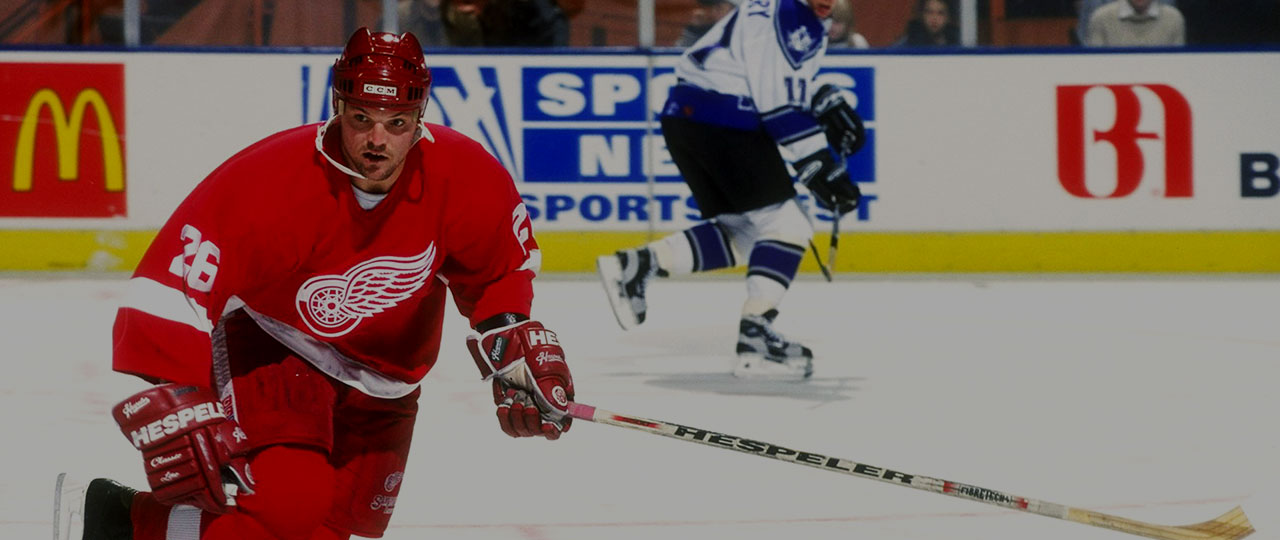

Hockey's Greatest Bodyguards: Who Protected the Stars
In every era of professional hockey, the game's most gifted players have faced the same brutal reality: the better you are, the harder they come after you. For decades, the answer to this problem was the bodyguard -- a teammate whose primary job was to ensure that nobody laid a finger on the franchise player without paying a steep price.
It was never an official position. You would not find "bodyguard" listed on any roster card. But every coach, every general manager, and every player in the dressing room understood exactly who filled the role, and exactly what it meant. The bodyguard was the reason a 165-pound centre could skate through traffic with his head up. He was the reason opposing tough guys stayed on the bench when the star had the puck. He was, in the truest sense, the unsung guardian of hockey greatness.
This is the story of those guardians -- across three distinct eras, from the freewheeling 1980s to the analytics-driven modern game -- and of the unique bond between protector and protected that shaped the sport we know today.
Era 1: The 1980s -- Semenko, McSorley, and The Great One
Dave Semenko: The Original Bodyguard
When Wayne Gretzky arrived in the NHL with the Edmonton Oilers in 1979, he was 18 years old and weighed barely 170 pounds. He was also, almost immediately, the most dangerous offensive player in the league. That combination made him the biggest target in professional hockey.
Enter Dave Semenko.
Standing 6-foot-3 and weighing 215 pounds, Semenko was a left winger from Winnipeg who had joined the Oilers in the WHA the year before. He could not skate like Gretzky. He could not pass like Gretzky. What he could do was fight better than almost anyone in professional hockey, and that single skill made him one of the most important players on a team destined to become a dynasty.
The arrangement was elegantly simple. Semenko skated on the same line as Gretzky, giving him a direct view of every shift. Anyone who slashed, cross-checked, or even looked at The Great One the wrong way would answer to Semenko. Not later. Not next game. Right now.
The mere threat was usually enough. As Semenko himself once told reporters: "Paul Baxter was threatening Gretz once, and he went by our bench and threatened Gretz, and I dropped him with a punch right from the bench, so I didn't even have to get on the ice."
That story captures the essence of the bodyguard role. Semenko did not need to fight every night. He needed to fight just often enough that every opposing player did the math in his head before going near number 99. Over 575 NHL games, Semenko recorded 70 fights -- each one a message to the rest of the league.
The results speak for themselves. With Semenko clearing the ice, Gretzky posted the most dominant offensive seasons in hockey history: 212 points in 1981-82, 196 points in 1982-83, 205 points in 1983-84. The Oilers won their first Stanley Cup in 1984 and repeated in 1985, with Semenko a key part of both championship runs.
Gretzky never forgot what Semenko meant to him. After winning the MVP car at the 1983 NHL All-Star Game, Gretzky gave it to Semenko as a gesture of gratitude. When Semenko passed away from pancreatic cancer on June 29, 2017, Gretzky paid tribute: "He was the toughest player I knew and yet the biggest teddy bear you would ever know."
Kevin Lowe, the Oilers defensive legend, called Semenko "the Wayne Gretzky of the tough guys" -- the highest compliment anyone in Edmonton could pay. As Lowe eulogized at Semenko's memorial: "The greatest of all time are up in the rafters at Rogers Place, but those greats couldn't have done it without the support and aid of Dave Semenko."
Marty McSorley: The Bodyguard Who Followed His Star
When Semenko was traded to the Hartford Whalers in 1986, the Oilers did not leave Gretzky unprotected for long. Marty McSorley, who had arrived in Edmonton the previous year, stepped seamlessly into the bodyguard role.
McSorley was a different kind of protector than Semenko. Where Semenko was pure enforcer -- a fighter first and a hockey player second -- McSorley was a legitimate two-way player who could also terrify anyone on the ice. He played both forward and defence, logged heavy minutes, and fought with a ferocity that earned him the fourth-highest penalty minute total in NHL history at 3,381 career PIM.
The bond between McSorley and Gretzky was so strong that when the blockbuster trade to the Los Angeles Kings happened on August 9, 1988, Gretzky refused to allow the deal unless McSorley came with him. The trade that changed hockey forever -- Gretzky, McSorley, and Mike Krushelnyski to LA for Jimmy Carson, Martin Gelinas, first-round picks, and $15 million in cash -- was partly shaped by a superstar's insistence on keeping his bodyguard.
In Los Angeles, McSorley continued his dual role: contributing offensively while making sure nobody touched Gretzky. The Kings, previously a league afterthought, reached the 1993 Stanley Cup Finals against Montreal. It was McSorley who became the tragic figure of that series when he was caught with an illegal stick curve in Game 2, leading to a power play goal that turned the momentum. The Canadiens won in five games.
The incident haunts McSorley to this day, but it should not overshadow the broader truth: for nearly a decade, across two cities, he was the reason The Great One could play his game. As one former opponent put it, "You didn't just have to beat Gretzky. You had to get through McSorley first, and nobody wanted that fight."
Era 2: The 1990s -- Probert, the Bruise Brothers, and the Lemieux Problem
Bob Probert and Steve Yzerman: The Detroit Bond
If Semenko and McSorley defined the bodyguard role in Edmonton, Bob Probert perfected it in Detroit.
The connection between Probert and Steve Yzerman was built from the very beginning. Both were selected in the 1983 NHL Entry Draft, along with Joey Kocur -- giving the Red Wings a franchise centre and two of the most feared enforcers in hockey history on the same day. It was a coincidence that would shape a franchise.
Probert and Kocur became known as the "Bruise Brothers," and their stated mission was unambiguous. As Kocur explained: "Our role was to help protect Steve Yzerman, Petr Klima, and the other skilled players, but at times when our team needed a boost we would try and create some excitement by winning a fight."
Between 1985 and 1991, the Bruise Brothers combined for a staggering 2,897 penalty minutes. Most of those minutes were earned in direct service of keeping Yzerman safe. The late 1980s were the peak of hockey's mutually assured destruction era, when enforcers genuinely rode shotgun for superstars instead of just vaguely threatening to from the bench. And Yzerman had the meanest bodyguard of them all.
The 1987-88 season was the pinnacle. Probert led the league with 398 penalty minutes -- the sixth-highest single-season total in NHL history -- while also contributing 62 points, third on the team. He was voted to the All-Star Game that year, and when he walked into the locker room, the biggest names in hockey wanted to meet him. As Yzerman recalled in the foreword to Probert's autobiography Tough Guy: "All the greats, like Wayne Gretzky and Mark Messier, were there, and the first thing they wanted to do was meet Probie."
The depth of the Probert-Yzerman bond became clear on July 4, 2010, when Probert died of a heart attack at the age of 45 while boating on Lake St. Clair. Posthumous examination of his brain at Boston University confirmed chronic traumatic encephalopathy -- the terrible price of a career spent fighting for his teammates. At the funeral, it was Steve Yzerman who delivered the eulogy.
The Men Who Shielded Mario Lemieux
In Pittsburgh, protecting Mario Lemieux was a different kind of challenge. Where Gretzky was slight and elusive, Lemieux was 6-foot-4 and 230 pounds -- a giant who could absorb punishment but whose back problems and eventual cancer diagnosis made the physical abuse he endured genuinely dangerous.
The Penguins cycled through bodyguards throughout Lemieux's career, never quite finding a Semenko-like permanent solution. Jay Caufield was the first true Lemieux protector, arriving in Pittsburgh in the late 1980s. At 6-foot-4 and 247 pounds, Caufield scored just 10 points in 194 games but racked up 714 penalty minutes. The disparity tells you everything about his job description. It was famously said that "Gretzky had it with McSorley and Lemieux had it with Caufield."
Warren Young fought 19 times during Lemieux's rookie season in 1984-85, looking after the talented centerman. McSorley himself briefly returned to Pittsburgh in 1993-94, battling Bob Probert in what is considered one of the greatest fights in league history. Rick Tocchet combined scoring ability with toughness during the back-to-back Cup years, recording 252 penalty minutes in 1992-93 alone.
When Lemieux came out of retirement in January 2001, the Penguins immediately acquired Krzysztof Oliwa -- the "Polish Hammer," standing 6-foot-5 and 245 pounds -- specifically to shield the 35-year-old legend. Oliwa treated his assignment with reverence, accumulating 281 penalty minutes over two seasons in Pittsburgh while making sure nobody touched Super Mario.
Rob Ray and the Buffalo Sabres
In Buffalo during the late 1990s, the enforcer dynamic took a different shape. Rob Ray was the Sabres' primary tough guy, racking up over 3,200 career penalty minutes, while Dominik Hasek was the team's franchise player. The challenge was unique: Hasek was a goaltender, which meant the threats came from crease-crashing forwards and the protection had to come from the defensive corps as well as the enforcers.
Ray, along with Matthew Barnaby and Paul Kruse, provided the physicality that allowed the Sabres to reach the 1999 Stanley Cup Finals. Hasek won his fifth Vezina Trophy that season with a league-best .939 save percentage, and the safety net provided by Buffalo's physical players was part of what allowed him to play with such freedom.
Era 3: The 2000s and 2010s -- The Bodyguard's Last Stand
Ryan Reaves and the Penguins' Experiment
By the time Sidney Crosby established himself as the best player in the world, the enforcer role was already in decline. But the need for protection had not disappeared. Crosby had suffered multiple concussions, and opposing teams continued to target Pittsburgh's stars with physical play in the playoffs.
At the 2017 NHL Draft, fresh off their second consecutive Stanley Cup, the Penguins made a statement. General manager Jim Rutherford traded a first-round pick to the St. Louis Blues for Ryan Reaves -- a 230-pound winger whose primary skill was making life miserable for anyone who crossed the line.
Reaves understood his role perfectly. "It's more just making sure everybody on the ice knows I'm coming every night," he told reporters. "You go run one of my guys, you've got 230 pounds coming right back at you. Sometimes that makes guys think twice."
The numbers backed him up. During Reaves' time in Pittsburgh, Crosby received 1.77 fewer hits per 60 minutes compared to the previous season. Malkin's hits received dropped by 1.44, and Kris Letang's by 2.12. The mere presence of a heavyweight on the roster changed how opposing teams played against Pittsburgh's stars.
But the Reaves experiment also illustrated why the bodyguard era was ending. He sometimes played fewer than four minutes per game, and the Penguins ultimately traded him to the Vegas Golden Knights at the deadline, less than a full season after acquiring him. A first-round pick for a player who barely saw the ice was a steep price, even for protection.
The Evolution: From Fighter to Physical Presence
The modern NHL has not entirely abandoned the concept of protection. It has simply evolved. Today's version of the bodyguard is not a one-dimensional fighter but a physical, versatile player who can skate, check, and occasionally drop the gloves when necessary. Players like Tom Wilson, Ryan Reaves in his later career, and Radko Gudas serve protective functions without being exclusively enforcers.
The evolution of the enforcer mirrors broader changes in the sport. Rule changes after the 2004-05 lockout opened up the game, making speed and skill more valuable than ever. The instigator penalty, introduced in 1992, added consequences for starting fights. Analytics revealed that carrying a player who played four minutes a night was a competitive disadvantage, no matter how tough he was.
Fighting itself declined dramatically. In the 1980s, there was roughly one fight every two games. By the 2020s, that number had dropped to approximately 0.18 fights per game. Without fighting, the traditional bodyguard had no weapon.
The Psychology of Protection
What It Meant to Be the Protector
The bodyguard role carried a psychological weight that few outsiders understood. For the enforcer, it was a source of profound purpose. In a sport where his skating and scoring often fell short of NHL standards, protecting a superstar gave him a reason to exist on the roster, a clear and vital mission.
Dave Semenko spoke about this openly. He knew he was not an elite hockey player in the traditional sense. But he also knew that without him, the most dominant offensive force in hockey history might not have survived long enough to rewrite the record book. That knowledge gave him a quiet pride that transcended statistics.
Probert felt the same way in Detroit. For all his personal struggles -- the substance abuse, the border incident, the suspensions -- his role as Yzerman's protector was the one constant he could point to with unqualified pride. He was needed. He mattered. In the violent ecosystem of 1980s hockey, that meant everything.
What It Meant to Be the Protected
For the stars, the bodyguard relationship was more complex. There was gratitude, certainly. Gretzky's gift of the All-Star Game car to Semenko was genuine appreciation. Yzerman delivering Probert's eulogy was an expression of real love. But there was also an uneasy awareness that another man was absorbing punishment -- and the long-term consequences of that punishment -- on your behalf.
Wayne Gretzky once acknowledged this tension directly. He understood that Semenko and McSorley were sacrificing their bodies, accumulating damage that would manifest years later, so that he could play freely. The relationship was not symmetrical. The star got the records, the endorsements, the Hall of Fame induction. The bodyguard got the broken knuckles, the suspensions, and too often, the CTE diagnosis.
It was, in its way, hockey's most honest relationship. No pretense, no ambiguity. I protect you, and you make us all winners. The simplicity of the arrangement was what made it work, and what made the bonds forged within it so enduring.
The Bond That Lasts
Perhaps the most telling detail about the bodyguard relationship is how it endured long after the final whistle. Gretzky and Semenko remained close friends for decades. Yzerman and Probert stayed connected until Probert's death. McSorley still speaks about Gretzky with a loyalty that goes beyond mere nostalgia.
These were not just professional partnerships. They were forged in the most intense possible circumstances -- in arenas filled with hostility, in moments where one man's willingness to bleed determined whether another man could do his job. That kind of bond does not dissolve when the careers end. It deepens.
The Legacy
The bodyguard era in hockey is effectively over. No NHL team in 2026 carries a player whose sole purpose is to protect the franchise star through physical intimidation. The game has moved on, and by most measures, it is better for it. Players are safer. The skill level is higher. The speed is breathtaking.
But something was lost, too. The bodyguard tradition spoke to a fundamental truth about hockey that distinguished it from every other sport: that toughness and skill were not opposites but partners. That the willingness to sacrifice for a teammate was the highest form of respect. That some of the most important players on a championship roster never made an All-Star team.
Dave Semenko won two Stanley Cups. Marty McSorley reached a Finals. Bob Probert was voted an All-Star. Ryan Reaves won a Cup with Vegas. None of them are in the Hockey Hall of Fame, and none of them ever will be. But every player they protected knows the truth: without the bodyguard, the stars might never have shone at all.
Frequently Asked Questions
Who were Wayne Gretzky's bodyguards in the NHL?
Wayne Gretzky had two primary bodyguards during his career. Dave Semenko protected him with the Edmonton Oilers from 1979 to 1986, and Marty McSorley took over the role in Edmonton before following Gretzky to the Los Angeles Kings in the famous 1988 trade. Gretzky reportedly insisted that McSorley be included in the deal, demonstrating how essential the bodyguard relationship was to his game.
How did NHL enforcers protect star players?
NHL enforcers protected stars primarily through deterrence. Their reputation as fighters meant opponents thought twice before taking cheap shots at skilled teammates. When deterrence failed, the enforcer would challenge the offending player to a fight, sending a message throughout the league. As Semenko demonstrated when he punched Paul Baxter right from the bench for threatening Gretzky, sometimes the enforcer did not even need to be on the ice to do his job.
Who protected Sidney Crosby as an enforcer?
The Pittsburgh Penguins acquired Ryan Reaves specifically to protect Sidney Crosby and Evgeni Malkin in 2017, trading a first-round draft pick for the 230-pound enforcer. During his time in Pittsburgh, all four of the Penguins' star players received fewer hits per game. Earlier in Crosby's career, players like Eric Godard and Matt Cooke filled aspects of the protective role.
What was Bob Probert's role in protecting Steve Yzerman?
Bob Probert served as Steve Yzerman's primary protector on the Detroit Red Wings throughout the late 1980s and early 1990s. Alongside Joey Kocur in the "Bruise Brothers" pairing, Probert combined for 2,897 penalty minutes between 1985 and 1991. Their stated mission was protecting Yzerman and the other skilled forwards, and Probert's 398 penalty minutes in 1987-88 remain the sixth-highest single-season total in NHL history.
Why did the bodyguard role disappear from hockey?
The bodyguard role disappeared due to several converging factors: rule changes after the 2004-05 lockout that penalized fighting more severely, the instigator rule introduced in 1992, the rise of analytics-driven roster construction that exposed the cost of carrying a player with minimal ice time, and a league-wide cultural shift toward player safety. Fighting dropped from roughly one fight every two games in the 1980s to about 0.18 fights per game by the 2020s, removing the enforcer's primary tool.
Related Stories
- Dave Semenko: The Man Who Protected Wayne Gretzky
- Marty McSorley: Gretzky's Bodyguard
- Bob Probert: Hockey's Toughest Man
- The Bruise Brothers: Kocur and Probert
- Coached by Wayne
- How Enforcers Have Evolved in Hockey
Love Hockey? Try Hockey Betting
Think you know the game better than the oddsmakers? Put your hockey knowledge to work with Canada's best sportsbooks.