The Cardboard We Clipped to Our Spokes
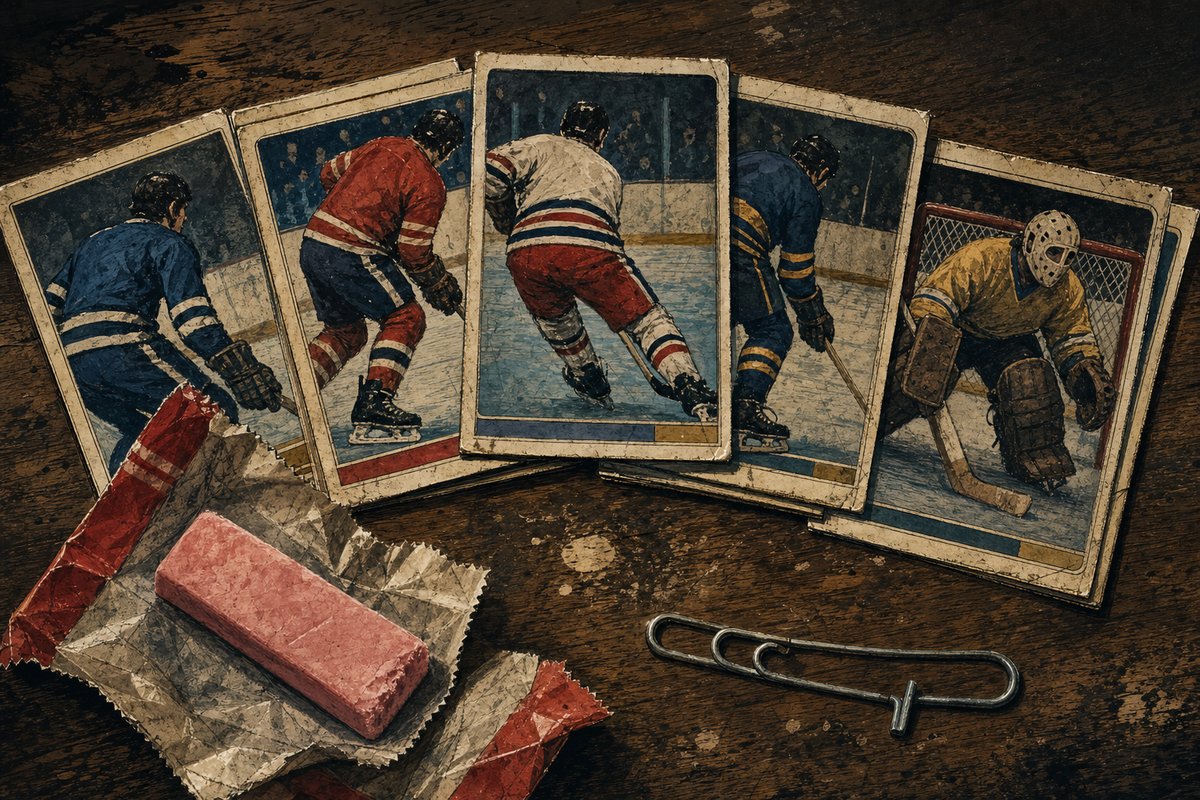
There is a particular smell that the kids of a certain era will never forget: the dusty-sweet exhale of a freshly torn wax pack, the chalky pink slab of gum already cracked down the middle, and underneath it the faint cardboard tang of seven or eight hockey cards still warm from the corner-store rack. You did not buy hockey cards for an investment. You bought them for a quarter, maybe fifty cents, and you tore them open right there on the sidewalk to see whether you had finally pulled the one you wanted.
Most of the time you did not. Most of the time you got a goaltender from a team you had never watched and three commons you already had twice. But the hope was the whole point. This is the story of that hope - of the cardboard we treasured, traded, ruined and threw away, and of how a handful of those throwaway pictures became some of the most valuable objects in all of sport.
Every kid had a system. You shook the rack at the variety store, you weighed the packs in your palm as if you could feel a rookie through the wax paper, and you picked the one that felt right. The whole transaction was theatre. The gum was almost beside the point - a hard, brittle, faintly powdery rectangle that snapped rather than chewed and lost its flavour in roughly ninety seconds - but it was part of the contract. Cards and gum, gum and cards. You could not have one without the other.
The tearing was the moment. You did not open a pack neatly; you ripped it. The wax paper made that specific crinkling tear, the gum tumbled out, and then came the flip-through: front of one card, front of the next, faster and faster, the disappointment or the jackpot arriving in a half-second. A double of a player you had four of already landed in the "trade pile." A new one for your set went carefully into the shoebox. And on the rare, electric afternoon when a star slid into view, you held it by the edges as if it might burn you.
It was a deeply social ritual, too. Cards moved through the schoolyard like currency. You traded them, you flipped them in games of skill against the wall of the gym, and you argued endlessly about who was worth what. None of it had anything to do with money. A card was worth exactly what the kid across from you would give up for it, and that value changed week to week depending on whose team was winning. The same instinct that pulls people toward the rituals and sounds that bind the game together ran straight through the trading circle on the schoolyard blacktop.
If you grew up in Canada, your cards almost certainly said O-Pee-Chee on the back. If you grew up in the United States, they said Topps. For decades the two were tangled together in a way most kids never thought about while they were busy chewing the gum.
O-Pee-Chee started as a gum and candy company in London, Ontario, founded in 1911 by two brothers, John and Duncan McDermid. The odd name comes from The Song of Hiawatha - an Ojibwe word for "the robin" - and also happened to be the name of the family's summer cottage. For its first decades the company was about confectionery, building a sprawling plant on Adelaide Street that exported gum as far as the United Kingdom. Cards came later.
In 1958, O-Pee-Chee entered a marketing agreement with the Topps Company in the United States, and that partnership is the reason Canadian and American cards looked like cousins. Topps held the design and the photography; O-Pee-Chee produced and distributed cards for the Canadian market, printing them in London starting in the early 1960s. The two sets often shared the same player photos and the same year's design, but the differences mattered to a sharp-eyed collector: O-Pee-Chee sets were frequently larger, the card backs carried bilingual text, and the cardboard and cutting were notably rougher.
That roughness is now part of the legend. O-Pee-Chee cards were cut from large sheets with a wire process rather than a clean blade, which left softer edges and corners that frayed easily. For a kid that meant nothing. For today's market it means high-grade O-Pee-Chee cards are genuinely scarcer than their Topps twins, because the Canadian cards arrived in your hands already a little soft around the edges. The company kept making cards until the partnership wound down and O-Pee-Chee was eventually purchased by Nestlé in 1996 - the candy business outlasting the cardboard, fittingly enough.
Every hobby has its holy relics, and hockey's are a small and famous trinity. These are the cards every kid dreamed of pulling and almost none of us ever did.
The card. If there is one piece of hockey cardboard the whole world knows, it is the blue-bordered 1979-80 O-Pee-Chee Wayne Gretzky rookie, number 18 in the set. It captured the Great One at the very start, the season he announced that the record book was about to be rewritten - and the cardboard arrived right alongside the player, as if the printers somehow knew. Because it is an O-Pee-Chee card with those soft, wire-cut edges, finding one in pristine shape is extraordinarily difficult; only a tiny number have ever earned a perfect grade. A top-condition copy sold at Heritage Auctions for $1.29 million, the highest price ever paid for a hockey card. For the rest of us, the value was always the same: it was the one we wanted and never got. The full scope of what made him worth chasing lives in the records that may never be broken.
Older collectors point further back, to the 1966-67 Topps Bobby Orr rookie, number 35, the young Bruin framed inside a brown "TV set" border borrowed from that year's football design. Orr changed what a defenceman could be, and his rookie card became the cornerstone of vintage hockey collecting. Even a well-worn, low-grade copy commands thousands of dollars - a measure of how few survived the way kids treated them.
The third pillar belongs to Mario Lemieux, whose 1985-86 O-Pee-Chee rookie, number 9, is the highlight of its set. Like the Gretzky, it is an O-Pee-Chee card, which means high grades are punishingly rare; only around one per cent of the copies submitted have ever reached the top of the scale. It is the card that bridges the eras - the last of the true vintage grails before the hobby exploded and then nearly drowned in its own overproduction.
Here is the great irony of the whole hobby. The very things that made cards magical to a child are the things that destroyed their value to a collector. We did not protect these cards. We loved them to death.
The most famous sin of all was the bicycle spoke. You took a common - a player you did not care about, a third-line winger you had six of - and you clothes-pinned it to the fork of your bike so it slapped against the spinning spokes. The faster you pedalled, the louder the engine-rattle, and for a summer that sound was the sound of being a kid with a bike and somewhere to be. Nobody clipped a Gretzky to their spokes. But plenty of cards that would be worth real money today went into the spokes and came out shredded, never to be thought of again.
Even the cards we kept were rarely "mint." We rubber-banded our sets into thick bricks, which left permanent dents across the top and bottom rows. We flipped them against gym walls. We carried our favourites in our back pockets until the corners went round and soft. And the cards were not exactly pristine to begin with - the cheap stock and rough cutting of the era meant a card could come out of the pack already off-centre, with a soft corner or a fuzzy edge. The same scrappy, take-it-as-it-comes spirit that defined a frozen afternoon of pond hockey applied to the cards in our pockets: nothing was precious, everything was for playing.
That is exactly why genuinely high-grade vintage cards are so valuable now. They were made as toys, treated as toys, and only a tiny fraction escaped childhood intact. Scarcity in the hobby is not really about how many were printed - it is about how few survived the way we played with them.
And then there is the other reason the survivors are so few. Ask almost anyone of a certain age about their old hockey cards and you will hear some version of the same heartbreak: "My mom threw them out."
It is half legend and half true, and it became a defining piece of hobby folklore for a reason. The cards sat in a shoebox in a closet or under a bed for years after the kid moved on to other things. Then came a move, or a basement clean-out, or a kid leaving for school, and a parent - entirely reasonably - decided that the dusty box of bent cardboard was junk. Out it went with the rest of the clutter.
The cruelty of it is that nobody was wrong. The cards were junk by any sensible measure of the time. They were cheap children's ephemera, produced by the millions, the kind of thing every household had a box of and nobody thought twice about. The idea that a torn pack of hockey cards might one day be worth more than the family car would have sounded insane. By the time anyone realized the cards had become collectible, the boxes were long gone to landfill - and the survivors that remained became, by simple subtraction, that much rarer and more precious.
It is worth being honest about the scale, though. The cards most likely to have been thrown out were the ones from the truly overproduced years - the late 1980s and early 1990s - when manufacturers, having watched prices climb, printed cards in such staggering quantities that the supply still dwarfs demand today. A 1990 box of commons is not a retirement fund no matter how carefully your mother kept it. The mom-purge stings most for the genuinely scarce vintage stuff from the 1960s and 1970s, where every lost box really did matter.
For most of its life, card collecting ran on trust and a price guide. You and the other kid agreed on what a card was worth, or you consulted a magazine, and condition was a matter of squinting and arguing. That changed in 1991, and the hobby has never been the same since.
That year, a company called PSA - Professional Sports Authenticator - introduced third-party grading. The idea was simple and revolutionary: send your card to a neutral expert, who assesses its condition on a standardized scale from 1 to 10, seals it in a tamper-evident plastic holder with the grade printed on the label, and returns it. Suddenly "mint" was not an opinion shouted across a trading table; it was a number a stranger would trust. Beckett, the long-running price-guide publisher that collectors had leaned on since the 1980s, launched its own grading service in 1999, and the graded-card era was fully underway.
Grading transformed the cardboard we used to clip to our spokes into a liquid, almost financial market. A raw card might be worth a modest sum; the same card in a PSA holder with a high grade could be worth many multiples more, because the buyer no longer had to take anyone's word about the corners. The internet poured fuel on the fire - online auctions in the dot-com years let collectors anywhere find each other, and a graded card in a sealed slab was the perfect product for a marketplace where you could not hold the item in your hand.
The result is a hobby that looks very different from the schoolyard. The slab replaced the shoebox. Population reports - the public count of how many copies of a card exist at each grade - replaced the price-guide squint. And the cards themselves moved from kids' pockets into climate-controlled safes and auction-house display cases. Something was gained: the great vintage cards are now protected, catalogued and celebrated. And something was lost, too, the same way it was lost when the corner store stopped stocking nickel packs. There is no gum in a graded slab.
Yet the old feeling never fully went away. The hobby has boomed again in recent years, pulling in a new generation alongside the grown kids returning to the cards of their youth - many of them chasing the exact card their mother threw out. It is the same impulse that sends a former player back to the rink or pulls a fan toward the warm, slightly battered traditions of the game, the same instinct catalogued in our pieces about the small rituals we never let go of and the legends like Gordie Howe whose faces stared up out of those wax packs in the first place. The cardboard was never really about the cardboard. It was about being a kid, hoping, and holding the game in your hands.
The 1979-80 O-Pee-Chee Wayne Gretzky rookie card, number 18 in the set, is the most coveted vintage hockey card. A high-grade copy sold at Heritage Auctions for $1.29 million, a record for a hockey card. The 1966-67 Topps Bobby Orr rookie (#35) and the 1985-86 O-Pee-Chee Mario Lemieux rookie (#9) are the other two pillars of the vintage market.
Topps printed cards for the United States; O-Pee-Chee, a gum company in London, Ontario, printed cards for the Canadian market under a marketing agreement with Topps that began in 1958. The two sets often shared photography and design but differed in card backs, language, checklist size and stock. O-Pee-Chee cards were cut from sheets with a wire process, leaving softer edges, which makes high-grade O-Pee-Chee copies harder to find than their Topps equivalents.
Cards from the 1960s through the 1980s were made as cheap children's toys, not investments. They were shoved into pockets, flipped against walls, rubber-banded into stacks, and famously clipped to bicycle spokes. The cardboard stock and cutting methods of the era also produced soft corners and off-centre cuts straight out of the pack, so genuinely pristine survivors are scarce.
Third-party grading arrived in 1991, when PSA (Professional Sports Authenticator) introduced a standardized 1-to-10 scale and a sealed holder. Beckett, the long-running price-guide publisher, launched its own grading service in 1999. Grading turned a subjective hobby into a graded, liquid market and reshaped how vintage hockey cards are bought and sold.
Usually not much. After watching prices climb, manufacturers in that period printed cards in enormous quantities, so the supply of those years still far outstrips demand. Boxes of commons from that "junk wax" era are common no matter how carefully they were stored. The genuinely valuable vintage cards come mainly from the scarcer 1960s and 1970s, where far fewer copies survived.