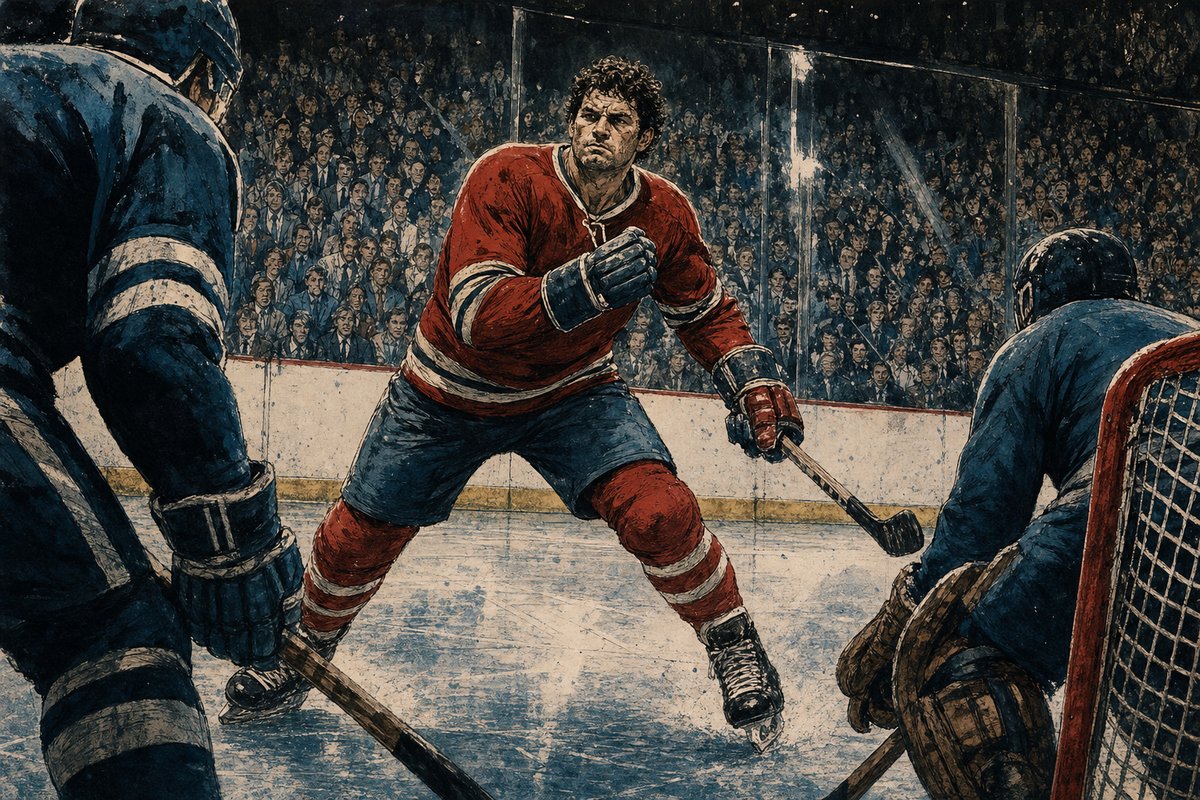
Captain Crunch, the Saskatchewan Farm Boy Who Became Toronto's Folk Hero
Updated May 2026 — A look back at the first-overall pick who hit like a freight train, scored like a sniper, and bled blue for three separate stints in Toronto.
There are players a city respects, and there are players a city loves. Wendel Clark belonged firmly in the second category. For the long-suffering faithful of the Toronto Maple Leafs, the Saskatchewan farm boy with the thunderous bodychecks and the heaviest one-timer in the building was not merely a good hockey player. He was a feeling. He was proof that someone in the dressing room cared as much as the people in the cheap seats did.
This is the story of how a quiet kid from a town of barely a thousand people became one of the most beloved figures in Maple Leafs history—and stayed that way long after his skates were hung up for good.
Wendel Clark was born on October 25, 1966, in Kelvington, Saskatchewan, a small farming community in the northeast corner of the province. It is the kind of prairie town where hockey is less a pastime than a way of measuring the winter, and the Clark family was steeped in it. Wendel grew up the way generations of Saskatchewan players had before him: on cold outdoor ice, in long drives to rinks, in a culture that valued hard work and finishing your checks above all else.
That prairie upbringing left a permanent mark on the way he played. There was nothing flashy about Clark's game in the modern sense. What he had instead was an unshakeable intensity and a willingness to put his body in harm's way that scouts could see from across the rink. The grit was not an act. It was who he was.
By his teens, Clark had become a star defenceman with the Saskatoon Blades of the Western Hockey League. He was a punishing presence on the blue line, a player who could quarterback an attack and just as happily flatten a forechecker. In his draft year with the Blades he posted eye-catching numbers for a rearguard—32 goals and 87 points in 64 games, alongside 253 penalty minutes—the kind of line that gets a teenager talked about as the best player available in his class.
In June 1985, the Toronto Maple Leafs held the first overall selection in the NHL Entry Draft, and they used it on Wendel Clark. For a franchise mired in some of the bleakest years in its history, the pick carried enormous weight. The Leafs of the mid-1980s were a team starved of identity and short on hope. They needed a cornerstone. They believed they had found one in the prairie defenceman with the mean streak.
The first significant decision of his pro career was a positional one. Toronto looked at Clark's combination of skating, shot, and ferocity and decided his future was not on the blue line but up front. He was converted from defenceman to left wing, a switch that would define the rest of his career and, in time, give the league one of its most distinctive power forwards.
It did not take long for the move to look inspired. As a rookie in 1985-86, Clark led the Maple Leafs in goals with 34 and in penalty minutes with 227—a combination that announced exactly what kind of player Toronto had drafted. He finished as the runner-up for the Calder Trophy as the league's top rookie. From his very first season, the message was unmistakable: this was a young man who would score on you and run you through the boards in the same shift, and feel no contradiction in doing both.
To understand why Wendel Clark mattered so much, you have to understand the rare thing he was. In an era of clearly defined hockey roles—snipers who scored, grinders who checked, and enforcers who fought—Clark refused to be filed under any single heading. He was a genuine power forward in the truest sense: a player who could fill the net, finish a check hard enough to change the temperature of a building, and drop the gloves with the toughest men in the league when the moment demanded it.
His shot was a thing of legend in Toronto. The wrist shot in particular was a heavy, snapping release that goaltenders hated to see coming off his stick in full stride. But it was the physical dimension that earned him his enduring nickname. Clark became "Captain Crunch," a name that captured both his bone-rattling bodychecks and, fans liked to point out, the bushy mustache he wore that recalled the breakfast-cereal character. The handle fit perfectly, and it stuck.
What set Clark apart from the pure enforcers of his time was that opponents could never simply send a tough guy to neutralize him. He was too skilled to be hounded by a checker and too willing to fight to be intimidated by a heavyweight. The connection runs naturally to the broader story of the lost art of hitting—the way a clean, devastating bodycheck could once turn a game on its own, before the open-ice hit became an endangered species. Clark was a master of exactly that craft, and he practiced it without hesitation. He also never backed down from a scrap, a quality that made him a fixture in conversations about the toughest, most fearless competitors of the period, the same lineage explored in our look at the greatest hockey fights in NHL history.
That fearlessness came at a cost, which is part of why he is remembered the way he is. Clark gave his body away night after night, and the bill came due early.
In 1991, the Maple Leafs named Wendel Clark their captain, formalizing a role he had effectively filled by example for years. The "C" on his sweater turned out to be one of the most fitting decisions the franchise made in that era. Clark was not a captain in the boardroom sense; he was a captain in the trench sense, the kind whose leadership was measured in blocked shots, retaliatory hits on behalf of teammates, and a refusal to be the first man to quit on a shift.
His captaincy reached its emotional summit in the spring of 1993. Under head coach Pat Burns, with Doug Gilmour orchestrating one of the great individual seasons in Leafs history, Toronto went on a playoff run that brought a hockey-mad city roaring back to life. The Maple Leafs advanced all the way to the Campbell Conference Final against Wayne Gretzky and the Los Angeles Kings, one round from the Stanley Cup Final. The country, and especially the long-tortured Toronto fan base, allowed itself to dream of an all-Canadian final against Montreal—a dream tied directly to the bitter history chronicled in our piece on the Leafs–Canadiens rivalry.
It came down to Game 6 in Los Angeles, with Toronto leading the series three games to two and one win from the final. The Leafs fell behind, and what followed became one of the defining performances of Clark's career. He scored a hat trick, dragging his team back into the game by sheer will, and buried the tying goal in the final two minutes of regulation to force overtime. For a few electric minutes, it felt as though the captain might single-handedly will Toronto to the Cup final.
The ending is etched into Leafs lore for the wrong reasons. In overtime, a high stick from Gretzky cut Gilmour's chin open; no penalty was called, and Gretzky scored the overtime winner to send the series back to Toronto for a seventh game. Gretzky then turned in a brilliant Game 7 to eliminate the Leafs and carry Los Angeles to its first Stanley Cup Final. Toronto's run ended one win short. But Clark's Game 6 hat trick endured as a symbol of everything he represented: a captain who refused to let his team go down without leaving everything he had on the ice.
The flip side of Wendel Clark's all-out style was the toll it took on his body. The trouble began early. By his third NHL season he was being plagued by back problems that would shadow him for the rest of his career and cost him long stretches of action. The injuries were the direct consequence of the way he played—the hits he delivered and absorbed, the fights, the refusal to protect himself.
The numbers are sobering. Between 1987 and 1992, Clark's physical, fight-heavy style contributed to him missing close to 200 games, the equivalent of nearly three full NHL seasons. For a player of his talent, it was a maddening pattern: flashes of dominance interrupted again and again by the trainer's table. There were stretches when Toronto fans wondered whether they would ever see a fully healthy Clark over a complete campaign.
And yet the injuries, paradoxically, deepened the bond between Clark and the city. Fans understood that he was hurting because of how hard he played for them. Every time he came back, strapped together and lining up for another shift, it reinforced the sense that here was a man giving his body to the cause. In Toronto, durability is admired, but courage is worshipped, and Clark had courage to spare. The same era produced other beloved heart-and-soul Leafs whose value could never be captured by a stat sheet, a tradition that runs through our profile of Tie Domi and the role players who made the building shake.
For all the love between Clark and Toronto, the business of hockey eventually intervened. On June 28, 1994, the Maple Leafs made one of the most seismic trades in franchise history. They sent their captain—along with Sylvain Lefebvre, Landon Wilson, and a first-round draft pick—to the Quebec Nordiques. In return, Toronto received a package built around a young Swedish centre named Mats Sundin, who would go on to become the franchise's all-time leading scorer.
The deal stunned the city. Trading away the heart of the team, the player fans had adopted as one of their own, was the kind of move that tested the faith of even the most devoted supporter. With the benefit of decades of hindsight, the swap is often judged a sound piece of business for Toronto, given everything Sundin became. But in the moment, it felt to many like a betrayal of something larger than a roster decision.
Clark's time away was eventful and short on stability. He played the lockout-shortened 1994-95 season in Quebec. When the Nordiques relocated to become the Colorado Avalanche, a contract dispute helped push him out the door, and he was moved in a three-team trade that sent him to the New York Islanders. The captain who had seemed permanently fused to the city of Toronto was suddenly a hockey vagabond, suiting up in unfamiliar colours far from the building where he had become a folk hero.
The story did not end in exile, which is a large part of why it resonates. Wendel Clark would return to the Maple Leafs not once but twice, and each homecoming reaffirmed the place he held in the city's heart. The first return brought him back to Toronto in the mid-1990s, reuniting Clark with the fan base that had never stopped considering him theirs. The roar that greeted him said everything about how the relationship had survived the trade.
His career also took him through stints with the Tampa Bay Lightning, the Detroit Red Wings, and the Chicago Blackhawks—a journeyman's late-career tour for a player whose body had absorbed so much over the years. But the final chapter, fittingly, was written back where it began. After being released by Chicago, Clark signed with Toronto as a free agent in January 2000, returning for one last stint in the only sweater that ever truly suited him. He played out the remainder of that season and then announced his retirement in the summer of 2000, at the age of 33.
He retired as a Leaf, which mattered enormously to him and to the people who watched him. Over a 15-year NHL career he played 793 regular-season games, scoring 330 goals and 564 points, with 1,690 penalty minutes—and adding 69 points in 95 playoff games. The great bulk of that work, 608 of those games, came in Toronto. The numbers tell part of the story. The fact that he kept finding his way home tells the rest.
What is it that makes a city hold one player above so many others? In Wendel Clark's case, it was the sense that he was, fundamentally, one of them. He was not a polished superstar floating above the fray; he was the embodiment of how a hard, honest fan wanted a hockey player to behave. He hit, he scored, he fought, he bled, and he came back. He carried the captaincy through the franchise's most stirring run in a generation. He left, against his will, and then he came home—twice.
The franchise made the relationship official on November 22, 2008, when the Maple Leafs honoured Clark by raising his legendary number 17 to the rafters. It was a fitting tribute to a player whose connection to the city had only deepened in retirement. To this day, Clark remains one of the most popular ambassadors the organization has, a familiar face at events and a living link to the gritty, emotional teams of the late 1980s and early 1990s.
His standing also belongs to a broader prairie tradition. Saskatchewan has produced an outsized share of the toughest, most respected players in hockey history, and Clark sits comfortably in that lineage—a son of small-town Saskatchewan who carried its values to the biggest stage in the sport. His story is woven into the larger fabric of Maple Leafs history, where the names that endure are not always the ones with the most points, but the ones who made the people in the stands feel something.
That is, in the end, the simplest way to explain Wendel Clark. He made an entire city feel something. And more than two decades after his final shift, the building still erupts when his name is announced. Not because of what he won—he never lifted the Cup—but because of how completely he gave himself to the cause. Captain Crunch. The heart of the Leafs. A folk hero who never really left.
| Full Name | Wendel Clark |
| Born | October 25, 1966 - Kelvington, Saskatchewan, Canada |
| Position | Left Wing (drafted as a defenceman) |
| NHL Draft | 1985, 1st overall (Toronto Maple Leafs) |
| Junior Team | Saskatoon Blades (WHL) |
| Maple Leafs Captain | 1991–1994 |
| NHL Teams | Toronto Maple Leafs, Quebec Nordiques, New York Islanders, Tampa Bay Lightning, Detroit Red Wings, Chicago Blackhawks |
| Career Stats | 793 GP, 330 G, 234 A, 564 PTS, 1,690 PIM |
| Playoff Stats | 95 GP, 69 PTS |
| Number Honoured | No. 17 raised to the rafters, November 22, 2008 |
| Retired | 2000 (age 33) |
Wendel Clark earned the nickname "Captain Crunch" for his bone-jarring bodychecks and his fearless, physical style of play. The handle also nodded to his mustache, which resembled that of the breakfast-cereal character of the same name. It became closely associated with him after he was named captain of the Toronto Maple Leafs in 1991.
Wendel Clark was selected first overall by the Toronto Maple Leafs in the 1985 NHL Entry Draft. He had starred as a defenceman for the Saskatoon Blades of the Western Hockey League and was converted to left wing after turning professional.
In Game 6 of the 1993 Campbell Conference Final against the Los Angeles Kings, Clark scored a hat trick, including the tying goal in the final two minutes of regulation to force overtime. The Kings won in overtime and then took Game 7, ending Toronto's run one win short of the Stanley Cup Final.
Yes. On June 28, 1994, Toronto traded Clark, Sylvain Lefebvre, Landon Wilson and a first-round pick to the Quebec Nordiques in a deal that brought Mats Sundin to the Leafs. Clark later played for the Islanders, Lightning, Red Wings and Blackhawks before returning to Toronto for two more stints.
Yes. After being released by Chicago, Clark signed with Toronto as a free agent in January 2000 and played out his final season there before announcing his retirement that summer at age 33. He played 608 of his 793 career games as a Maple Leaf.
Clark scored 330 goals and recorded 564 points in 793 regular-season NHL games over a 15-year career, adding 69 points in 95 playoff games. He also accumulated 1,690 penalty minutes, reflecting his hard-nosed, physical style.
Wendel Clark's legend has only grown in the years since his number was raised to the rafters. He remains a cherished figure across the city of Toronto, a reminder that in hockey, the players a city remembers most fondly are often the ones who gave the most of themselves. Captain Crunch never won a Stanley Cup—but in the hearts of Leafs Nation, he won something that lasts longer.
Think you know the game better than the oddsmakers? Put your hockey knowledge to work with Canada's best sportsbooks.