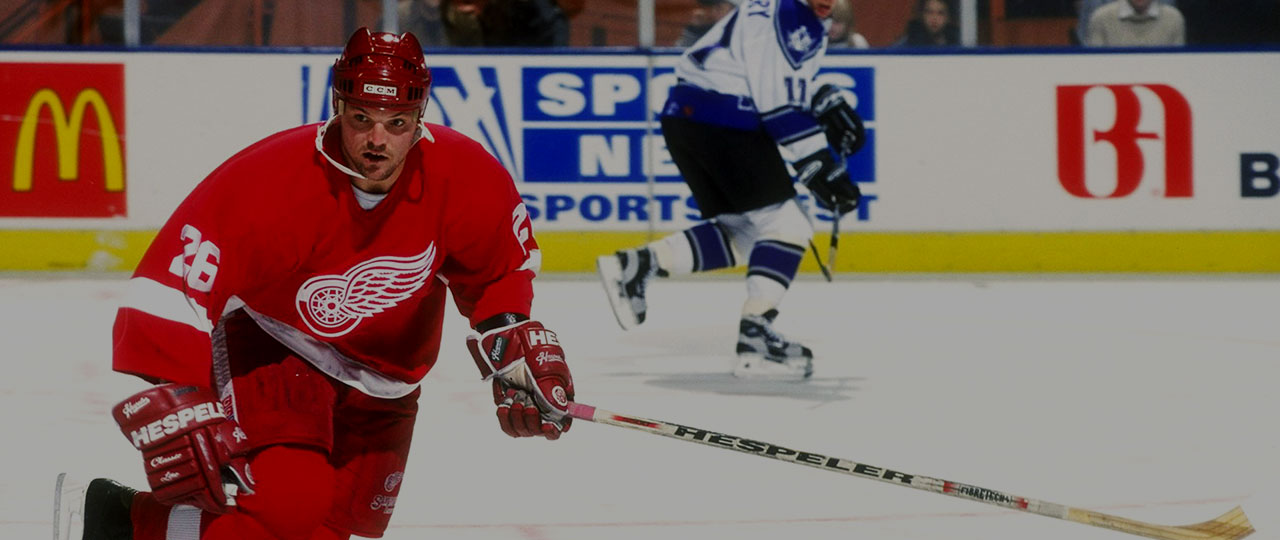

Derek Boogaard
The Boogeyman
He stood 6'7" and weighed 265 pounds. When Derek Boogaard skated toward you, it wasn't a question of whether the fight would hurt. It was a question of how badly. For six seasons in the NHL, the man they called "The Boogeyman" was the most feared enforcer in professional hockey. And then, on May 13, 2011, he was found dead in his Minneapolis apartment. He was 28 years old.
The story of Derek Boogaard is not simply a hockey story. It is a story about what we ask of young men, what they sacrifice in return, and what happens when nobody is watching after the final whistle blows.
An RCMP Family on the Prairies
Derek Leendert Boogaard was born on June 23, 1982, in Regina, Saskatchewan. His father, Len Boogaard, was a Royal Canadian Mounted Police officer, and the family moved frequently across the prairies as Len was transferred from one remote posting to another. Derek and his siblings grew up in small towns across Saskatchewan and Alberta—places like Herbert, Melfort, and eventually Saskatoon.
The Boogaard children played hockey the way all Canadian prairie kids did: outdoors, on frozen ponds and backyard rinks, in temperatures that would make most people stay indoors. Derek was always the biggest kid on the ice. By the time he was a teenager, he towered over his peers. But size alone doesn't make a hockey player.
"Derek wasn't a natural skater," his father Len once recalled. "He was big, and he was strong, and he had a good heart. But the skating was always something he had to work at. He worked harder than anyone."
That work ethic would define Boogaard's career. It would also, eventually, destroy him.
The Long Road to the NHL
Boogaard's junior hockey career was a grind. He played for the Regina Pats of the WHL, but he wasn't putting up points. He was fighting. At 6'7", he was simply too large for most opponents to handle, and coaches quickly realized that his value lay not in his wrist shot but in his fists.
He was drafted by the Minnesota Wild in the seventh round of the 2001 NHL Draft—202nd overall. It was the kind of pick that most fans barely notice, buried deep in the draft's final rounds. But for Boogaard, it was everything. It was a chance.
He spent four years in the minor leagues, fighting his way through the AHL and ECHL. In places like Louisiana, Houston, and Rochester, Boogaard honed his craft. He fought constantly. He won almost every time. And he paid a physical price that no one fully understood at the time.
"The minor leagues were brutal," a former teammate recalled. "Derek fought guys who had nothing to lose. Every night, someone wanted to test the big guy. And Derek never said no. He couldn't say no. That was his job."
The Boogeyman Arrives in Minnesota
Boogaard finally made the Wild's roster for the 2005-06 season, the year the NHL returned from its lockout. His debut was electric. Minnesota fans immediately embraced the giant from Saskatchewan, and a tradition was born: every time Boogaard fought, the crowd at the Xcel Energy Center would chant "Boo-oo-oo-oo-gaard!" It sounded like booing to opposing fans. It was, in fact, a roar of adoration.
His first NHL fight came against Kip Brennan of the Los Angeles Kings. Boogaard dispatched him quickly. It was a sign of things to come.
The Heavyweight Champion
In an era that still celebrated hockey fighting, Boogaard was the undisputed heavyweight champion. He accumulated over 60 NHL fights in just 277 career games. His reach, his power, and his sheer physical presence made him nearly unbeatable in one-on-one combat.
"You could see guys' eyes change when Derek stood up on the bench," said a former Wild teammate. "They knew what was coming. Half the time, the fight was won before it started because the other guy was already afraid."
Boogaard fought the best of his generation. He squared off against Todd Fedoruk, breaking his cheekbone with a single punch. He battled D.J. King, Raitis Ivanans, and Colton Orr. He took on every willing challenger and left most of them on the ice.
More Than Muscle
What teammates and coaches knew—and what the public often missed—was that Boogaard was far more than a fighter. He was, by all accounts, one of the kindest and most gentle people in the Minnesota Wild organization. He visited children's hospitals. He befriended the team's equipment managers and training staff. He was quiet, self-deprecating, and genuinely beloved in the locker room.
"Derek was a teddy bear," said a Wild staff member. "Off the ice, he wouldn't hurt a fly. He was sweet, he was funny, and he cared about people. The disconnect between who he was as a person and what he had to do for a living—I think that's what makes his story so painful."
The Price of Violence
Every fight took something from Derek Boogaard. His hands were a mess of scar tissue and broken bones. His face bore the marks of a hundred battles. But the real damage was invisible.
Boogaard suffered multiple concussions throughout his career, though the exact number will never be known. In an era when concussion protocols were minimal and "getting your bell rung" was treated as routine, Boogaard did what enforcers have always done: he shook it off and went back to work.
The headaches started early. So did the depression. And then came the painkillers.
The Spiral
Prescription opioids entered Boogaard's life the way they enter the lives of so many professional athletes: through the training room. Injuries required surgery. Surgery required pain management. Pain management meant pills. And the pills worked—not just for the physical pain, but for the anxiety, the depression, and the constant dread of having to fight again.
"The pills made everything go away," Boogaard reportedly told a friend. "The pain, the fear, all of it. When I took them, I could just be normal for a while."
By the time he was in his mid-twenties, Boogaard was dependent on oxycodone. He obtained prescriptions from multiple doctors, a practice that would later raise serious questions about the NHL's handling of controlled substances. He entered the league's substance abuse program. He tried to get clean. But the addiction had taken hold.
The Rangers: A Final Chapter
In the summer of 2010, Boogaard signed a four-year, $6.5 million contract with the New York Rangers. It was supposed to be a fresh start—a new city, a new team, a chance to reinvent himself on Broadway.
It was a disaster.
Boogaard suffered a concussion early in the season after a fight with Matt Carkner of the Ottawa Senators on November 9, 2010. The concussion was severe. He never fully recovered. He appeared in only 22 games that season, spending most of his time on injured reserve, battling headaches, depression, and the relentless pull of addiction.
The Rangers sent him to a rehabilitation facility. He went. He came back. He relapsed. The cycle repeated. Meanwhile, the hockey world moved on without him. Games were played, seasons progressed, and Derek Boogaard sat alone in his apartment, in pain, forgotten by the machine that had used him up.
May 13, 2011
Derek Boogaard was found dead in his Minneapolis apartment on the evening of May 13, 2011. The cause of death was determined to be an accidental overdose—a combination of oxycodone and alcohol. He was 28 years old. The NHL playoffs were underway. The Rangers had been eliminated in the first round.
His family was devastated. His teammates were shattered. And the hockey world was forced, however briefly, to confront an uncomfortable truth: the enforcer system was killing people.
"We asked Derek to do a job that no human being should have to do," his brother Aaron Boogaard said. "And when it broke him, we looked the other way."
The CTE Diagnosis
After Boogaard's death, his family donated his brain to researchers at Boston University's Center for the Study of Traumatic Encephalopathy. The findings were devastating but unsurprising: Boogaard's brain showed clear evidence of chronic traumatic encephalopathy (CTE)—the degenerative brain disease caused by repeated head trauma.
He was one of the first NHL players to be publicly diagnosed with CTE, joining a growing list of athletes across multiple sports whose brains had been destroyed by the very games they played. The diagnosis confirmed what many had suspected: the depression, the anxiety, the addiction—these weren't character flaws. They were symptoms of a brain that had been battered beyond repair.
"Boy on Ice"
In 2014, New York Times reporter John Branch published Boy on Ice: The Life and Death of Derek Boogaard, a meticulously researched account of Boogaard's life and death. The book won the PEN/ESPN Award for Literary Sports Writing and became one of the most important works ever written about hockey violence.
Branch documented everything: the minor league grind, the prescription pill pipeline, the NHL's inadequate oversight of players' drug use, and the fundamental moral question at the heart of the enforcer debate. Boy on Ice didn't just tell Boogaard's story. It indicted a system.
"The book made people uncomfortable," Branch later said. "It was supposed to. Derek's story should make all of us uncomfortable."
A Mother's Crusade
In the years following her son's death, Joanne Boogaard became one of hockey's most powerful advocates for player safety. She filed a wrongful death lawsuit against the NHL, alleging that the league had failed to protect her son from the known dangers of fighting and had enabled his addiction through negligent medical practices.
The lawsuit was eventually settled, but Joanne Boogaard's advocacy continued. She spoke publicly about the need for better concussion protocols, stricter oversight of prescription medications in professional sports, and a fundamental rethinking of the enforcer's role in hockey.
"My son didn't have to die," she said. "He died because the system failed him. I won't let that be forgotten."
The Legacy of Derek Boogaard
Boogaard's death, along with the deaths of fellow enforcers Bob Probert, Rick Rypien, and Wade Belak—the latter two dying within months of Boogaard in the summer of 2011—forced a reckoning in professional hockey. The "enforcer summer" of 2011, as it came to be known, made it impossible to ignore the human cost of hockey violence.
Fighting in the NHL has declined dramatically since Boogaard's death. The role of the designated enforcer—the player whose primary job is to fight—has largely disappeared from the sport. Teams now value speed and skill over intimidation. The game has changed.
Whether it changed enough, or fast enough, remains a matter of debate. But Derek Boogaard's name is never far from that conversation. He has become, in death, the symbol of everything that was wrong with hockey's culture of violence—and the most compelling argument for why it had to change.
He was 6'7". He was 265 pounds. He was "The Boogeyman." And he was someone's son, someone's brother, someone's friend. He deserved better than what hockey gave him.
Derek Boogaard's Legacy in 2026
More than a decade after his death, Derek Boogaard remains the case that crystallised hockey's reckoning with brain trauma. The Boston University finding that the 28-year-old had developed chronic traumatic encephalopathy — the youngest hockey player diagnosed at the time — reframed every conversation about the role of the enforcer. His story, told in detail by John Branch's reporting and the book Boy on Ice, is now standard reference material in the concussion debate.
As of the 2025-26 season, the trends that Boogaard's death helped accelerate are unmistakable: fighting majors are at historic lows, the dedicated heavyweight has largely vanished from NHL rosters, and player-safety protocols around head trauma are vastly stricter than anything that existed during his career. None of it brings him back, and his family's advocacy has always insisted the point is the players still skating. But the line from his story to the modern game is direct — and it runs through every enforcer who came before and after him, from Bob Probert to the generation that followed.
Derek Boogaard: Quick Facts
| Full Name | Derek Leendert Boogaard |
| Born | June 23, 1982 - Regina, Saskatchewan, Canada |
| Died | May 13, 2011 (age 28) - Minneapolis, Minnesota |
| Position | Left Wing |
| Height/Weight | 6'7" / 265 lbs |
| NHL Teams | Minnesota Wild (2005-2010), New York Rangers (2010-2011) |
| NHL Draft | 2001, Round 7, 202nd overall (Minnesota) |
| Career Stats | 277 GP, 3 G, 13 A, 16 PTS |
| Penalty Minutes | 589 |
| Career Fights | 60+ documented |
| Cause of Death | Accidental overdose (oxycodone and alcohol) |
| CTE Diagnosis | Confirmed posthumously by Boston University |
Frequently Asked Questions About Derek Boogaard
How did Derek Boogaard die?
Derek Boogaard died on May 13, 2011, at the age of 28, from an accidental overdose of oxycodone and alcohol in his Minneapolis apartment. He had struggled with painkiller addiction throughout his NHL career, a consequence of the physical toll of being a professional fighter on the ice.
Did Derek Boogaard have CTE?
Yes. After his death, researchers at Boston University examined Boogaard's brain and confirmed he had chronic traumatic encephalopathy (CTE), a degenerative brain disease caused by repeated head trauma. He was one of the first NHL players to receive a public CTE diagnosis.
How many fights did Derek Boogaard have in the NHL?
Derek Boogaard had over 60 documented fights during his NHL career with the Minnesota Wild and New York Rangers. At 6'7" and 265 pounds, he was one of the largest and most feared fighters in the league, earning the nickname "The Boogeyman."
What book was written about Derek Boogaard?
New York Times reporter John Branch wrote Boy on Ice: The Life and Death of Derek Boogaard, published in 2014. The book chronicles Boogaard's entire life and won the PEN/ESPN Award for Literary Sports Writing. It remains one of the most important books ever written about hockey violence and the enforcer's role.
What teams did Derek Boogaard play for?
Derek Boogaard played for the Minnesota Wild from 2005 to 2010 and the New York Rangers during the 2010-11 season. He also played extensively in the minor leagues, including stints in the AHL and ECHL, before making the NHL at age 23.
Research into CTE in hockey has accelerated significantly since Boogaard's death in 2011. A 2024 Boston University study found that 96% of former NHL players who donated their brains showed signs of CTE. The NHL has responded with enhanced concussion protocols, fighting deterrents, and expanded player assistance programs. Boogaard's story, along with those of Wade Belak and Rick Rypien (both of whom also died in 2011), forced the league to confront the human cost of the enforcer era. The Derek Boogaard Foundation continues to fund youth hockey programs in his home province of Saskatchewan.
Related Stories- Bob Probert: Hockey's Toughest Enforcer
- How Enforcers Have Evolved in Hockey
- The Greatest Hockey Fights in NHL History
- Tie Domi: The Albanian Assassin
- What Happened to NHL Enforcers?
Love Hockey? Try Hockey Betting
Think you know the game better than the oddsmakers? Put your hockey knowledge to work with Canada's best sportsbooks.