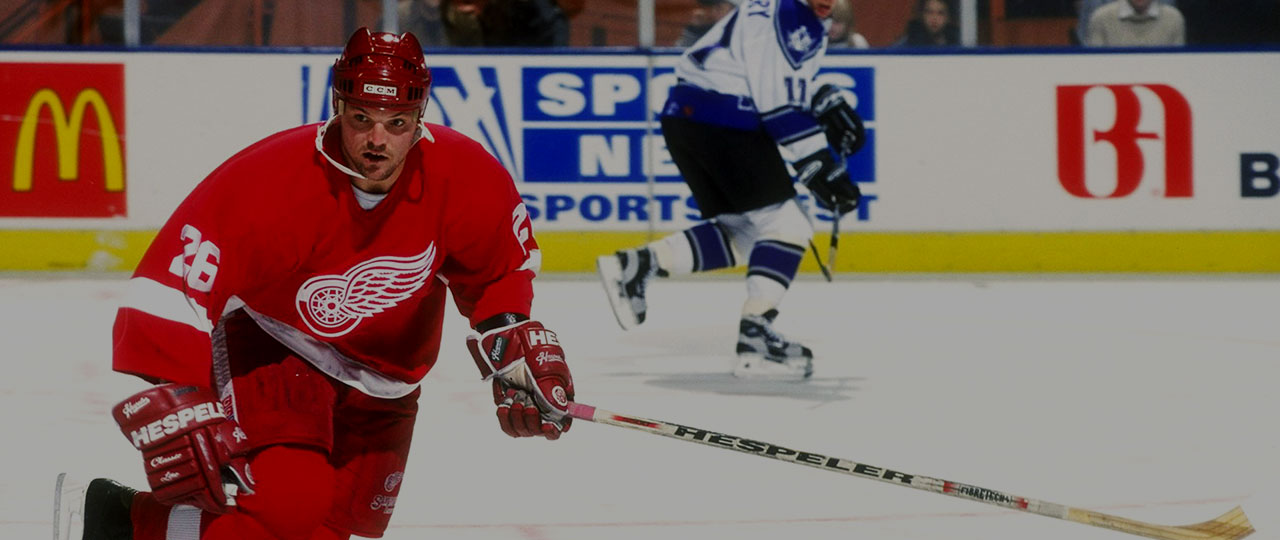

Heavyweight · The 1990s · Buffalo Sabres
Razor. The namesake of the Rob Ray Rule — his habit of losing the jersey mid-fight forced the NHL to mandate tie-down straps. Played 889 games with Buffalo, one of the last one-team enforcer careers. Now a Sabres broadcaster who still talks about the role with clear eyes.
Rob Ray operated at the heavyweight tier — the tier where matchups were scheduled before the opening face-off and nobody needed a reason to drop the gloves. The NHL career numbers tell the short version: 900 regular-season games, 3,207 penalty minutes, 41 goals, 91 points. That is 3.56 penalty minutes per game across a full NHL life — a workload that, in today's game, would end most careers inside three seasons.
The bulk of his work was done in a Buffalo Sabres sweater, a franchise identity that defined him the way he defined the franchise. The 1990s was the environment in which his style made sense — a league where the rules, the rinks, and the roster sizes all allowed a role player to build an entire career out of a specific kind of willingness.
The 1990s heavyweight was a television event. Staged fights, marquee cards, crossover recognition with fans who didn't otherwise follow the sport — the position's commercial peak.
At 3.56 PIM per game, Rob Ray was firmly in the regular-shift enforcer bracket — big enough minutes to develop two-way habits, willing enough to drop the gloves when the roster demanded it.
In a Buffalo Sabres jersey, that identity was sharpened by franchise history. Every organization has a different tolerance for the role and a different set of expectations for the man who plays it, and Rob Ray's career cannot be separated from the building in which he played it.
That context matters because the enforcer conversation has collapsed into a few oversimplified arguments — pro-fighting vs. anti-fighting, goon vs. artist — that ignore the actual craft of the job. Rob Ray is one of fewer than a hundred men who ever did this work at NHL level for long enough to learn it. The details of how he did it — the opponents he matched up with, the years he was on the ice, the team that employed him — are the only way to take the position seriously.
NHL regular-season totals, sortable by column. Minor-league and playoff numbers are excluded for clarity.
| Season | Team | GP | G | A | PTS | PIM |
|---|---|---|---|---|---|---|
| 1989-1990 | Buffalo Sabres | 27 | 2 | 1 | 3 | 99 |
| 1990-1991 | Buffalo Sabres | 66 | 8 | 8 | 16 | 350 |
| 1990-1991 | Buffalo Sabres | 6 | 1 | 1 | 2 | 56 |
| 1991-1992 | Buffalo Sabres | 63 | 5 | 3 | 8 | 354 |
| 1991-1992 | Buffalo Sabres | 7 | 0 | 0 | 0 | 2 |
| 1992-1993 | Buffalo Sabres | 68 | 3 | 2 | 5 | 211 |
| 1993-1994 | Buffalo Sabres | 82 | 3 | 4 | 7 | 274 |
| 1993-1994 | Buffalo Sabres | 7 | 1 | 0 | 1 | 43 |
| 1994-1995 | Buffalo Sabres | 47 | 0 | 3 | 3 | 173 |
| 1994-1995 | Buffalo Sabres | 5 | 0 | 0 | 0 | 14 |
| 1995-1996 | Buffalo Sabres | 71 | 3 | 6 | 9 | 287 |
| 1996-1997 | Buffalo Sabres | 82 | 7 | 3 | 10 | 286 |
| 1996-1997 | Buffalo Sabres | 12 | 0 | 1 | 1 | 28 |
| 1997-1998 | Buffalo Sabres | 63 | 2 | 4 | 6 | 234 |
| 1997-1998 | Buffalo Sabres | 10 | 0 | 0 | 0 | 24 |
| 1998-1999 | Buffalo Sabres | 76 | 0 | 4 | 4 | 261 |
| 1998-1999 | Buffalo Sabres | 5 | 1 | 0 | 1 | 0 |
| 1999-2000 | Buffalo Sabres | 69 | 1 | 3 | 4 | 158 |
| 2000-2001 | Buffalo Sabres | 63 | 4 | 6 | 10 | 210 |
| 2000-2001 | Buffalo Sabres | 3 | 0 | 0 | 0 | 2 |
| 2001-2002 | Buffalo Sabres | 71 | 2 | 3 | 5 | 200 |
| 2002-2003 | Buffalo Sabres | 41 | 0 | 0 | 0 | 92 |
| 2002-2003 | Ottawa Senators | 5 | 0 | 0 | 0 | 4 |
| 2003-2004 | Ottawa Senators | 6 | 1 | 0 | 1 | 14 |
The men Rob Ray faced most often on the end of a dropped pair of gloves. Opponents linked below have their own profiles in the encyclopedia.
The 1990s were the era of the staged fight. Heavyweight bouts became scheduled events — opening face-off, a nod, the gloves come off, the crowd comes to its feet. Tie Domi vs. Bob Probert at Madison Square Garden in 1992 is the fight everyone of a certain generation watched on repeat. Rob Ray, Tony Twist, Stu Grimson, Sandy McCarthy — the rotation of legitimate heavyweights was so deep you could have iced a second All-Star team of men who averaged three minutes of ice time a night. It was also the decade the injuries started catching up and the conversations began about what the job was quietly costing.
Rob Ray is still with us, and in many cases still part of the hockey conversation — as a broadcaster, a coach, a league executive, or simply a voice who will pick up the phone when a younger player needs to ask what the job actually takes. The surviving enforcers of the The 1990s have, collectively, become hockey's most honest self-critics about what the role cost and what parts of it the game was right to retire.