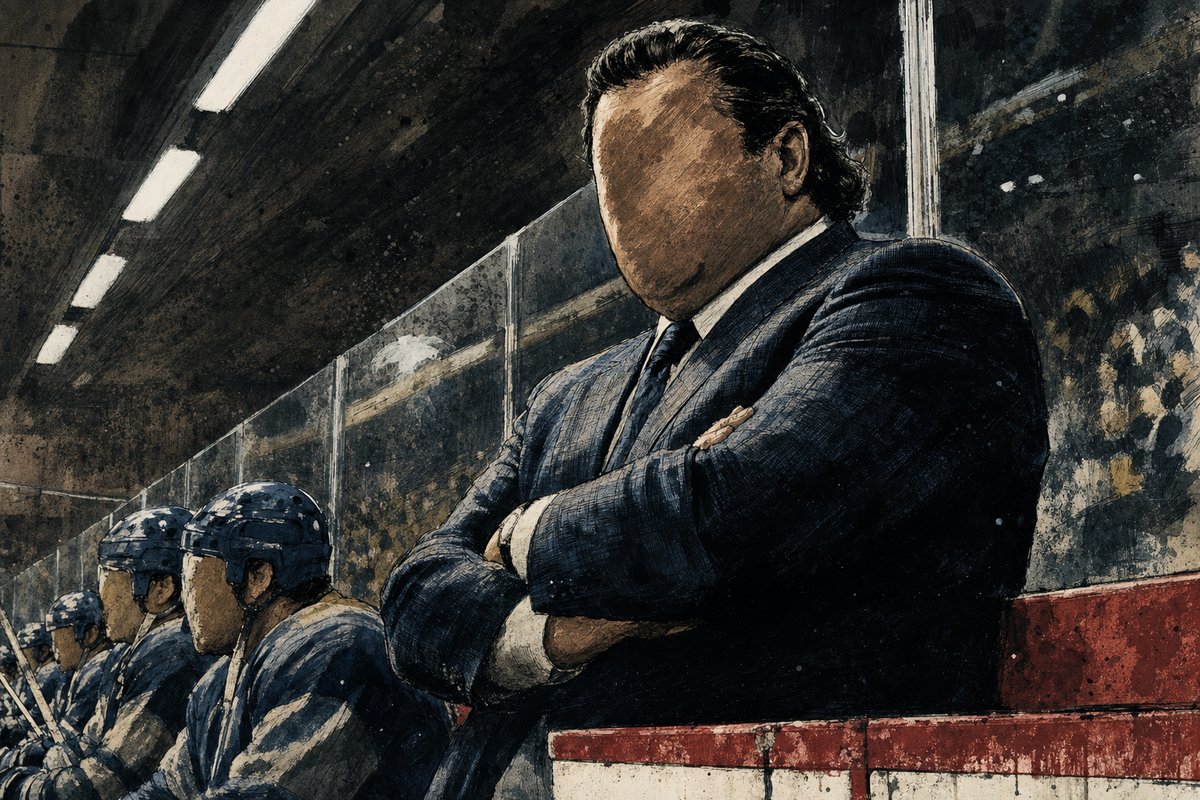
From a rookie's hit on Bobby Orr to Olympic gold and the Hall of Fame
Pat Quinn was a hockey lifer who lived almost every role the game has to offer. He was a hard-nosed defenceman who once flattened the most gifted player of his era. He was a bench boss whose teams reached two Stanley Cup Finals two decades apart. He was an executive who ran franchises and a national-team coach who finally ended a 50-year wait for Olympic gold. Through all of it, he kept the same unhurried, cigar-flavoured calm that made players want to run through a wall for him.
This is the story of the man they called The Big Irishman, told the way the hockey world has come to remember him.
John Brian Patrick Quinn was born on January 29, 1943, in Hamilton, Ontario, and grew up in the city's east end in a working-class household. He was a big, rugged defenceman more than a skilled one, the type who measured his value in clean hits, blocked shots and the respect of the men in his own dressing room. He reached the NHL with the Toronto Maple Leafs for the 1968-69 season after years of grinding through the minor leagues, a late-arriving rookie who had earned every shift.
It was in that rookie season that Quinn authored the single most famous moment of his playing days. In the opening game of the 1969 playoffs in Boston, he caught a young Bruins phenom named Bobby Orr with his head down and delivered a thunderous open-ice bodycheck that knocked Orr unconscious. The Boston Garden erupted, the Bruins bench emptied, and a furious brawl followed. For years the hit was replayed and re-litigated as one of the most jarring collisions of its time. Orr himself later maintained that the check was clean, and the two men eventually became friends, a footnote that says as much about both as the hit itself.
Quinn's playing career carried him to three franchises across nine NHL seasons. After two years in Toronto he was claimed by the expansion Vancouver Canucks in 1970, then selected by the Atlanta Flames in the 1972 expansion draft, where he served as captain in his final two seasons before an ankle injury ended his career in 1977. He finished with 606 NHL games, 18 goals, 113 assists, 131 points and 952 penalty minutes, the line of a defender who was paid to defend. The numbers were modest. What he absorbed in those years, about toughness, accountability and how players want to be treated, would define the far larger second act that followed.
Quinn did not drift into coaching as a fallback. He approached it the way he approached everything, deliberately and with an eye on the long game. While still finishing his playing days and into his early coaching career, he pursued a law degree, eventually earning a J.D. from Widener University in Delaware. He never practised law, but the discipline of it shaped how he negotiated, how he read a room and how he later handled the executive side of the business. It was an unusual credential for a hockey man of his generation, and it underscored that there was a sharp, methodical mind behind the gruff exterior.
His first NHL head-coaching job came with the Philadelphia Flyers, the franchise that had built its identity on intimidation in the era of the Broad Street Bullies. Quinn inherited a team that still carried that reputation but was ready to evolve, and he proved to be exactly the steady hand it needed. The blueprint he laid down in Philadelphia, structured defensively, demanding without being abusive, would travel with him to every stop that followed.
Quinn's defining achievement in Philadelphia arrived in the 1979-80 season, his first full year behind the bench. That Flyers team went on a tear that still stands as one of the great runs in league history, going 35 consecutive games without a loss, a record unbeaten streak that no NHL club has matched since. The Flyers rode that momentum all the way to the 1980 Stanley Cup Final, where they were beaten by the dynastic New York Islanders in six games.
For his work that season, Quinn won the Jack Adams Award as the NHL's coach of the year. It was the first major recognition of a coaching career that was only beginning, and it announced that the former defenceman had a genuine feel for getting more out of a roster than the sum of its parts. His tenure in Philadelphia would not last forever, but the foundation it built, a reputation as a coach who could take a good team and make it formidable, was permanent.
Quinn's next stop, the Los Angeles Kings beginning in the mid-1980s, was the most turbulent chapter of his career. His time there became entangled in controversy and a high-profile dispute that interrupted his coaching, a reminder that the business side of hockey could be every bit as combative as anything on the ice. He continued his education during the period and emerged with his standing intact, but the Kings years were a detour rather than a triumph.
It was the kind of episode that might have soured a lesser man on the game. Quinn instead absorbed it the way he absorbed a hard hit as a player, filed it away, and moved on. The next opportunity would prove to be the making of him as an executive as much as a coach.
In Vancouver, Quinn became something more than a head coach. Over roughly eleven seasons with the Canucks beginning in the late 1980s, he held the roles of coach, general manager and team president, at times wearing more than one of those hats at once. It was here that his full vision of how to build and run a hockey team came into focus, and here that the now-familiar image of him took hold, the heavyset figure behind the bench with the trademark cigar, the florid complexion, the unmistakable old-school presence.
The on-ice peak came in 1991-92, when a dramatically improved Canucks club won its division and Quinn collected his second Jack Adams Award. That made him one of a small handful of coaches to win the honour with two different franchises. Two seasons later, in 1993-94, he guided Vancouver to the Stanley Cup Final, where the Canucks pushed the New York Rangers to a seventh game before falling short of the championship. It remains one of the most memorable runs in franchise history, and Quinn was its architect from both the bench and the front office.
His Canucks era also brought him into the orbit of a Western Canadian hockey culture full of strong personalities and fierce rivalries, the world chronicled in stories like the Kings-Canucks rivalry. Quinn thrived in it. The franchise he ran was respected and feared, and the executive instincts he sharpened there set him up for the high-profile job that would come next.
In 1998, Quinn returned to the franchise where his NHL journey had begun, taking over as head coach of the Toronto Maple Leafs and adding general manager to his duties the following year. For a Hamilton kid who had broken into the league with the Leafs three decades earlier, the homecoming carried real weight, and his years in Toronto became some of the most beloved of his coaching life.
Quinn's Leafs were a perennial contender. He guided the team to the playoffs in his first five seasons and twice to the Eastern Conference Final, fielding skilled, entertaining clubs that played with a swagger their city adored. He coached through the heat of the Leafs-Canadiens rivalry, one of the oldest and most charged rivalries in the sport, and he did it with the same outward calm that had become his signature. Toronto never broke through to a Cup Final under him, but his teams gave the fan base years of genuine hope, and the city's affection for him never wavered.
His dual role as coach and GM was demanding in a way few jobs in hockey are, and it eventually wore down even a man of Quinn's stamina. When his Toronto tenure ended in 2006, he left behind a strong winning record and a reputation as one of the most respected figures the franchise had employed in the modern era.
Quinn's greatest single triumph came not with a club but with his country. Named to coach Canada's men's team at the 2002 Winter Olympics in Salt Lake City, he was handed a roster bursting with stars and the crushing expectation that comes with leading a hockey-mad nation. Canada had not won Olympic gold in men's hockey since 1952, a half-century drought that had hardened into a national anxiety.
After a shaky start to the tournament, Quinn's team found its footing and surged to the gold-medal game against the United States, winning 5-2 to end the 50-year wait. The victory was a watershed moment in Canadian sport, and Quinn, calm and assured throughout, was the steadying presence at the centre of it. The connection to Canada's broader international hockey story, the lineage of the country's national-team triumphs and heartbreaks, runs through pieces like the meaning of wearing the maple leaf.
The 2002 gold was not his only international success. Quinn went on to lead Canada to the World Cup of Hockey title in 2004, winning every game, and to a gold medal at the 2009 World Junior Championship in Ottawa, where the host nation captured a fifth consecutive junior title with a decisive win over Sweden in the final. He also coached Canada to gold at the IIHF World Under-18 Championship in 2008. Few coaches in history have collected international hardware across so many age levels and formats.
For all the trophies and titles, what former players talk about most is the way Quinn made them feel. He was an old-school coach in temperament, a big man with a commanding presence who did not need to raise his voice to fill a room. But he was widely regarded as a players' coach in the truest sense, a man who trusted talent, demanded accountability and protected the people who played for him.
His leadership style was rooted in the lessons of his own playing days. He had been a role player who survived on toughness and respect, and he never forgot what it was like to be the man at the end of the bench. That empathy, paired with the gravitas of a former enforcer who happened to hold a law degree, gave him a rare credibility. Players believed he had their backs, and they responded by giving him everything they had.
Quinn belonged to a generation of larger-than-life Canadian hockey men whose personalities defined the game's culture in their era, figures whose blunt wisdom and old-school instincts are explored in stories about coaches like Don Cherry and broadcasters and lifers such as Harry Neale. Quinn fit comfortably in that company, yet he carried himself with a measured dignity that set him apart. He was the rare bench boss who could be feared and beloved at once.
Quinn finished his NHL coaching career, which included a final season with the Edmonton Oilers in 2009-10, with one of the most impressive win totals in league history, ranking among the top coaches of all time in regular-season victories. He also served the game off the ice, including a long stint on the Hockey Hall of Fame selection committee and a turn as chairman of the Hall's board of directors. His fingerprints were on the sport at nearly every level, from the blue line to the boardroom.
Pat Quinn died on November 23, 2014, at the age of 71 after a long illness. He had been too ill to attend that autumn's Hall of Fame induction ceremony, and his passing was mourned across the hockey world by the players, executives and rivals who had known him. The tributes were striking in their unanimity, a sign of how rare it is for a figure to command that much respect across so many cities and so many decades.
In 2016, Quinn was inducted into the Hockey Hall of Fame as a builder, the formal recognition of a lifetime spent shaping the game as a coach and executive. It was a fitting capstone for a man who had touched the sport as a player, a bench boss, a general manager, a team president and a national-team coach, and who had done it all with the same unflappable presence. The Big Irishman left the game larger than he found it, and the hockey world is still better for the way he ran it.
| Full Name | John Brian Patrick Quinn |
| Born | January 29, 1943 - Hamilton, Ontario, Canada |
| Died | November 23, 2014 (age 71) |
| Nickname | The Big Irishman |
| Playing Position | Defenceman |
| NHL Teams (Player) | Toronto Maple Leafs, Vancouver Canucks, Atlanta Flames |
| Playing Stats | 606 GP, 18 G, 113 A, 131 PTS, 952 PIM |
| NHL Teams (Coach) | Flyers, Kings, Canucks, Maple Leafs, Oilers |
| Stanley Cup Finals | 1980 (Flyers), 1994 (Canucks) |
| Jack Adams Awards | 1980, 1992 |
| International Gold | 2002 Olympics, 2004 World Cup, 2009 World Juniors, 2008 U18 |
| Hockey Hall of Fame | Inducted 2016 (Builder) |
Pat Quinn was a Canadian ice hockey defenceman, head coach and executive nicknamed The Big Irishman. After nine NHL seasons on the blue line with Toronto, Vancouver and Atlanta, he became one of the game's most respected bench bosses and front-office men, and he guided Canada to Olympic gold in 2002. He was inducted into the Hockey Hall of Fame as a builder in 2016.
In the opening game of the 1969 playoffs in Boston, Maple Leafs rookie defenceman Pat Quinn caught Bruins star Bobby Orr with a thunderous open-ice bodycheck that knocked Orr unconscious and triggered a bench-clearing brawl. Orr later said the check was clean, and the two men became friends in later years.
Pat Quinn coached five NHL teams: the Philadelphia Flyers, Los Angeles Kings, Vancouver Canucks, Toronto Maple Leafs and Edmonton Oilers. He reached the Stanley Cup Final twice, with the Flyers in 1980 and the Canucks in 1994, and won the Jack Adams Award as coach of the year in 1980 and 1992.
Yes. Quinn coached Team Canada to the men's hockey gold medal at the 2002 Winter Olympics in Salt Lake City, a 5-2 win over the United States that ended a 50-year drought. He also led Canada to the 2004 World Cup title and a gold medal at the 2009 World Junior Championship in Ottawa.
Yes. In addition to coaching, Quinn served as general manager and team president of the Vancouver Canucks across roughly eleven seasons, and he later held the dual role of coach and general manager with the Toronto Maple Leafs. He also held a law degree from Widener University in Delaware, which he applied to the executive side of the business.
Yes. Pat Quinn was inducted into the Hockey Hall of Fame as a builder in 2016, recognizing his lifetime of contributions as a coach and executive. He had also served on the Hall's selection committee and as chairman of its board of directors. He died in November 2014 at the age of 71.
Think you know the game better than the oddsmakers? Put your hockey knowledge to work with Canada's best sportsbooks.