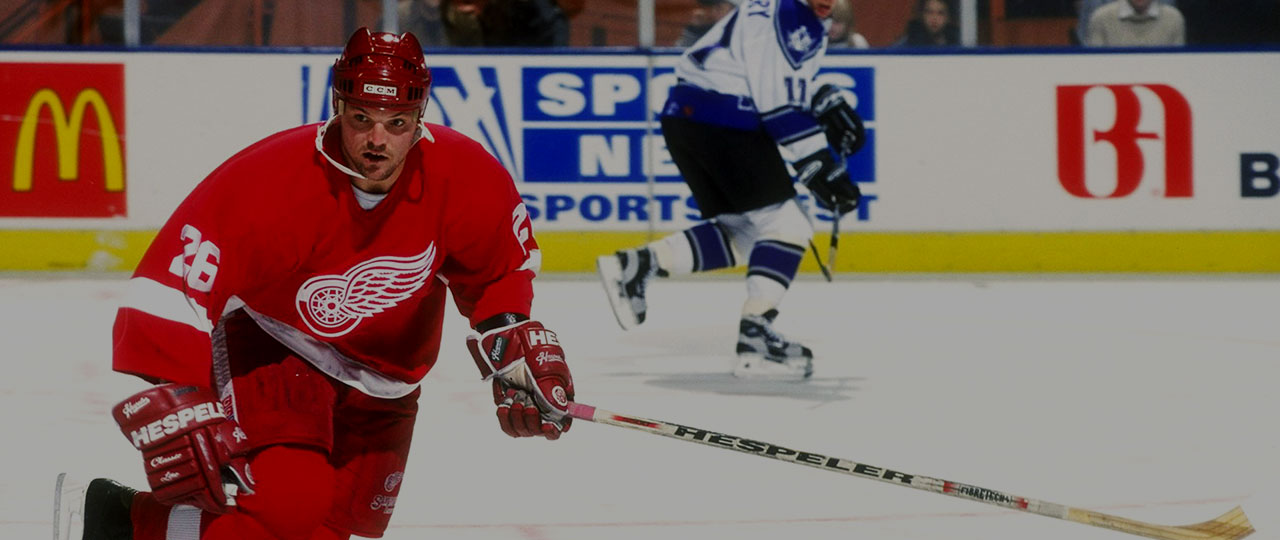

Terry O'Reilly & the Night the Bruins Stormed the Stands
The Heart, the Blood, and the Shoe at Madison Square Garden
There are players who wear the jersey, and then there are players who bleed for it. Terry O'Reilly did both, literally, for 891 games over 13 NHL seasons. Every single one of them with the Boston Bruins. He was the kind of player who would lose teeth in the first period, score a goal in the second, and fight twice in the third. Boston didn't just love him. Boston recognized him as one of their own.
But one night in December 1979, O'Reilly led his teammates somewhere no hockey player had gone before: over the glass and into the crowd at Madison Square Garden. What happened that night became one of the most infamous incidents in the history of professional sports, and it tells you everything you need to know about the man they called "Bloody O'Reilly."
Quick Facts: Terry O'Reilly
| Full Name | Terence Timothy O'Reilly |
| Born | June 7, 1951 - Niagara Falls, Ontario |
| Position | Right Wing |
| Height / Weight | 6'1" / 200 lbs |
| NHL Team | Boston Bruins (1971-1985) |
| Draft | 14th overall, 1971 NHL Amateur Draft |
| NHL Stats | 204 G, 402 A, 606 PTS in 891 GP |
| Penalty Minutes | 2,095 career PIM |
| Nickname | "Bloody O'Reilly," "Taz" |
| Captaincy | Bruins Captain, 1983-1985 |
| Coaching Record | 115-86-26 as Bruins Head Coach (1986-89) |
A Niagara Falls Kid Who Found His Home on Causeway Street
Terry O'Reilly grew up in Niagara Falls, Ontario, a working-class town that produced tough, no-nonsense people. He was never the most skilled skater on the ice or the prettiest player with the puck. What he had instead was a motor that never stopped and a will that simply could not be broken.
The Bruins selected him 14th overall in the 1971 NHL Amateur Draft, and he arrived in Boston at a remarkable time. The Big Bad Bruins of Bobby Orr and Phil Esposito were at their peak, having won the Stanley Cup in 1970 and again in 1972. O'Reilly was not Orr. He was not Esposito. He was something else entirely.
"Terry was the bridge between those championship teams and what came after," one former Bruin recalled. "When Orr's knees gave out and Espo got traded, Terry was the guy who carried the identity of that franchise on his back. He was the Bruins. Not the most talented, but the most Bruin."
That identity was forged in blood. O'Reilly played with a ferocity that terrified opponents and inspired teammates. He would barrel into corners like a man possessed, throwing elbows, absorbing hits, and emerging with the puck or, failing that, with someone else's blood on his sweater. Often it was his own.
"Bloody O'Reilly" - Five Years of Controlled Chaos
The nickname was not a marketing invention. It was simply what happened when you watched Terry O'Reilly play hockey. His face bore the scars of hundreds of battles. His nose had been broken so many times it no longer sat straight. Stitches above his eyes were a weekly occurrence.
From 1976-77 through 1980-81, O'Reilly recorded five consecutive seasons with over 200 penalty minutes. In 1977-78, he led the entire NHL with 211 PIM. That same season, he scored 29 goals and 61 points, making him one of the rare enforcers who could genuinely impact the scoreboard.
"Most tough guys, you put them on the ice and you're basically playing four-on-five," a former coach explained. "With O'Reilly, you were getting a legitimate top-nine forward who also happened to be the toughest man in the building. That combination is almost impossible to find."
He was not a heavyweight in the traditional sense. At 6'1" and 200 pounds, he was smaller than many of the league's designated fighters. He compensated with an absolutely relentless style. O'Reilly didn't wait for fights to come to him. He created chaos everywhere he went, and if that chaos turned into a fight, so be it.
What separated O'Reilly from other enforcers was simple: he was a hockey player first. He could forecheck, he could cycle the puck, he could park himself in front of the net and take punishment all night. He did the things that don't show up on a highlight reel but that win hockey games.
December 23, 1979: The Night Everything Changed
It was four days before Christmas. The Bruins were at Madison Square Garden to play the Rangers. The game was rough, as Bruins-Rangers games tended to be, and by the final period, tempers were running hot on both sides.
What happened next has been replayed on grainy video countless times, and it still doesn't seem real.
With time winding down, a brawl broke out on the ice. During the melee, a fan in the stands reached over the glass, grabbed the stick of Bruins defenseman Al Secord (some accounts say it was Stan Jonathan), and struck one of the Boston players with it. The Bruins saw it happen.
"That was the line," one Bruin from that team said years later. "You can scream at us. You can throw stuff. But you do not put your hands on one of our guys. That was something you just did not do."
Terry O'Reilly was the first one over the glass.
Into the Stands
It defied everything about how professional athletes are supposed to behave. O'Reilly, still in full equipment, climbed the dasher boards and went directly into the crowd. Behind him came Mike Milbury, Peter McNab, and several other Bruins. The players waded into the seats at Madison Square Garden and began fighting with fans.
The scene was pandemonium. Fans scattered in every direction. Others charged toward the players. In the middle of it all, O'Reilly was throwing punches with the same ferocity he showed on the ice, going after the men who had attacked his teammate.
And then came the moment that would live forever in sports infamy.
Mike Milbury, the Bruins' hard-nosed defenseman, ripped a shoe off the foot of a fan and began beating the man with it. The image of an NHL player pummeling a spectator with his own loafer became one of the most iconic, and disturbing, moments in hockey history.
"I'm not proud of what happened," Milbury said years later. "But I'm not going to apologize for protecting my teammates either. That fan crossed a line."
The Aftermath
The consequences were swift and severe. O'Reilly was fined $500 by the NHL, a significant sum at the time. Milbury received the same fine. Criminal charges were filed against several Bruins players, though most were eventually settled out of court. The fan who had started the altercation by grabbing the stick? He filed a lawsuit against the Bruins organization.
The NHL was forced to examine its arena security protocols. Within months, higher glass barriers were installed in arenas across the league, specifically designed to prevent fans from making physical contact with players. The incident also prompted new regulations about spectator behavior and the legal liability of sports organizations.
For O'Reilly, the incident cemented his legend in Boston. The city didn't see him as a thug who'd lost control. They saw a man who protected his teammates at any cost, even if it meant climbing into the stands at an opposing arena. That was O'Reilly's code, and it never wavered.
The Complete Player They Don't Talk About Enough
The stands-storming incident and the "Bloody O'Reilly" nickname tend to overshadow what a genuinely good hockey player Terry O'Reilly was. His career numbers tell a story that goes far beyond fighting.
204 goals. 402 assists. 606 points. Those are not enforcer numbers. Those are the numbers of a legitimate NHL forward who contributed in every zone, on every shift.
His best offensive season came in 1977-78, when he posted 29 goals and 61 points while simultaneously leading the league in penalty minutes. Only a handful of players in NHL history have managed that kind of dual-threat production. Bob Probert accomplished a similar feat in 1987-88, and it speaks to the rarity of the achievement that those are essentially the only two comparable seasons in league history.
O'Reilly also shone in the playoffs. In the 1978 postseason, he recorded 8 goals and 16 points in 15 games, nearly leading the Bruins to the Stanley Cup before they fell to the Montreal Canadiens in the Final. His playoff intensity was, if possible, even greater than his regular season fire.
"In the playoffs, Terry was a different animal," a former linemate recalled. "During the regular season, he was a handful. In April and May? He was a force of nature. Guys who had fought him all season suddenly wanted no part of him."
Captain O'Reilly: Leading by Example
In 1983, Terry O'Reilly was named captain of the Boston Bruins, an honor that surprised no one who had ever shared a dressing room with him. By then, he was the elder statesman of a team transitioning to a new generation, and the "C" on his sweater formalized what had been true for years: O'Reilly was the heart of the team.
"Terry never had to say much," one of his former teammates said. "He led by doing. When things got tough, he was the first guy over the boards. When we needed a goal, he'd find a way to create something. When someone took a run at one of our young guys, Terry handled it. That's leadership. Not speeches. Actions."
He wore the "C" for his final two seasons before retiring after the 1984-85 campaign. In typical O'Reilly fashion, he went out still playing the same way he'd played since day one: all-out, every shift, consequences be damned.
Behind the Bench: Coaching the Bruins
Terry O'Reilly's connection to the Boston Bruins did not end with his playing career. In 1986, he was named head coach of the team, succeeding Butch Goring. It was a natural fit. Who better to coach the Bruins than the man who had embodied their identity for over a decade?
His coaching tenure lasted three seasons, and the results were impressive. O'Reilly compiled a record of 115-86-26, and in 1988, he led the Bruins all the way to the Stanley Cup Finals. They were overmatched by Wayne Gretzky's Edmonton Oilers, losing in four straight, but reaching the Final was a testament to O'Reilly's ability to get the maximum out of his roster.
"Terry coached the way he played," observed a hockey journalist who covered those Bruins teams. "He demanded effort. He demanded toughness. He demanded that you care about the guy sitting next to you in the room. If you did those three things, Terry was behind you one hundred percent."
He was replaced as coach after the 1988-89 season, but his impact on the franchise was indelible. Players who came through the organization during his coaching tenure speak of him with the same reverence as those who played alongside him.
The Last of a Breed
Terry O'Reilly played in an era when the game rewarded exactly what he brought to the rink. Toughness. Grit. An absolute refusal to yield an inch. The evolution of hockey enforcers has moved the game away from players like O'Reilly, but his legacy endures in Boston and across the hockey world.
His number 24 has never been officially retired by the Bruins, a fact that irks many longtime Boston fans. But O'Reilly himself has never lobbied for the honor. That's not his style. He did his job, he protected his teammates, he gave everything he had to the sweater, and then he walked away.
"Terry is the most beloved Bruin who isn't in the Hall of Fame," one local sportswriter noted. "And honestly, he might be more beloved than some who are. In this city, toughness and loyalty mean everything. Terry O'Reilly had both in unlimited supply."
In an era of legendary hockey brawls, O'Reilly stood apart not because he was the biggest or the strongest, but because he was the most committed. He played every game like it was his last. He fought every fight like his teammates' safety depended on it. And on one unforgettable night at Madison Square Garden, he went somewhere no player had gone before, because that's what protecting your team meant to Terry O'Reilly.
The tough guys of today's NHL, the few who remain, walk a path that O'Reilly helped define. Players like Tie Domi and Bob Probert who came after him understood the code: protect your teammates, play with your heart, and never, ever back down. O'Reilly wrote that code in blood. His own, mostly.
Frequently Asked Questions About Terry O'Reilly
What happened at Madison Square Garden on December 23, 1979?
During a Bruins-Rangers game at Madison Square Garden, a fan in the stands grabbed a Bruins player's stick and struck him with it. Terry O'Reilly led several Boston players, including Mike Milbury and Peter McNab, into the stands to confront the fans. Milbury famously beat a fan with the man's own shoe. The incident resulted in fines, criminal charges, and ultimately led to the installation of higher glass barriers in NHL arenas.
Why was Terry O'Reilly called "Bloody O'Reilly"?
O'Reilly earned the nickname because he was constantly bleeding during games from cuts and scrapes sustained through his aggressive, reckless style of play. His face was a patchwork of stitches and scars. He recorded five consecutive seasons with over 200 penalty minutes from 1976-77 through 1980-81, and his willingness to sacrifice his body made him a constant presence in the trainer's room.
How many penalty minutes did Terry O'Reilly accumulate?
Terry O'Reilly accumulated 2,095 penalty minutes across 891 NHL regular season games, all with the Boston Bruins. He led the NHL in penalty minutes during the 1977-78 season with 211 PIM. In the playoffs, he added another 168 penalty minutes in 108 postseason games.
Was Terry O'Reilly only a fighter, or could he score?
O'Reilly was a complete hockey player. He finished his career with 204 goals, 402 assists, and 606 points. His best season was 1977-78, when he scored 29 goals and 61 points while also leading the NHL in penalty minutes. He was a legitimate top-nine forward who could play on the power play and contribute in every situation.
Did Terry O'Reilly coach the Boston Bruins?
Yes. After retiring in 1985, O'Reilly became head coach of the Bruins in 1986. He coached for three seasons, compiling a record of 115-86-26, and led the team to the 1988 Stanley Cup Finals, where they were swept by the Edmonton Oilers. He was replaced after the 1988-89 season.
Related Stories
- Bob Probert: Hockey's Toughest Man
- The Greatest Hockey Fights in NHL History
- The Most Brutal Hockey Brawls Ever
- How Enforcers Have Evolved in Hockey
- Tie Domi: The Last True Enforcer
- The Unwritten Code: Hockey's Rules of Fighting
Love Hockey? Try Hockey Betting
Think you know the game better than the oddsmakers? Put your hockey knowledge to work with Canada's best sportsbooks.