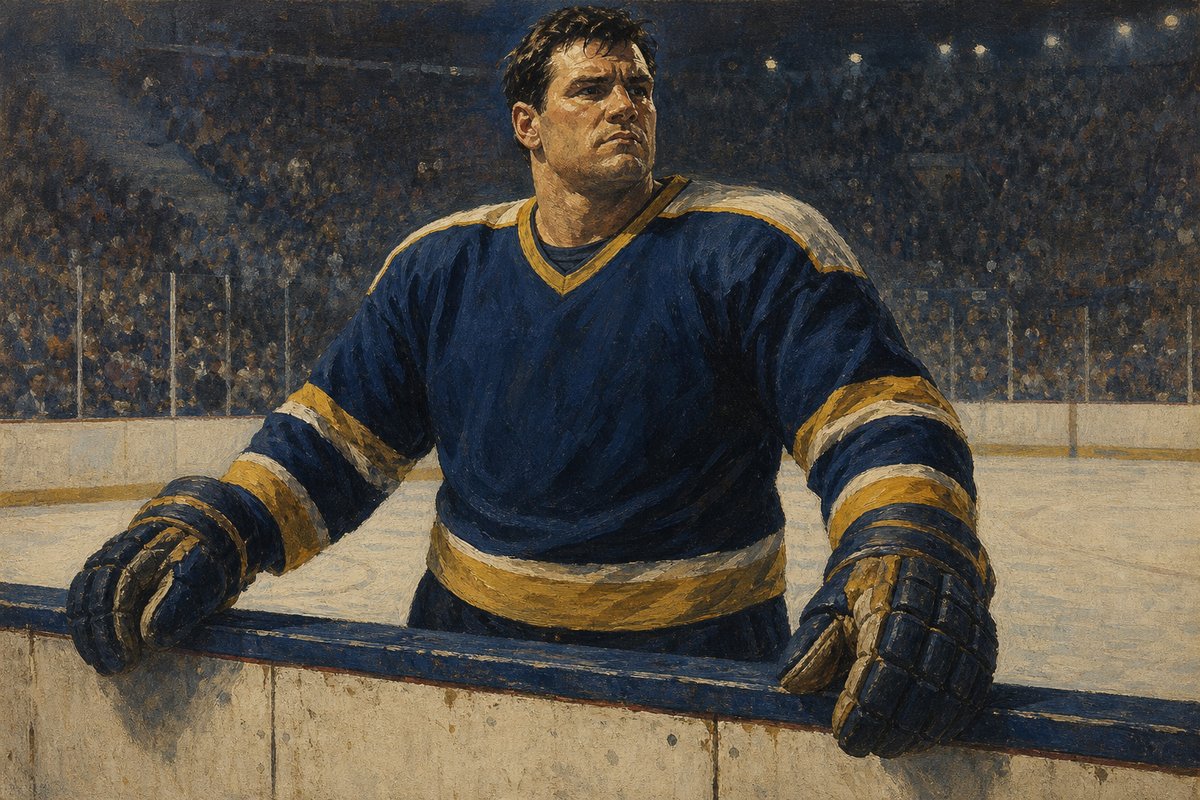
The St. Louis Legend, the One-Punch Reputation & the Lawsuit That Made History
Published June 2026 — A complete profile of the most feared puncher of the 1990s: the numbers, the fights, the career-ending crash, and the landmark Spawn right-of-publicity case that put his name in law-school textbooks.
There is a particular kind of fear that only a handful of hockey players have ever produced, and Tony Twist owned it for most of the 1990s. He was not the most prolific fighter of his era, and his name does not sit near the top of the all-time penalty-minute list. What set Twist apart was simpler and far more frightening: when he connected, the fight was over. Ask the men who lived in the same heavyweight class, and the same word comes up again and again — dangerous.
This is the story of "The Twister": where the punch came from, the career it built and the accident that ended it, and the strange second act in which a comic book turned a St. Louis enforcer into one of the most-cited names in American publicity law.
Tony Twist was born on May 9, 1968, in Sherwood Park, Alberta, a suburb of Edmonton in the heart of hockey country. By his draft year he was a heavyweight in the most literal sense — a 6-foot-1, 265-pound left winger whose game was built entirely around protecting teammates and punishing anyone who took liberties.
The St. Louis Blues selected him in the ninth round of the 1988 NHL Entry Draft, 177th overall — the kind of late pick that almost never produces an NHL regular. Twist made it on the strength of one transferable skill. He could fight, and he could fight better than nearly anyone in professional hockey.
"You can teach a lot of things in this game," one longtime scout observed of the enforcer trade. "You can't teach a guy to hit like that. Some of them are just born with it, and the rest of the league spends years learning to stay out of the way."
Most enforcers of the era were attrition fighters — they traded blows, absorbed punishment, and won by volume and durability. Twist was the opposite. He was an execution. He threw a short, brutally heavy right hand, and the men who faced him knew that a single clean connection could end their night and, occasionally, their season.
The respect was close to unanimous among his peers. Marty McSorley, no stranger to the heavyweight ranks himself, repeatedly named Twist among the most dangerous fighters he ever stood across from. Tie Domi said much the same. In a fraternity where admitting fear was rare, Twist was the exception that everyone acknowledged.
"There were guys you fought because it was your job, and you'd be sore the next day," a former Western Conference enforcer recalled. "And then there was Twist, who you fought knowing that if you made one mistake you might not get up. That changes how you approach the whole thing. You're not trying to win. You're trying to survive."
What made the reputation stick was how rarely it was tested successfully. Twist did not lose often. He did not need to fight constantly to make his presence felt — opponents adjusted their behaviour the moment he stepped over the boards, which was always the point of the job.
Twist broke into the NHL with St. Louis in 1989-90, then was traded to the Quebec Nordiques, where he spent four seasons from 1990 to 1994 as the team rebuilt into the young, talented core that would later become the Colorado Avalanche. He became a free agent in 1994 and did the thing that defined the rest of his life: he went back to St. Louis.
The second Blues stint, from 1994 to 1999, is when Twist became a genuine fan institution. In a hockey market that prized toughness, he was the perfect folk hero — a heavyweight who protected stars like Brett Hull, fought the league's most dangerous men without hesitation, and embraced the city completely off the ice. The Twister chants in the old Arena, and later the Kiel Center, were a fixture of Blues nights.
His career line was never about offence. Across 445 NHL games he recorded 10 goals, 18 assists, and 1,121 penalty minutes — roughly two and a half penalty minutes per game, a number that captures exactly what he was paid to do. The detailed season-by-season breakdown lives in his Enforcer Encyclopedia profile.
Twist's bouts were short by design — he was hunting for the one punch, not a two-minute war. The list of heavyweights who matched up against him reads like a roll call of 1990s tough guys, and surviving the exchange was often considered a victory in itself.
For the wider context of how these matchups fit into the sport, see our guide to the greatest hockey fights in NHL history and how the enforcer role evolved over the decades.
In the early 1990s, comic-book creator Todd McFarlane — the artist behind the wildly popular Spawn series — introduced a violent New York mafia boss named "Antonio 'Tony Twist' Twistelli." McFarlane acknowledged borrowing the name from the hockey player. Twist, who was building a family-friendly public profile in St. Louis through charity and youth work, did not find it flattering to share a name with a comic-book mob enforcer, and he sued for misappropriation of his name — what the law calls the right of publicity.
What followed became one of the most significant right-of-publicity cases in American law. In 2000, a St. Louis jury awarded Twist a stunning $24.5 million. That verdict was overturned, and the Supreme Court of Missouri ordered a new trial in its 2003 decision (Doe v. TCI Cablevision), holding that McFarlane's commercial use of the name was not shielded by the First Amendment as protected artistic speech. A 2004 retrial awarded Twist $15 million, and the Missouri Court of Appeals upheld that judgment in 2006.
The case is now taught in law schools as a leading example of where the right of publicity ends and free-expression protection begins. It is a genuinely unusual legacy for any athlete: Tony Twist is remembered by hockey fans for his fists, and by a generation of law students for his name. Few players have left a mark in two fields that have nothing to do with one another.
In July 1999, at age 31 and still an effective NHL enforcer, Twist was involved in a motorcycle accident in St. Louis that left him with a broken pelvis and serious injuries. He was never able to return to professional hockey. A career that had been built on physical durability ended not in the rink but on a city street, in an instant.
The abruptness of it is part of why his story resonates. There was no slow decline, no fading into a fourth-line role — one of the most physically imposing players of his generation was simply stopped, all at once, at an age when many enforcers still had years left.
Twist did what he had always done: he stayed in St. Louis. He became a popular local media personality, co-hosting the "Smash and Twist" show on 590 The Fan, and remained visible in the community through charity work. The same city that had chanted his name on fight nights embraced him as a broadcaster and local fixture, and he remained one of the most beloved figures in Blues history long after his last shift.
It is a softer second act than the one-punch reputation would suggest — which is, in the end, the recurring theme of the enforcer story. The job demanded a kind of controlled violence on the ice that rarely matched the men who performed it once they took the equipment off.
Where does Tony Twist rank among hockey's enforcers? Not by penalty minutes — plenty of men sat in the box longer. His standing comes from something harder to measure and impossible to fake: the genuine, peer-acknowledged fear he produced. When the toughest men in the sport tell you a particular opponent was the one who frightened them, that is a legacy no statistic can capture.
The role Twist played has largely vanished from the modern NHL. The heavyweight specialist whose entire value was the threat of his fists is a figure from another era. Whatever one makes of that change, the men who watched Twist work — and especially the men who had to stand across from him — will tell you there was no one quite like him.
| Full Name | Tony Twist |
| Born | May 9, 1968 - Sherwood Park, Alberta, Canada |
| Position | Left Wing (Enforcer) |
| Height/Weight | 6'1" / 265 lbs |
| NHL Teams | St. Louis Blues (1989-1990, 1994-1999), Quebec Nordiques (1990-1994) |
| NHL Draft | 1988, Round 9, 177th overall (St. Louis) |
| Career Stats | 445 GP, 10 G, 18 A, 28 PTS |
| Penalty Minutes | 1,121 (2.52 per game) |
| Career End | July 1999 - motorcycle accident, broken pelvis |
| Nickname | "The Twister" |
Tony Twist was widely regarded by his peers as the single hardest puncher of the 1990s. Fellow enforcers including Marty McSorley and Tie Domi named him among the most dangerous men they ever faced because of his one-punch knockout power. He rarely lost a fight and was known for ending bouts in a single connection rather than a prolonged exchange.
Tony Twist's NHL career ended in July 1999 when he broke his pelvis in a motorcycle accident in St. Louis. He was 31 and was never able to return to professional hockey, finishing with 445 NHL games, 1,121 penalty minutes, and a reputation as the most feared fighter of his era.
Comic creator Todd McFarlane named a violent mafioso character "Antonio 'Tony Twist' Twistelli" in the Spawn comics. Twist sued for misappropriation of his name. After a 2000 jury award of $24.5 million was overturned and a retrial ordered by the Missouri Supreme Court in 2003, a 2004 retrial awarded Twist $15 million, a judgment upheld on appeal in 2006. It became a landmark right-of-publicity case taught in U.S. law schools.
Tony Twist played for two NHL teams: the St. Louis Blues (1989-1990 and 1994-1999) and the Quebec Nordiques (1990-1994). He was drafted by St. Louis in the ninth round, 177th overall, of the 1988 NHL Entry Draft.
After hockey, Tony Twist became a popular St. Louis media personality, co-hosting the "Smash and Twist" show on 590 The Fan, and remained active in local charity work. He stayed one of the most beloved figures in St. Louis Blues history.
Think you know the game better than the oddsmakers? Put your hockey knowledge to work with Canada's best sportsbooks.