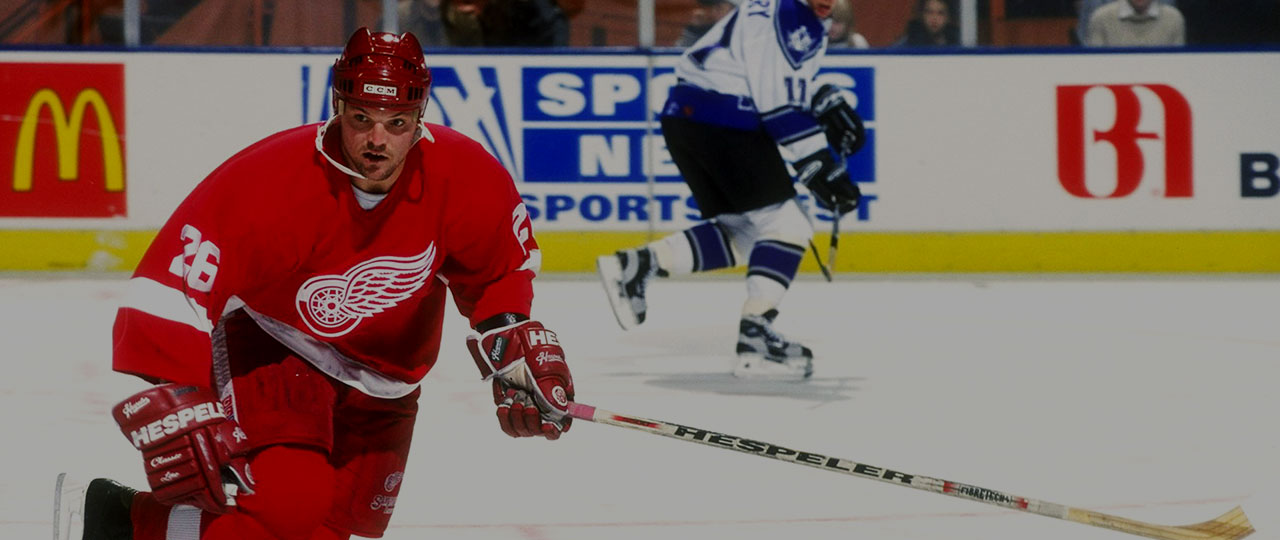

The men who came closest to solving him — and what happened next
Probert fought 246 times. Most of those fights were one-offs: a young challenger wanting to build a reputation, a veteran checking a box. But a handful of opponents came back night after night, season after season. Their rivalries with Probert shaped their careers as much as their own skills did. Here are the five most consequential, ranked roughly by their cumulative meaning to Probert's legacy.
No rivalry in Probert's career carried the weight of the Tie Domi series. Domi was 5'10", 200 pounds, an Albanian-Canadian kid from Belle River, Ontario — fifteen minutes from Probert's Windsor. They grew up on the same rinks. They knew the same people. And from the moment Domi cracked the NHL in 1990, the story wrote itself: the pest who grew up watching Probie was coming for his throne.
Their first serious fight came on February 9, 1992, at Madison Square Garden. Domi, then a New York Ranger, caught Probert with a series of uppercuts from the inside and knocked him down. He then made the unforgivable gesture: he mimed buckling a championship belt around his waist. It was, by consensus, the only genuinely decisive loss of Probert's prime. The image — Domi's arms raised, Probert on the ice — ran on every sportscast in North America for a week.
Probert's response took almost a full calendar year. On February 2, 1993, Domi had been traded to Winnipeg and the teams met at Joe Louis Arena. The hype leading in was like a heavyweight title fight. Probert dominated. He tied Domi's lefts up, worked the body, and finished with a right uppercut. The belt conversation ended that night.
“Tie is a good guy. Off the ice, honestly, one of the funniest guys in the league. But that MSG thing — you don't do that to Probie. You just don't. Everybody knew a rematch was coming, and everybody knew what was going to happen.”
— A former Detroit Red Wings teammate, 2011
They fought three more times across their careers — draws in 1996, a Probert win in 1996, and a final draw in 1997. Final series score: Probert 2, Domi 1, draws 2. After retirement, the two reconciled publicly; Domi has spoken on multiple podcasts about the respect he developed for Probert in the years after their feud cooled. Cross-ref: the full Domi biography is on Slapshot Diaries.
What happened next: Domi retired in 2006 as the NHL's penalty-minutes leader among living players at the time, with 3,515 PIM. He's now a Toronto businessman and a TV personality. His son Max Domi became an NHL forward and a Hart Trophy candidate. The irony of Tie's legacy is that he's remembered at least as much for the Probert rivalry as for his own considerable hockey career.
The Grim Reaper was 6'5", 240 pounds, and built like a sheriff from a Sam Peckinpah movie. He played for seven NHL teams across 14 seasons and he was, on any given night, the most physically intimidating man in the league. He also never beat Bob Probert.
Their first meeting came February 18, 1987, at the Olympic Saddledome in Calgary — Grimson's home ice as a young Flame. Probert ducked the first bomb, tied Grimson's reach, and landed three short rights inside. The book on beating Grimson was written that night: you had to close the distance, because if you let him work from the outside his length would kill you. Every future Grimson opponent borrowed from Probert's blueprint.
They fought four times. Probert won twice clearly; the other two were draws. Grimson has spoken openly and repeatedly in interviews and on his own podcast about the experience. It's clear he holds Probert in something close to reverence.
“You don't hit Probie. Nobody hits Probie. You survive him. That's the job. If you survive, you win something, even if the scoreboard says draw.”
— Stu Grimson, across multiple post-career interviews
What happened next: Grimson graduated from the University of Manitoba with a law degree during his playing career — one of the most unusual second acts in NHL history. He retired in 2002, the same year as Probert. He is now a practicing attorney and a national broadcaster for the Nashville Predators. He has become one of the most eloquent advocates for the post-career mental-health and substance-abuse support network that Probert himself badly needed and rarely had. Their friendship in retirement, from Grimson's description, was deep.
For about three weeks in November 1990, Troy Crowder was the most talked-about tough guy in hockey. He was a New Jersey Devils rookie, 6'4", 225 pounds, and on November 10, 1990, at the Meadowlands Arena, he had a legitimate Hockey Night in Canada fight against Bob Probert — and won it. Cleanly. He landed a series of rights and Probert, almost for the first time, looked overmatched.
It was supposed to be a changing of the guard.
It wasn't.
The rematch came December 1, 1990, at Joe Louis Arena. Probert didn't waste a punch. He tied Crowder up immediately, worked the body, and took the fight back inside a minute. The difference between fight one and fight two is the entire Probert craft in a sentence: the first was a brawl; the second was a seminar.
“Crowder got him in Jersey and the world lost its mind. Three weeks later Probie went and got it back, and nobody said another word about it.”
— A former NHL official, 2010
They fought a third time in November 1991 — by then a mutual-respect draw — and the series was over. What happened next: Crowder's career never quite matched the brief blaze of November 1990. He played parts of seven NHL seasons, retired in 1998, and has been a small-business owner and youth coach in Sudbury, Ontario, ever since. He speaks generously about Probert in interviews. In one often-quoted line, he said the first fight made his career and the second fight taught him what he was really up against.
McSorley was Wayne Gretzky's bodyguard for the better part of a decade — Edmonton, then Los Angeles. Probert was Steve Yzerman's bodyguard in Detroit. When the Oilers and Wings met, the two of them ended up in each other's orbit virtually every shift. They fought three clearly documented times and probably three or four more undocumented times; McSorley has said in interviews that he and Probert had an understanding.
Their most meaningful fight came December 6, 1989 — Probert's fourth game back from the post-border-arrest suspension. McSorley had been running the league in Probert's absence and the Oilers came into Joe Louis Arena for what was supposed to be a statement. Probert ended it in 30 seconds: a short right that staggered McSorley, a second that sealed it. The standing ovation lasted longer than the fight.
“Marty and Bobby had a relationship. They'd fought enough by then. That one wasn't about the two of them. That was Bobby telling the league: I'm back, and you're not taking my room.”
— A Red Wings equipment manager, 1989
What happened next: McSorley is remembered in hockey history for two things — the illegal-stick penalty that cost the Kings the 1993 Stanley Cup Final, and the Donald Brashear incident of February 2000 that effectively ended his career. He served a lifetime ban (later reduced) and never played another NHL game. He has since worked as a broadcaster and in various hockey-adjacent businesses. His relationship with Probert remained respectful; the two were often on opposite sides of the same debates about the evolution of fighting.
Brashear was the man who, eventually, got the last clear win. It took him until 2001 — Probert's final season, Probert 36 years old, Probert playing on legs that had given him everything they had — but Brashear got it. The final fight between them, December 7, 2001, at GM Place in Vancouver, went to Brashear on shots landed. Probert took the loss with the same grace he had always taken them. He tapped Brashear on the shoulder skating to the box. There was no drama. There was only the ledger.
They had fought three times. The 1997 United Center fight was a draw. The 1999 United Center fight went to Probert. The 2001 Vancouver fight went to Brashear. Head-to-head: 1-1-1, with Brashear getting the decisive late one.
“You watch the Brashear fight from '99 and you're watching a chess match. He's thirty-three. He's already hurt. And he's still smarter than everyone on the ice. By '01 the body wasn't there any more. But the chess was.”
— An NHL coach, 2010
What happened next: Brashear's career never recovered the same stature after the 2000 McSorley incident left him with a severe concussion. He played until 2010 and briefly boxed professionally after retirement. He has spoken carefully and thoughtfully about Probert in interviews — more so than about almost any other opponent. The two shared a substance-abuse history, a background of childhood hardship, and a late-career recognition that the game they had given so much to had taken more than it had given back. Cross-ref: full profile at Donald Brashear on Slapshot Diaries.
A dozen more men played meaningful parts in Probert's fighting life without quite reaching the top-five threshold. Dave Brown and the Philadelphia Flyers were a constant dance partner — three fights, two Probert wins, one draw. Basil McRae was the first NHL opponent Probert ever dropped the gloves with and one of the last veterans Probert ever faced; their career arc from rookie-to-rookie to veteran-to-veteran is its own small story. Tony Twist was the rare opponent Probert genuinely worried about physically — Twist hit as hard as anyone who ever played the game, and both of their fights were, by mutual agreement, stopped before anyone got seriously hurt. Georges Laraque represented the passing of the heavyweight torch; Ken Baumgartner represented the Islanders' bomber generation; Chris Nilan represented Montreal and an older style of Quebec-born ferocity that Probert genuinely respected.
Every one of those men, in their own way, made Probert who he was. The Vault exists in part to give them credit. Fighting is a collaborative act. The person throwing the punch is only half the equation; the person standing up to absorb it is the other half. Probie understood that better than anyone.
—
Back to: Bob Probert Fights Vault · Life Timeline › · Bob Probert biography