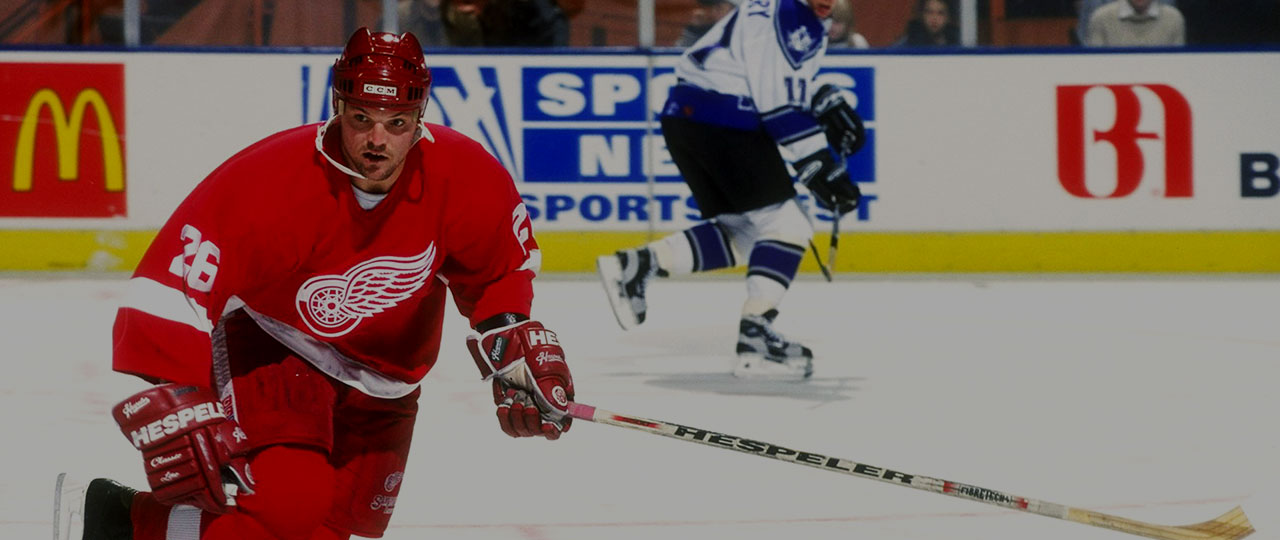
Bob Probert: A Life Timeline
From Windsor to the NHL to Lake St. Clair — 45 years in 22 dates
Robert Alan Probert lived loudly and died too soon. Forty-five years between Windsor, Ontario and Lakeshore, Ontario — with Detroit and Chicago and every Original Six building in between. Below is a structured chronology of the life: what we know, when we know it, and what each event actually meant in the arc. Dates are drawn from public records, his autobiography Tough Guy (2010), and the contemporary reporting of the Windsor Star, the Detroit Free Press, and the Chicago Tribune.
Three threads run through the timeline: the hockey, the addiction, and the family. They are not separable. Every biographer who has tried to pull them apart has ended up rewriting the same paragraph over and over. Probert was a once-in-a-generation hockey player who was also a once-in-a-generation addict who was also one of the most devoted fathers many of his friends ever met. He is none of those things in isolation.
We've broken the timeline into four rough eras: the early years in Windsor and junior hockey (1965-1985); the Detroit years in three phases — ascension (1985-88), crisis (1988-1990), and redemption-into-decline (1990-94); the Chicago years (1995-2002); and the post-career chapter (2002-present), which became, after his death, a chapter about CTE and legacy.
June 5, 1965
Born in Windsor, Ontario
Robert Alan Probert is born in Windsor, Ontario — a blue-collar border town across the river from Detroit. His father, a Windsor police officer, passes away when Bobby is 13. The loss marks him deeply and friends later describe it as the first fracture that never fully healed.
Fall 1981
Joins Brantford Alexanders (OHL)
Probert reports to the Brantford Alexanders of the Ontario Hockey League. By his 17th birthday he is fighting grown men and scoring goals at an unusual combined rate. Junior coaches already nickname him 'Probie'.
June 8, 1983
Drafted 46th overall by Detroit
The Detroit Red Wings select Bob Probert 46th overall in the 3rd round of the 1983 NHL Entry Draft. Detroit is rebuilding under GM Jimmy Devellano and they are betting on a Windsor kid who can play and punish. The pick will become one of the best 3rd-round selections in franchise history.
Spring 1984
Memorial Cup run with Sault Ste. Marie Greyhounds
Traded mid-season from Brantford to the Sault Ste. Marie Greyhounds, Probert reaches the Memorial Cup final. Teammates include future NHLers; coaches include a young Ted Nolan. Probert's two-way game is already unusual for a fighter.
October 1985
NHL Debut with Detroit Red Wings
Probert makes his NHL debut in October 1985 against the Minnesota North Stars. Within weeks he has his first career fight — vs Basil McRae on November 7, 1985. The league learns his name immediately.
1987-88 Season
Peak Probert: 29 goals, 398 PIM
In his third full NHL season Probert posts 29 goals, 33 assists, 62 points and a league-leading 398 penalty minutes. Named to the NHL All-Star Game. No player in league history combines elite offence and heavyweight fighting at this volume. The Red Wings reach the Clarence Campbell Conference Final.
March 2, 1989
Arrested at Detroit-Windsor border
Probert is arrested at the Detroit-Windsor tunnel border crossing with 14.3 grams of cocaine hidden in his underwear. The arrest triggers a three-month U.S. federal sentence and an indefinite NHL suspension. His hockey career — and his life — hang by a thread.
March 1989
Indefinite NHL suspension
NHL President John Ziegler hands Probert an indefinite suspension. He misses 90+ games across the 1988-89 and 1989-90 seasons. Many observers declare his career over before it reaches its prime.
September 1989
Three-month federal prison sentence
Probert serves a three-month sentence at a federal minimum-security facility in Rochester, Minnesota. In interviews years later he describes the stay as a wake-up call that did not, in the short term, actually wake him up.
Late 1989
Reinstated by NHL
After intensive treatment and meetings with league counselors, Probert is reinstated by the NHL and rejoins the Red Wings in December 1989. In his 4th game back, he beats Marty McSorley. Detroit's fans give him a standing ovation that lasts minutes.
Summer 1992
Canadian travel restrictions eased
Following his 1989 drug conviction Probert had been barred from re-entering the United States and his movement between Detroit and Windsor was tightly managed. By summer 1992, with the cooperation of immigration authorities, he regains more normal cross-border travel — a quiet but crucial step for a player who lives in Ontario and plays in Michigan.
July 15, 1994
Motorcycle crash and Detroit release
In July 1994 Probert crashes his motorcycle in West Bloomfield Township, Michigan. His blood-alcohol level is more than three times the legal limit and traces of cocaine are found in his system. The Red Wings announce they will not re-sign him; nine seasons in Detroit end with a release. Yzerman, Fedorov and Shanahan lose a friend and bodyguard.
August 1994
Signs with Chicago Blackhawks
The Chicago Blackhawks, led by GM Bob Pulford, sign the free-agent Probert to a multi-year deal in August 1994. He misses the entire 1994-95 lockout-shortened season recovering and serving a new league suspension, but Chicago commits to him as part of a forward core that still features Chelios, Roenick, and Belfour.
October 7, 1995
Chicago debut
Probert debuts for the Chicago Blackhawks in October 1995 — 16 months after his last NHL game. He posts 19 goals and 237 PIM in his first Chicago season. The 'Bruise Brothers' era is over; a second act has begun.
April 6, 2002
Final NHL game
Probert plays his final NHL game on April 6, 2002 — a road loss to the Nashville Predators. He retires that summer with 246 career fights, 3,300 regular-season penalty minutes, 163 goals, and 221 assists across 935 games. No other 300+ PIM player in history ever scored 29 in a single NHL season.
July 5, 2010
Death at Lake St. Clair
Bob Probert dies on July 5, 2010, aged 45, after collapsing while boating with his wife Dani and their children on Lake St. Clair, Ontario. The official cause of death is listed as heart failure. He is survived by Dani and four children. The hockey world mourns a player who never fully left the spotlight.
March 2011
CTE diagnosis announced
Researchers at the Boston University Center for the Study of Traumatic Encephalopathy announce that Probert suffered from Chronic Traumatic Encephalopathy (CTE). His brain, donated by his wife Dani, shows the signature tau-protein damage associated with repetitive head trauma. Probert becomes one of the first NHL players posthumously diagnosed with CTE and the case reshapes the conversation around fighting in hockey.
Spring 2014
Autobiography 'Tough Guy' paperback re-release
Probert's memoir 'Tough Guy: My Life on the Edge', co-written with Kirstie McLellan Day and completed shortly before his death, reaches a new audience in paperback. The book remains one of the most unflinching first-person accounts of NHL fighting life ever published.
June 2016
Windsor memorial mural unveiled
On what would have been Probert's 51st birthday, the city of Windsor unveils a mural in his honour in the Walkerville neighbourhood. Local artists and former teammates attend; his mother Theresa cuts the ribbon.
October 2019
Concussion Legacy Foundation partnership
Dani Probert formally joins the Concussion Legacy Foundation's advisory circle, expanding her advocacy work. She lobbies NHL GMs, equipment manufacturers, and youth associations to take head-trauma science seriously — using Probert's case as the anchoring story.
July 5, 2020
10-year remembrance
On the 10th anniversary of his death, former teammates — Yzerman, Shanahan, Chelios, Roenick — publish tributes. The Detroit Red Wings observe a moment of silence at their training facility. The weekend becomes an annual reunion point for his family and hockey friends.
2025
Continued legacy
Fifteen years after his death, Probert's name still anchors every discussion of hockey fighting. His daughter Tierney speaks publicly for the first time about growing up with a complicated hero. The BU CTE bank has now examined more than 30 former NHL brains; Probert's 2011 diagnosis remains the reference case that opened the door.
The Medical Story: CTE, BU, and the Brain That Changed Everything
When Probert collapsed on his boat on Lake St. Clair on July 5, 2010, the hockey world mourned a man. When the Boston University Center for the Study of Traumatic Encephalopathy announced in March 2011 that Probert had been diagnosed posthumously with Chronic Traumatic Encephalopathy, the hockey world started mourning something larger — the assumption that fighting in the NHL was, on balance, manageable.
Probert's wife Dani made the decision to donate his brain. It was not an easy decision. Probert had struggled with memory loss, emotional dysregulation, and depression in the years before his death — symptoms he and his family had chalked up, variously, to past addiction, past injuries, and simple aging. The BU diagnosis put a name on a disease that had, for years, been whispered about in dressing rooms but never scientifically documented in an NHL player.
Probert became the second professional hockey player in history to receive a posthumous CTE diagnosis, after Reg Fleming earlier the same year. But Probert's was the case that moved the public conversation. His name was the one NHL fans knew. His fights were the ones that ran on highlight reels. When Boston University announced that his brain had the characteristic tau-protein damage of CTE, the league's long-standing public posture — that the link between fighting and long-term brain damage was scientifically unproven — became immediately, obviously, untenable.
“When we got the results back, I felt both a kind of relief and a kind of grief. Relief that there was a reason for the last years. Grief that the reason was what it was. And then, pretty quickly, determination — that this was going to mean something. That he wasn't going to have suffered for nothing.”
— Dani Probert, paraphrased from Concussion Legacy Foundation public addresses
In the years since, the Concussion Legacy Foundation — with Dani Probert as an outspoken public voice — has worked with families, youth leagues, equipment manufacturers, and eventually the NHL itself to change the culture. CTE awareness is now standard in junior hockey concussion protocols. Dozens of former NHL players and their families have participated in the BU brain bank since Probert's case. The research, for a while, outpaced the league's willingness to act on it. That gap has closed, incompletely, over the last fifteen years.
Related reading on Slapshot Diaries: Enforcers and CTE: The Dark Side of the Game, and Derek Boogaard — whose 2011 death and subsequent CTE diagnosis at an even younger age made Probert's case impossible for the league to ignore.
The Legacy Thread
Fifteen years after his death, Probert's name still anchors every discussion of hockey fighting. When the NHL released its 2020s player-safety initiatives, Probert's case was cited in the supporting materials. When researchers at Boston University publish annual updates on the CTE brain bank, Probert is referenced as the index case. When a former enforcer tells his own story on a podcast — Grimson, Laraque, Brashear, Domi — Probert comes up within the first five minutes. Always.
In Windsor, the mural unveiled in 2016 is still maintained. In Detroit, Red Wings alumni events regularly feature a tribute segment. Probert's four children — Brogan, Tierney, Declyn, and Jack — have each spoken publicly at various points about growing up with a father who was larger than life and who was, in complicated ways, not always fully there. They have spoken about him with love. They have also spoken about him with honesty. Dani Probert has built a second career, essentially, as an advocate for brain-trauma awareness and substance-abuse support, drawing on her own experience as Bob's partner through his final years.
The Vault exists inside this legacy. We are not neutral. We loved Probie. We also think he deserves to be remembered honestly — as the greatest hockey fighter of his era, the most complete two-way enforcer the league ever saw, a son of Windsor, a husband, a father, an addict, a survivor, a patient, eventually a diagnosis, and now a name that carries weight every time the league talks about how to keep the next generation of players safer than it kept him.
—
Back to: Bob Probert Fights Vault · ‹ Opponent Deep Dives · Bob Probert biography