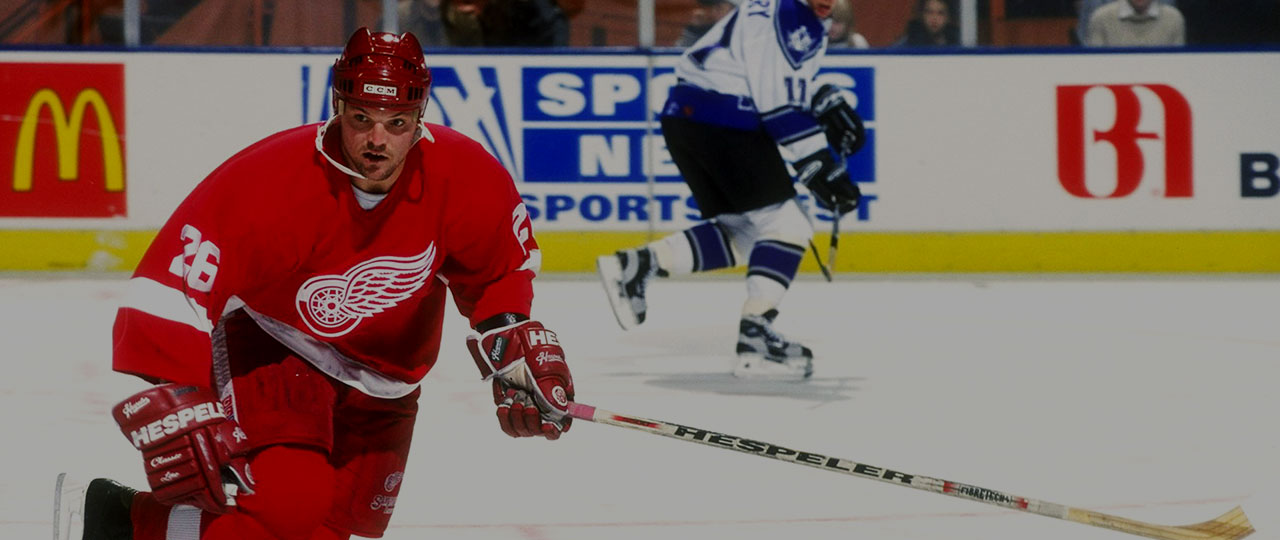

Brendan Shanahan
The 656-Goal Power Forward Who Rewrote the Enforcer Job Description
Brendan Shanahan scored 656 NHL goals and accumulated 2,489 penalty minutes. No one else in history has put up those numbers. Not Gordie Howe. Not Mark Messier. Not Cam Neely. Nobody. Shanahan sits alone at the intersection of skill and violence, and he has been sitting there for almost two decades now.
That is the headline number, the one that goes in the Hockey Hall of Fame plaque. But it undersells the story. Because the man who fought Bob Probert at centre ice and then went home and thought about systemic rule reform is also the man who now runs one of the two most scrutinised hockey operations on the continent. Shanahan did the job. Then he changed the job. Then he changed the business around the job. There are very few hockey lives like it.
This is his story, from a kid in Mimico to the corner office on Bay Street.
Mimico, Ontario: The Making of a Power Forward
Brendan Frederick Shanahan was born on January 23, 1969, in Mimico, a working-class pocket of west Toronto. His parents were Irish immigrants; his father Donal was a firefighter. That detail matters. Firefighter families in Toronto in the 1970s were hockey families by default - the rinks were close, the fees were manageable, and the kids came up playing a certain kind of game. Shanahan played that kind of game his entire life.
He was big early. By peewee he was already taller than most of his teammates, and he had the rare combination of long reach, soft hands, and a genuine appetite for contact. In hockey, you get to choose one or two of those things at a time. Shanahan had all three.
"Brendan was the kid on the rink who scored the goal and then finished his check on the next shift," a former Metro Toronto Hockey League coach remembered. "Most kids pick a lane. Brendan just... didn't. He was going to score, and he was going to hit you, and he was going to do both with a smile on his face."
He left home at 16 to play for the London Knights of the OHL, a franchise that has turned out more NHL talent than almost any junior program in the country. Two seasons in London, and by the spring of 1987 he was one of the most-watched players available in that year's draft.
The 1987 Draft: Second Overall to New Jersey
The 1987 NHL Draft was a deep one. Pierre Turgeon went first overall to Buffalo. The New Jersey Devils, holding the second pick, took Brendan Shanahan. Glen Wesley went third. Wayne McBean went fourth. Joe Sakic went 15th. Look down that draft board thirty-plus years later and you can map almost the entire shape of the 1990s league.
The Devils knew what they were getting - a power forward prototype - but they were not yet the organisation that would go on to win three Stanley Cups. New Jersey in 1987 was a rebuilding franchise with a brutal roster and a fan base still learning the team's name. Shanahan played his first NHL game at 18 and scored his first goal before the end of the month. He was not yet a star, but the runway was obvious.
Four seasons in New Jersey. By the end of it he was a 30-goal scorer with growing penalty-minute totals and a reputation around the league for being the rare young player who wouldn't duck the heavyweights.
St. Louis: The Breakout and the Back-to-Back 50s
In the summer of 1991, Shanahan signed with the St. Louis Blues as a restricted free agent. The compensation package - Scott Stevens going the other way, eventually settled by an arbitrator - was one of the landmark free-agency rulings of the era, and it permanently changed how NHL teams approached RFA offer sheets for the rest of the decade.
On the ice, the move made Shanahan a star. He scored 33 goals his first year in St. Louis, 51 goals in 1992-93, and 52 goals in 1993-94. Back-to-back 50-goal seasons, alongside Brett Hull. The Blues in the early 1990s had one of the most entertaining top-six combinations in the league, and Shanahan was the muscle, the net-front presence, and increasingly the voice in the room.
"Shanny was different from any power forward I'd ever played with," a former Blues teammate said. "Cam Neely was the one everybody compared him to, but Brendan was smarter. He'd set up a goal at 2-1 in the third, then look for a hit. Then drop the gloves at 18:00 if the game needed it. He understood game management at twenty-two years old."
Hartford: The Four Brothers Line and a Short, Strange Season
The summer of 1995 brought the Blues' salary squeeze, and Shanahan was moved to the Hartford Whalers in a deal that sent Chris Pronger to St. Louis. The trade is mostly remembered now for the Pronger half, but in Hartford Shanahan was the new captain, the marquee scorer, and briefly one-third of the Four Brothers line alongside Geoff Sanderson and Andrew Cassels.
The line name came from a mid-season photo op - the three forwards with coach Paul Maurice styled in a mock family portrait, an attempt at branding a struggling market franchise. It didn't save the Whalers; nothing was going to save the Whalers. Shanahan played 81 games in Hartford, scored 44 goals, and by October 1996 he was gone again.
"I don't remember being unhappy in Hartford," Shanahan said years later. "The building was loud when it was full. The teammates were good. But the franchise knew it wasn't going to be there much longer, and it's hard to play in that environment forever."
Detroit 1996-2006: The Dynasty Years
The October 9, 1996 trade is the one that made Brendan Shanahan a champion. Hartford sent Shanahan and Brian Glynn to Detroit; the Red Wings sent Keith Primeau, Paul Coffey, and a first-round pick the other way. At the time the deal was controversial in Detroit - Coffey was a former 100-point defenceman, Primeau was a rising young centre - but Scotty Bowman had identified exactly what his team was missing. A finisher with a heart rate.
Detroit had lost the 1995 Stanley Cup Final to the Devils. They had lost the 1996 Western Conference Final to Colorado - the series that produced the Kris Draper hit and the rivalry that followed. What they needed was a third-line power forward who could kill penalties, score 30-plus goals, and fight Adam Foote at centre ice. What they got was Brendan Shanahan.
1997: The First Cup and the Brawl in Hockeytown
Shanahan's first full season in Detroit ended with a Stanley Cup. On the way there, on March 26, 1997, he participated in the most-discussed brawl of the decade - the Fight Night at the Joe. While Darren McCarty was executing his revenge on Claude Lemieux and Patrick Roy was skating the length of the ice to fight Mike Vernon, Shanahan was trading heavyweight bombs with Adam Foote near the blue line. It was the kind of night that could only happen in 1990s hockey, and Shanahan was in the middle of it.
The Cup followed. Detroit swept Philadelphia. Shanahan scored goals that mattered.
1998 and 2002: Two More Rings
The 1998 Cup came against Washington - more of the same Detroit formula, a long playoff run anchored by the Russian Five, Steve Yzerman's will, and Shanahan showing up in every series. The 2002 Cup, against Carolina, is the one old-timers argue about most. That Detroit roster had nine future Hall of Famers. It should have won more. But it won one, and Shanahan scored the key goal of Game 1, and when Yzerman hoisted the cup in Joe Louis Arena for the third time, Shanahan was right behind him.
The Gordie Howe Hat Trick Record
Somewhere in all this, Shanahan became the all-time leader in Gordie Howe hat tricks: 17 career instances of a goal, an assist, and a fight in the same game. The second-most in history is Rick Tocchet at 10. It is the kind of record that will likely never be broken, because the job has ceased to exist. Nobody in today's NHL is going to score, set up a linemate, and then drop the gloves before the horn. It is a record specifically of an era.
Rangers, New Jersey Redux: The Last Act
By 2006, Detroit was moving on. Shanahan signed with the New York Rangers as a free agent in July of that year and spent two seasons on Broadway. He scored 29 and 23 goals. He played on a line with Jaromir Jagr. He was, by all accounts, a professional. He also - quietly, without fanfare - started paying attention to the structural side of the game in a way that would define his next act.
A brief return to the New Jersey Devils in 2008-09 closed the circle. He played 34 games back with the team that had drafted him 22 years earlier. He announced his retirement in November 2009.
Final numbers: 21 seasons, 1,524 games played, 656 goals, 698 assists, 1,354 points, 2,489 penalty minutes, three Stanley Cups, two All-Star Game MVPs, an Olympic gold medal in 2002, and first-ballot induction to the Hockey Hall of Fame in 2013.
The Shanahan Summit: August 2010
Most retired players go fishing. Shanahan rented a meeting room in Toronto and tried to fix hockey.
The Shanahan Summit, as it became known, was held over two days in August 2010 and brought together a remarkable cross-section of the hockey world - current NHL players, executives, general managers, coaches, referees, broadcasters, and a handful of retired enforcers who had been living with the consequences of the job. The topics on the agenda were deliberate: headshots, supplemental discipline, the role of fighting, goalie equipment, obstruction, and - in what was a radical topic for the era - player mental health.
The Summit had no formal authority. It produced no binding rulings. But the transcripts circulated widely inside the league, and several of the proposals - most notably the push for a dedicated Department of Player Safety and the Rule 48 ban on hits to the head - became NHL policy within eighteen months. It was the kind of moment that changes a career trajectory. Shanahan went from "respected retiree" to "next NHL commissioner candidate" almost overnight.
"The Summit was Brendan's resume," a former colleague said. "He didn't know it at the time. But he had sat everybody in a room and moderated a conversation the league should have been having for twenty years. After that, there was no going back to a normal civilian life."
Department of Player Safety: 2011-2014
In June 2011, the NHL formalised what the Summit had helped shape. The Department of Player Safety was created, and Brendan Shanahan was appointed its inaugural Senior Vice President. For three seasons he was the man who issued supplemental discipline - the suspensions, the fines, the video explanations that became mandatory viewing for every hockey fan.
The Shanahan video era changed the culture of NHL discipline. Instead of cryptic press releases, the league started publishing short videos in which Shanahan - in a charcoal suit, framed against a league-logo backdrop - explained exactly what the offending hit was, what rule it violated, what precedent was being followed, and what the suspension length was. It was transparent in a way the NHL had never been before.
It did not make him popular. Every suspension made one fan base furious. Every non-suspension made another fan base furious. But three years in, the numbers were moving. Headshot-related injuries were down. Illegal checks to the head were drawing longer suspensions. The culture was shifting.
"He was the perfect choice for that job and also exactly the wrong choice, if that makes sense," a former NHL executive said. "Perfect because players respected him - he had fought everyone in the league and scored 656 goals. Wrong because he was the guy being asked to take the stick away from his old teammates. He knew what that felt like. I think it wore on him."
Toronto Maple Leafs: April 2014 to Present
On April 11, 2014, the Maple Leafs announced Brendan Shanahan as team president. For a franchise that had not won a Stanley Cup since 1967 and had just missed the playoffs after a late-season collapse, the hire was an attempt to import executive credibility directly from the league office.
Shanahan's first move was to hire Mike Babcock. His second was to hire Lou Lamoriello. His third was to tear the roster down to the studs and commit, publicly, to a multi-year rebuild. The Leafs finished last in 2015-16, won the draft lottery, and selected Auston Matthews first overall. The Mitch Marner pick (fourth overall, 2015) was already on the books. William Nylander had been drafted the summer before Shanahan arrived but was developed under his watch.
The rebuild produced nine consecutive playoff appearances from 2017 onward, a stretch of regular-season success without parallel in the post-1967 history of the franchise. It also produced a run of first-round playoff exits that became a national psychological event every spring. The 2023 first-round win over Tampa Bay - the first Leafs playoff series victory since 2004 - was received in Toronto the way most cities receive championships.
Shanahan's Leafs tenure is the subject of more hockey content per square inch than any executive job in the sport. His philosophy has been consistent: build through the draft, pay your stars, trust the long game, and do not overreact to individual playoff series. Whether history judges that philosophy as a success or a failure depends entirely on what happens in the next two or three springs.
Shanahan on Fighting: The Evolution of a View
One of the more interesting arcs of Shanahan's career is his public position on fighting. As a player, he was an enthusiastic participant - 17 Gordie Howe hat tricks do not happen by accident. As a Department of Player Safety executive, he was publicly neutral, arguing that fighting should be regulated rather than banned. As Leafs president, he has been notably silent on the topic, presiding over a roster that has occasionally had to scratch the idea of a designated heavyweight altogether.
His position, to the extent he has articulated it, is that the role has evolved and that the modern game has less space for pure fighters. He has been careful not to criticise former peers - his public respect for Tie Domi, Bob Probert, and others from his playing era is genuine - but the roster decisions he oversees tell their own story.
Brendan Shanahan: Quick Facts
| Full Name | Brendan Frederick Shanahan |
| Born | January 23, 1969 - Mimico, Ontario, Canada |
| Position | Left Wing |
| Height/Weight | 6'3" / 220 lbs |
| NHL Teams | New Jersey (1987-91), St. Louis (1991-95), Hartford (1995-96), Detroit (1996-2006), NY Rangers (2006-08), New Jersey (2008-09) |
| NHL Draft | 1987, Round 1, 2nd overall (New Jersey) |
| Career Stats | 1,524 GP, 656 G, 698 A, 1,354 PTS |
| Penalty Minutes | 2,489 |
| Stanley Cups | 3 (1997, 1998, 2002 - Detroit) |
| Olympic Gold | 2002 Salt Lake City (Team Canada) |
| Gordie Howe Hat Tricks | 17 (all-time record) |
| Hall of Fame | Inducted 2013 (first ballot) |
| NHL Executive Roles | SVP Player Safety (2011-14), Toronto Maple Leafs President (2014-present) |
Frequently Asked Questions About Brendan Shanahan
How many goals and penalty minutes did Brendan Shanahan finish with?
Brendan Shanahan retired with 656 goals and 2,489 penalty minutes across 21 NHL seasons. He is the only player in league history with more than 600 goals and more than 2,000 penalty minutes, and he holds the all-time record for Gordie Howe hat tricks with 17 - a goal, an assist, and a fight in the same game, a record unlikely ever to be broken given how fighting has declined in the modern NHL.
How many Stanley Cups did Brendan Shanahan win?
Shanahan won three Stanley Cups, all with the Detroit Red Wings: 1997, 1998, and 2002. He was acquired by Detroit in the October 9, 1996 trade that sent Keith Primeau, Paul Coffey, and a first-round pick to Hartford. Shanahan became the final piece of the late-1990s Red Wings dynasty, playing alongside Steve Yzerman, Nicklas Lidstrom, Sergei Fedorov, and the Russian Five.
What was the Shanahan Summit?
The Shanahan Summit was a two-day gathering Brendan Shanahan organised in Toronto in August 2010, bringing together NHL players, executives, coaches, and officials to openly debate rule changes, head-injury protocols, supplemental discipline, and the future of the enforcer role. Several key reforms - including Rule 48 (the ban on hits to the head) and the creation of the Department of Player Safety - flowed directly out of those meetings, and the Summit is widely credited with jump-starting the NHL's modern player-safety conversation.
When did Brendan Shanahan become President of the Toronto Maple Leafs?
Brendan Shanahan was named President of the Toronto Maple Leafs on April 11, 2014, after stepping down from his role as the NHL's Senior Vice President of Player Safety. He oversaw a complete teardown of the Leafs roster and presided over the draft selections of William Nylander, Mitch Marner, and Auston Matthews - the core that has returned Toronto to annual playoff contention for the better part of a decade.
Was Brendan Shanahan an enforcer or a goal scorer?
He was genuinely both, which is what makes his career historically unique. Shanahan scored 50 goals in back-to-back seasons with St. Louis (1992-93 and 1993-94), finished with 656 career goals (13th all-time at retirement), and at the same time willingly fought heavyweights including Bob Probert, Tie Domi, Marty McSorley, and Adam Foote. He is considered the prototype NHL power forward of his era.
Is Brendan Shanahan in the Hockey Hall of Fame?
Yes. Brendan Shanahan was inducted into the Hockey Hall of Fame in 2013 in his first year of eligibility, alongside Chris Chelios, Scott Niedermayer, and Geraldine Heaney. He was a first-ballot selection - a reflection of both his 656 goals and his broader influence on the game through the Shanahan Summit and his tenure running the Department of Player Safety.
In 2026: Still Building Toronto
Brendan Shanahan remains President of the Toronto Maple Leafs in the 2025-26 season. The roster around Matthews, Marner, and Nylander continues to evolve. The annual Toronto playoff psychodrama continues to unfold. Somewhere in that same city, the Probert and Domi names still get spoken with reverence at rinks and pubs, and Shanahan - who fought both of them - sits in an office on Bay Street deciding which 21-year-old defenceman to call up. The arc from Mimico to Bay Street is about as Canadian a hockey story as it is possible to write.
Related Stories
- Bob Probert: Hockey's Toughest Enforcer
- Tie Domi: The Albanian Assassin
- The Greatest Hockey Fights in NHL History
- How Enforcers Have Evolved in Hockey
- The Gordie Howe Hat Trick: Goal, Assist, Fight
- Red Wings vs. Avalanche: Hockey's Greatest Rivalry
- The Greatest NHL Rivalries of All Time
- The Bruise Brothers: Kocur and Probert
Love Hockey? Try Hockey Betting
Think you know the game better than the oddsmakers? Put your hockey knowledge to work with Canada's best sportsbooks.