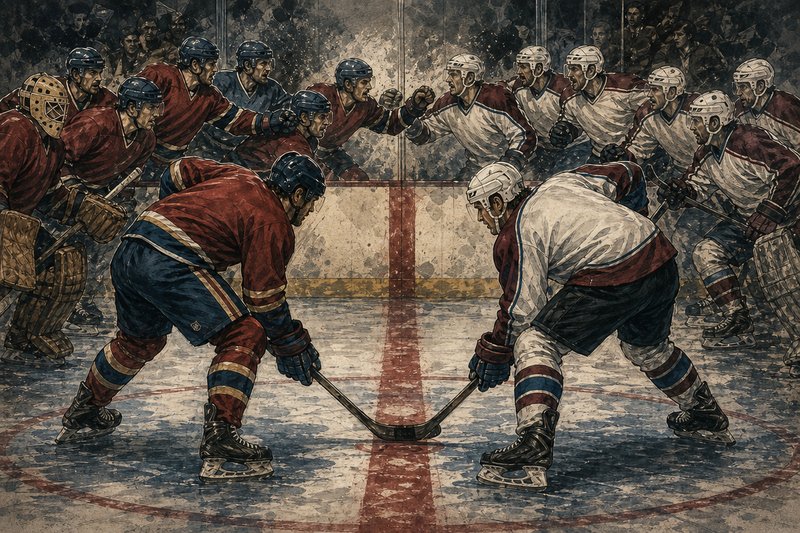
Red Wings vs. Avalanche
Blood, Revenge, and the Greatest Rivalry in Hockey History
There have been great rivalries in hockey. Canadiens and Bruins. Flyers and Rangers. Oilers and Flames. But none of them--not a single one--reached the level of pure, seething, white-hot hatred that defined the Detroit Red Wings and the Colorado Avalanche from 1996 to 2002. This wasn't a rivalry built on geography or tradition. It was built on broken bones, spilled blood, and a desire for vengeance so consuming it transformed two championship teams into armies willing to destroy each other.
This is the story of how one dirty hit ignited the most violent feud in modern hockey, and how the fire burned for nearly a decade before the last embers finally died.
The Hit That Started It All
May 29, 1996. Game 6 of the Western Conference Finals. The Colorado Avalanche were rolling, about to close out a Detroit Red Wings team that had won a record 62 games in the regular season. The series was already tense, but what happened in the third period turned tension into war.
Kris Draper, Detroit's scrappy checking center, was pursuing the puck along the boards. Claude Lemieux, Colorado's agitating right winger, came from behind and drove Draper face-first into the dasher boards. The impact was sickening. Draper crumpled to the ice, his face a mask of blood.
The damage: a broken jaw, shattered cheekbone, broken nose, and a concussion. Draper's face was so badly mangled that his mother didn't recognize him in the hospital.
"I looked at Kris in that hospital bed and I couldn't believe what I was seeing," said Darren McCarty, Draper's closest friend on the team. "His face was just... destroyed. And Lemieux got a slap on the wrist. That's when I knew this wasn't over. Not by a long shot."
Lemieux received a two-game suspension. The Red Wings considered it an insult. The Avalanche went on to win the Stanley Cup. Detroit was left with nothing but rage and a vow that they would have their reckoning.
The Long Wait for Revenge
Through the summer and fall of 1996, the Red Wings seethed. Kris Draper had his jaw wired shut for weeks. McCarty carried a pair of pliers to every team meal so he could help Draper pry open his wired jaw enough to eat. The team watched the Avalanche celebrate their championship and waited.
"That whole offseason, it was all anyone talked about," recalled a Detroit player from that era. "Not the Cup. Not next season's strategy. Just Lemieux. Just what we were going to do when we got our chance."
Scotty Bowman, Detroit's legendary coach, knew what his team needed. He didn't try to calm them down. He didn't preach restraint. He circled March 26, 1997--the next meeting with Colorado at Joe Louis Arena--and let the hate build.
March 26, 1997: Fight Night at The Joe
The atmosphere inside Joe Louis Arena that night was electric and dangerous. The 19,983 fans knew what was coming. The players knew what was coming. Even the officials must have sensed it--the ice practically vibrated with barely contained violence.
The game started, and for the first few minutes, it was hockey. But everyone was waiting. The tension built like pressure behind a dam. And then, at 18:22 of the first period, the dam broke.
McCarty vs. Lemieux: The Reckoning
Darren McCarty found Claude Lemieux near the Colorado bench. There were no words exchanged. No invitation to dance. McCarty simply grabbed Lemieux and started throwing punches with the fury of a man who had spent ten months planning this exact moment.
Lemieux turtled--curling into a ball on the ice, covering his head with his arms while McCarty rained down blows. It was not a fight so much as an execution. McCarty hit Lemieux again and again, dragging him across the ice, his fists connecting with Lemieux's face and head while the crowd at The Joe roared with savage approval.
"I'd been thinking about that moment every single day," McCarty said later. "Every time I saw Kris trying to eat with those pliers. Every time I thought about what Lemieux did and how the league barely punished him. When I finally got my hands on him, I wasn't going to stop until someone made me."
The officials eventually pulled McCarty off, but the message had been delivered. The debt was paid--in blood.
Roy vs. Vernon: Goalies at War
But the night was far from over. As fights erupted across the ice--nine separate brawls would occur before the final horn--the most iconic image of the evening was still to come.
Patrick Roy, Colorado's fiercely competitive goaltender and one of the greatest to ever play the position, skated the full length of the ice from his crease. His target: Detroit goalie Mike Vernon, who was waiting for him at center ice.
The two goalies--both wearing 40-plus pounds of equipment--threw haymakers at each other while the crowd went berserk. Roy, all fury and wild swings, against Vernon, compact and game. It was absurd and magnificent. Two men whose job was to stop pucks, throwing bare-knuckle punches under the bright lights at center ice while chaos reigned around them.
"When I saw Roy coming, I thought, 'Okay, here we go,'" Vernon recalled. "You don't back down from that. Not in that building. Not on that night."
Vernon got the better of the exchange, landing several clean shots that bloodied Roy's face. The Detroit faithful erupted. Their goalie had beaten the great Patrick Roy in a fistfight. It was almost too perfect.
The Full Card
The other brawls that night included:
- Brendan Shanahan vs. Adam Foote -- Two heavyweights throwing bombs
- Kirk Maltby vs. Claude Lemieux -- More punishment for the Avalanche agitator
- Aaron Ward vs. Brent Severyn -- Willing combatants on both sides
- Jamie Pushor vs. Rene Corbet -- Even the depth players joined in
The game produced 148 penalty minutes and featured some of the most violent hockey ever broadcast on national television. But it wasn't over yet.
McCarty's Overtime Winner
With the score tied in overtime, Darren McCarty--the same man who had pummeled Claude Lemieux hours earlier--collected the puck, deked around Avalanche defenseman Uwe Krupp, and tucked it past Patrick Roy for the game-winning goal.
Joe Louis Arena exploded. McCarty raised his arms, his knuckles still swollen from the Lemieux beating, and celebrated what had become the most complete performance by a hockey player in a single game: enforcer and assassin, fighter and finisher.
"That goal was the cherry on top," said a teammate. "McCarty beat the hell out of Lemieux, and then he beat Roy too--with a puck this time. You couldn't write a better script."
The Backstory: How Two Dynasties Collided
The rivalry wasn't born out of nothing. It was the product of two organizations stacked with future Hall of Famers who kept running into each other at the most important moments of the season.
Detroit's Loaded Roster
The Red Wings of this era were staggeringly talented:
- Steve Yzerman -- The Captain, one of the greatest leaders in hockey history
- Nicklas Lidstrom -- Perhaps the best defenseman to ever play the game
- Sergei Fedorov -- Dazzling Russian talent, capable of taking over any game
- Brendan Shanahan -- Power forward who could score and fight
- Igor Larionov -- The Professor, a genius with the puck
- Darren McCarty -- The team's heart, soul, and fists
- Chris Osgood / Mike Vernon -- Reliable goaltending
Behind the bench, Scotty Bowman--the winningest coach in NHL history--orchestrated everything with a master tactician's precision.
Colorado's Murderers' Row
The Avalanche were equally loaded:
- Joe Sakic -- Quiet, lethal, and arguably the purest goal scorer of his generation
- Peter Forsberg -- The most physically dominant forward in the game
- Patrick Roy -- A competitor so fierce he would fight goalies at center ice
- Rob Blake -- A bruising, Norris Trophy-winning defenseman
- Adam Foote -- Tough as iron, the backbone of the blue line
- Claude Lemieux -- The most hated man in Detroit, but an elite playoff performer
- Milan Hejduk -- Underrated Czech sniper
These two rosters combined for five Stanley Cups between 1996 and 2002. They were the two best teams in hockey, and they hated each other with a passion that transcended sport.
Five Playoff Series: A Decade of War
1996 Western Conference Finals (Colorado wins 4-2)
The series that started everything. Detroit had won 62 regular season games, a record that stood for nearly two decades. They were heavy favorites. Colorado, newly relocated from Quebec City, were supposed to be the underdog.
Instead, the Avalanche won in six games. The Lemieux hit on Draper in Game 6 was the exclamation point--and the declaration of war.
1997 Western Conference Finals (Colorado wins 4-2)
The rematch came after the March 26 brawl, and the bad blood was at its peak. Colorado won again, but Detroit was building something. The Red Wings went on to sweep the Philadelphia Flyers in the Stanley Cup Final for their first championship in 42 years.
The Cup win validated Detroit's pain. They had suffered at Colorado's hands, but they had emerged stronger. McCarty, fittingly, scored the clinching goal in the Cup Final.
1999 Western Conference Semifinals (Colorado wins 4-2)
More heartbreak for Detroit. The teams met for a third consecutive playoff showdown, and again Colorado prevailed. Patrick Roy was a wall, and the Avalanche's depth proved too much.
2000 Western Conference Semifinals (Colorado wins 4-1)
The most lopsided series of the rivalry. Colorado was dominant, and Detroit looked like an aging roster. Many wondered if the Red Wings' window had closed.
2002 Western Conference Finals (Detroit wins 4-3)
This was it. The masterpiece. Widely regarded as the greatest playoff series in modern NHL history, the 2002 Western Conference Finals had everything: overtime games, goaltending duels, devastating hits, and a Game 7 that left both teams and their fans utterly drained.
Detroit finally exorcised their demons, winning Game 7 at home. Dominik Hasek was brilliant in net. Yzerman, playing on essentially one leg due to a shattered knee, was superhuman. The Red Wings went on to win the Stanley Cup, their third in six years.
"Beating Colorado in 2002 meant more than winning the Cup," admitted one Detroit player. "I know that sounds crazy. But we had to get past them. We had to prove we could. And when we did, it felt like the weight of the world came off our shoulders."
The Characters Who Made the Rivalry
Patrick Roy: The Fiercest Competitor
Patrick Roy was many things--a Hall of Fame goaltender, a four-time Stanley Cup champion, a man with the reflexes of a cat and the temperament of a cornered wolverine. In the context of this rivalry, he was Colorado's emotional engine.
Roy didn't just play against Detroit. He warred against them. His fight with Mike Vernon became the rivalry's most iconic image, but it was his day-to-day competitiveness that set the tone. Roy talked trash. He stared down opponents. He made saves that seemed impossible and then smirked at the shooter.
"Roy was the best goalie I ever played against," said a Detroit forward. "And the most annoying. He'd rob you with an incredible save and then wink at you. It made you want to put your stick through the net."
Darren McCarty: Detroit's Avenger
McCarty was never the most skilled player on the Red Wings roster. He wasn't close. But in the context of this rivalry, he was the most important player on either team. His beating of Lemieux and overtime winner on March 26, 1997, made him a folk hero in Detroit--a status he maintains to this day.
McCarty was also Kris Draper's best friend. He served as best man at Draper's wedding. The bond between the two men--forged in the aftermath of Lemieux's hit--was one of the rivalry's most human elements.
"Mac didn't just fight for the team," Draper has said. "He fought for me. Personally. He saw what happened to my face, and he made it his mission. That's not just a teammate. That's a brother."
Claude Lemieux: The Villain
Claude Lemieux was one of the most fascinating figures in hockey history. A four-time Stanley Cup champion and Conn Smythe Trophy winner, Lemieux was an elite playoff performer whose combination of skill and agitation made him uniquely effective--and universally despised by opponents.
In Detroit, Lemieux's name was spoken with a venom reserved for few athletes in any sport. The hit on Draper was considered unforgivable. His turtling when McCarty came for revenge only deepened the contempt.
"Lemieux knew exactly what he was doing every time he stepped on the ice," said one observer. "He'd get under your skin, he'd take cheap shots, and then he'd score the goal that eliminated you. He was brilliant at his job. You just hated him for it."
Steve Yzerman and Joe Sakic: The Captains
At the center of the rivalry were two of the most respected captains in NHL history. Steve Yzerman and Joe Sakic were similar players--quiet leaders who let their performance speak, genuine sportsmen who respected each other even as their teams tried to tear each other apart.
The image of Sakic handing the Stanley Cup to Yzerman's longtime teammate Ray Bourque in 2001, and then Yzerman and the Red Wings ending Sakic's hopes in 2002, captured the bittersweet nature of a rivalry between two organizations that, at their core, admired each other's excellence.
The Kris Draper Story
Kris Draper's face healed, but the scars remained--both physical and emotional. He required extensive reconstructive surgery. The broken jaw had to be wired shut for weeks, during which time McCarty would sit with him at team meals, using pliers to help his friend eat.
"That image--McCarty with the pliers--tells you everything about what this team was," said a longtime Detroit observer. "They weren't just teammates. They were family. And when someone hurts your family, you don't forget."
Draper went on to have an excellent career, winning four Stanley Cups with the Red Wings and the Frank J. Selke Trophy as the league's best defensive forward in 2004. He became a symbol of resilience, proof that what doesn't kill you can indeed make you stronger.
The friendship between Draper and McCarty endured long after both retired. McCarty was best man at Draper's wedding, and the two remain close to this day.
The 2002 Series: The Greatest Ever Played
If the March 1997 brawl was the rivalry's most violent chapter, the 2002 Western Conference Finals was its most beautiful. By this point, both teams had matured. The hatred had evolved into something closer to fierce, grudging respect. The hockey was breathtaking.
Detroit had acquired Dominik Hasek, the Dominator, giving them an elite goaltender to match Patrick Roy. Colorado had added Rob Blake and added depth. Both teams knew this might be the last great battle between their cores.
The series went seven games:
- Game 1: Colorado wins 5-2 at home
- Game 2: Detroit evens it 5-3
- Game 3: Colorado takes a 2-1 series lead
- Game 4: Detroit fights back to tie the series
- Game 5: Colorado goes up 3-2 with a gutsy win
- Game 6: Detroit forces Game 7 behind Hasek's brilliance
- Game 7: Detroit wins at home in a classic, clinching the series
"That was the best hockey I ever played in, and I've been around a long time," said one participant. "Every shift mattered. Every goal felt like life and death. You looked across the ice and you saw Hall of Famers, guys who had won multiple Cups, and they were all playing like it was their last game on earth."
Yzerman, playing through excruciating pain from a knee injury that would have sidelined most players, was magnificent. His determination in that series remains one of the greatest individual performances in playoff history.
Detroit went on to beat Carolina in the Stanley Cup Final, and the image of Yzerman hoisting the Cup--his third--was the perfect culmination of a decade-long journey.
The Rivalry's Legacy
The Red Wings-Avalanche rivalry faded after 2002. Realignment moved the teams to different conferences. Roy retired. The rosters turned over. But the memories endure, vivid and violent, in the minds of everyone who witnessed them.
The rivalry produced some staggering combined numbers:
- 5 Stanley Cups between the two teams (3 Detroit, 2 Colorado)
- 5 playoff series between 1996 and 2002
- Multiple Hall of Famers on each roster (Yzerman, Lidstrom, Fedorov, Shanahan, Roy, Sakic, Forsberg, Bourque, Hasek, Blake)
- The most watched regular season game in ESPN history at the time (March 26, 1997)
The 2022 Reconciliation
In 2022, something unexpected happened. Darren McCarty and Claude Lemieux--the two men whose personal war defined the rivalry's most violent chapter--met at a bar and made peace.
McCarty has spoken openly about the encounter. They shared a drink. They talked about the old days. They acknowledged what had happened between them and moved on. After more than 25 years of animosity, the two former enemies buried the hatchet.
"It was time," McCarty said. "We're both older. We've both been through things that put hockey in perspective. Claude and I will never be best friends, but we can respect each other. We were both doing our jobs. It just happened that our jobs involved me trying to rearrange his face."
The reconciliation was, in its own way, the perfect ending to the greatest rivalry in hockey history. Not with another fight, but with a handshake and a beer.
What Made This Rivalry Different
There have been intense rivalries throughout NHL history. The history of hockey fights is long and storied. But what set Detroit-Colorado apart was the convergence of factors that may never align again:
- Elite talent: Both rosters were loaded with generational players
- Real hatred: This wasn't manufactured drama--the players genuinely despised each other
- High stakes: They met repeatedly in the playoffs when everything was on the line
- The enforcer era: This was the last great rivalry where fighting and physicality were central to the story
- Perfect villains and heroes: McCarty, Lemieux, Roy, Yzerman--every character played their role flawlessly
Modern hockey, with its emphasis on speed and skill over toughness, will likely never produce another rivalry quite like this one. The era of enforcers like Bob Probert and the Bruise Brothers was already waning when Detroit and Colorado went to war. The rivalry was, in a sense, the final great expression of old-time hockey's brutal code--played out at the highest possible level, by the best players of their generation.
And for those of us who watched it unfold, from Lemieux's hit to McCarty's revenge to the epic 2002 series, it remains the most compelling drama hockey has ever produced. Not because of the violence alone, though there was plenty of that. But because beneath the blood and the broken bones, there was an almost Shakespearean arc: injury, vengeance, redemption, and ultimately, reconciliation.
As Tie Domi once said about the nature of hockey grudges: "You play hard, you hit hard, you fight--and then, eventually, life teaches you that it's just a game. A beautiful, violent, incredible game."
Red Wings-Avalanche Rivalry: Quick Facts
| Rivalry Period | 1996-2002 |
| Playoff Series | 5 (Colorado won 4, Detroit won 1) |
| Combined Stanley Cups | 5 (Detroit 3, Colorado 2) |
| The Hit | May 29, 1996 -- Lemieux on Draper |
| Fight Night at The Joe | March 26, 1997 -- 9 fights, 148 PIM |
| Greatest Series | 2002 Western Conference Finals (Detroit wins 4-3) |
| Hall of Famers Involved | Yzerman, Lidstrom, Fedorov, Shanahan, Roy, Sakic, Forsberg, Bourque, Hasek, Blake |
| Reconciliation | 2022 -- McCarty and Lemieux bury the hatchet |
Frequently Asked Questions
What started the Red Wings-Avalanche rivalry?
The rivalry ignited on May 29, 1996, when Colorado's Claude Lemieux hit Detroit's Kris Draper face-first into the dasher boards during Game 6 of the Western Conference Finals. Draper suffered a broken jaw, shattered cheekbone, and broken nose. The Red Wings felt the hit was dirty and the two-game suspension insufficient, setting the stage for violent retribution.
What happened during the Brawl in Hockeytown on March 26, 1997?
On March 26, 1997, the Red Wings and Avalanche engaged in one of the most violent games in NHL history at Joe Louis Arena. There were 9 fights, including Darren McCarty pummeling Claude Lemieux, goalie Patrick Roy fighting Mike Vernon at center ice, and Brendan Shanahan fighting Adam Foote. McCarty then scored the overtime winner to cap the night.
How many times did the Red Wings and Avalanche meet in the playoffs?
The teams met five times between 1996 and 2002. Colorado won the first four series (1996, 1997, 1999, 2000) before Detroit finally broke through in the 2002 Western Conference Finals, winning in seven games in what is widely regarded as the greatest playoff series in modern NHL history.
Did Darren McCarty and Claude Lemieux ever reconcile?
Yes. In 2022, McCarty and Lemieux met at a bar and buried the hatchet after more than 25 years of animosity. McCarty has spoken publicly about the encounter, saying it was time to move on and that both men could respect what the other brought to the rivalry.
Who won more Stanley Cups during the rivalry, Detroit or Colorado?
Detroit won three Stanley Cups (1997, 1998, 2002) while Colorado won two (1996, 2001) during the rivalry era. Combined, the two franchises claimed five of seven possible championships between 1996 and 2002.
As of 2025–26, both franchises are in different stages of rebuilding. The Colorado Avalanche — who won the Stanley Cup in 2022 under Nathan MacKinnon — remain legitimate contenders. The Detroit Red Wings are developing young talent under coach Derek Lalonde. The rivalry's fires have cooled in the modern era, but no fan who watched the games of the late 1990s has forgotten them. The Claude Lemieux hit, the Fight Night at the Joe, McCarty's overtime winner — these moments are permanently embedded in hockey history.
Related Stories- Bob Probert: The Life and Death of Hockey's Toughest Enforcer
- The 30 Greatest Hockey Fights of All Time
- How Enforcers Have Evolved in Hockey
- The Bruise Brothers: Kocur and Probert
- Tie Domi: The Albanian Assassin
- The 10 Most Brutal Hockey Brawls in NHL History
Love Hockey? Try Hockey Betting
Think you know the game better than the oddsmakers? Put your hockey knowledge to work with Canada's best sportsbooks.