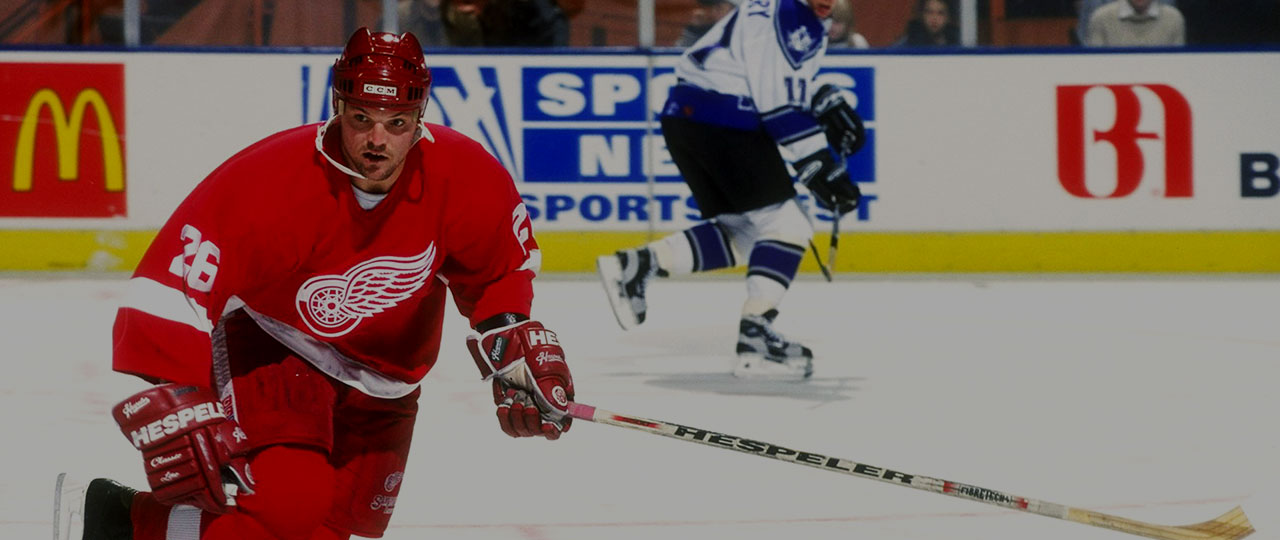

Heavyweight · The 1970s · Philadelphia Flyers
The Hammer set the template for the modern enforcer. His 472 PIM in 1974-75 is still the single-season NHL record and will almost certainly never be broken. Schultz wasn't the biggest man in the league, but he was the willingest — the bridge between old-school rough stuff and the organized goon squad era the Flyers perfected.
Dave Schultz operated at the heavyweight tier — the tier where matchups were scheduled before the opening face-off and nobody needed a reason to drop the gloves. The NHL career numbers tell the short version: 535 regular-season games, 2,292 penalty minutes, 79 goals, 200 points. That is 4.28 penalty minutes per game across a full NHL life — a workload that, in today's game, would end most careers inside three seasons.
The bulk of his work was done in a Philadelphia Flyers sweater, a franchise identity that defined him the way he defined the franchise. The 1970s was the environment in which his style made sense — a league where the rules, the rinks, and the roster sizes all allowed a role player to build an entire career out of a specific kind of willingness.
The 1970s heavyweight was a pioneer by default — the position was still being invented, the rules still being written, and the rinks still being built to reward a certain kind of physicality.
A penalty-minute rate of 4.28 per game is deep into the designated-fighter tier. In the The 1970s environment, that number meant the coach was putting Dave Schultz on the ice for short, high-leverage shifts with a clear mandate.
In a Philadelphia Flyers jersey, that identity was sharpened by franchise history. Every organization has a different tolerance for the role and a different set of expectations for the man who plays it, and Dave Schultz's career cannot be separated from the building in which he played it.
That context matters because the enforcer conversation has collapsed into a few oversimplified arguments — pro-fighting vs. anti-fighting, goon vs. artist — that ignore the actual craft of the job. Dave Schultz is one of fewer than a hundred men who ever did this work at NHL level for long enough to learn it. The details of how he did it — the opponents he matched up with, the years he was on the ice, the team that employed him — are the only way to take the position seriously.
NHL regular-season totals, sortable by column. Minor-league and playoff numbers are excluded for clarity.
| Season | Team | GP | G | A | PTS | PIM |
|---|---|---|---|---|---|---|
| 1971-1972 | Philadelphia Flyers | 1 | 0 | 0 | 0 | 0 |
| 1972-1973 | Philadelphia Flyers | 76 | 9 | 12 | 21 | 259 |
| 1972-1973 | Philadelphia Flyers | 11 | 1 | 0 | 1 | 51 |
| 1973-1974 | Philadelphia Flyers | 73 | 20 | 16 | 36 | 348 |
| 1973-1974 | Philadelphia Flyers | 17 | 2 | 4 | 6 | 139 |
| 1974-1975 | Philadelphia Flyers | 76 | 9 | 17 | 26 | 472 |
| 1974-1975 | Philadelphia Flyers | 17 | 2 | 3 | 5 | 83 |
| 1975-1976 | Philadelphia Flyers | 71 | 13 | 19 | 32 | 307 |
| 1975-1976 | Philadelphia Flyers | 16 | 2 | 2 | 4 | 90 |
| 1976-1977 | Los Angeles Kings | 76 | 10 | 20 | 30 | 232 |
| 1976-1977 | Los Angeles Kings | 9 | 1 | 1 | 2 | 45 |
| 1977-1978 | Los Angeles Kings | 8 | 2 | 0 | 2 | 27 |
| 1977-1978 | Pittsburgh Penguins | 66 | 9 | 25 | 34 | 378 |
| 1978-1979 | Pittsburgh Penguins | 47 | 4 | 9 | 13 | 155 |
| 1978-1979 | Buffalo Sabres | 28 | 2 | 3 | 5 | 86 |
| 1978-1979 | Buffalo Sabres | 3 | 0 | 2 | 2 | 4 |
| 1979-1980 | Buffalo Sabres | 13 | 1 | 0 | 1 | 28 |
The men Dave Schultz faced most often on the end of a dropped pair of gloves. Opponents linked below have their own profiles in the encyclopedia.
The 1970s were the crucible in which the modern enforcer was forged. The Philadelphia Flyers' back-to-back Cups in 1974 and 1975 proved that a line full of willing combatants could wear down teams with more skill. Every franchise in the league spent the back half of the decade trying to replicate the Broad Street Bullies template — Tiger Williams in Toronto, Terry O'Reilly in Boston, John Ferguson's last years in Montreal. Penalty-minute totals that would get a player suspended for a season today were a Tuesday night in 1976. The rules were looser, the ice was smaller in every meaningful way, and the nightly bounties on skill players were real.
Dave Schultz is still with us, and in many cases still part of the hockey conversation — as a broadcaster, a coach, a league executive, or simply a voice who will pick up the phone when a younger player needs to ask what the job actually takes. The surviving enforcers of the The 1970s have, collectively, become hockey's most honest self-critics about what the role cost and what parts of it the game was right to retire.