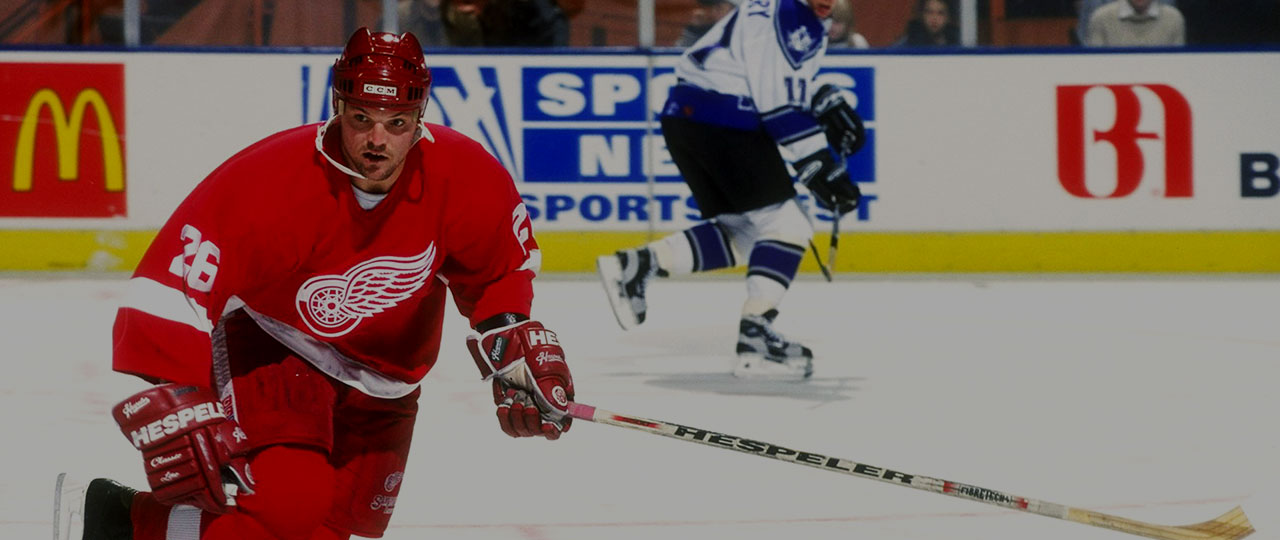

Heavyweight · The 1970s · Montreal Canadiens
Fergie. The prototype. 1,216 penalty minutes across eight seasons before the league kept close track, and five Cups with the Canadiens. Coaches and GMs from the 1970s onward — Scotty Bowman included — cited Ferguson as the player who proved you could win a championship with a designated tough guy.
John Ferguson Sr. operated at the heavyweight tier — the tier where matchups were scheduled before the opening face-off and nobody needed a reason to drop the gloves. The NHL career numbers tell the short version: 500 regular-season games, 1,216 penalty minutes, 145 goals, 303 points. That is 2.43 penalty minutes per game, in an era when the league recorded far less of what happened on the ice than it does now.
The bulk of his work was done in a Montreal Canadiens sweater, a franchise identity that defined him the way he defined the franchise. The 1970s was the environment in which his style made sense — a league where the rules, the rinks, and the roster sizes all allowed a role player to build an entire career out of a specific kind of willingness.
John Ferguson Sr. is no longer with us. The section further down the page on his legacy covers the circumstances and the research that has come out of the post-career health conversations the enforcer generation continues to drive.
The 1970s heavyweight was a pioneer by default — the position was still being invented, the rules still being written, and the rinks still being built to reward a certain kind of physicality.
The complete per-game workload numbers for John Ferguson Sr. don't survive cleanly in the modern NHL API — his career predates the digital era's full box-score record. The editorial consensus from teammates and contemporaries fills in what the database loses.
In a Montreal Canadiens jersey, that identity was sharpened by franchise history. Every organization has a different tolerance for the role and a different set of expectations for the man who plays it, and John Ferguson Sr.'s career cannot be separated from the building in which he played it.
That context matters because the enforcer conversation has collapsed into a few oversimplified arguments — pro-fighting vs. anti-fighting, goon vs. artist — that ignore the actual craft of the job. John Ferguson Sr. is one of fewer than a hundred men who ever did this work at NHL level for long enough to learn it. The details of how he did it — the opponents he matched up with, the years he was on the ice, the team that employed him — are the only way to take the position seriously.
NHL regular-season totals, sortable by column. Minor-league and playoff numbers are excluded for clarity.
| Season | Team | GP | G | A | PTS | PIM |
|---|---|---|---|---|---|---|
| 1963-1964 | Montréal Canadiens | 59 | 18 | 27 | 45 | 125 |
| 1964-1965 | Montréal Canadiens | 69 | 17 | 27 | 44 | 156 |
| 1965-1966 | Montréal Canadiens | 65 | 11 | 14 | 25 | 153 |
| 1966-1967 | Montréal Canadiens | 67 | 20 | 22 | 42 | 177 |
| 1967-1968 | Montréal Canadiens | 61 | 15 | 18 | 33 | 117 |
| 1968-1969 | Montréal Canadiens | 71 | 29 | 23 | 52 | 185 |
| 1969-1970 | Montréal Canadiens | 48 | 19 | 13 | 32 | 141 |
| 1970-1971 | Montréal Canadiens | 60 | 16 | 14 | 30 | 162 |
The men John Ferguson Sr. faced most often on the end of a dropped pair of gloves. Opponents linked below have their own profiles in the encyclopedia.
The 1970s were the crucible in which the modern enforcer was forged. The Philadelphia Flyers' back-to-back Cups in 1974 and 1975 proved that a line full of willing combatants could wear down teams with more skill. Every franchise in the league spent the back half of the decade trying to replicate the Broad Street Bullies template — Tiger Williams in Toronto, Terry O'Reilly in Boston, John Ferguson's last years in Montreal. Penalty-minute totals that would get a player suspended for a season today were a Tuesday night in 1976. The rules were looser, the ice was smaller in every meaningful way, and the nightly bounties on skill players were real.
John Ferguson Sr. passed away in 2007. The post-career conversation around enforcers of his generation has been unforgiving — substance abuse, chronic pain, concussion sequelae, and the quiet retirements of men who were never meant to play 15 seasons at that tempo. His legacy is both the highlight reel and the cautionary tale, and Slapshot Diaries exists in part to make sure both halves are remembered accurately.