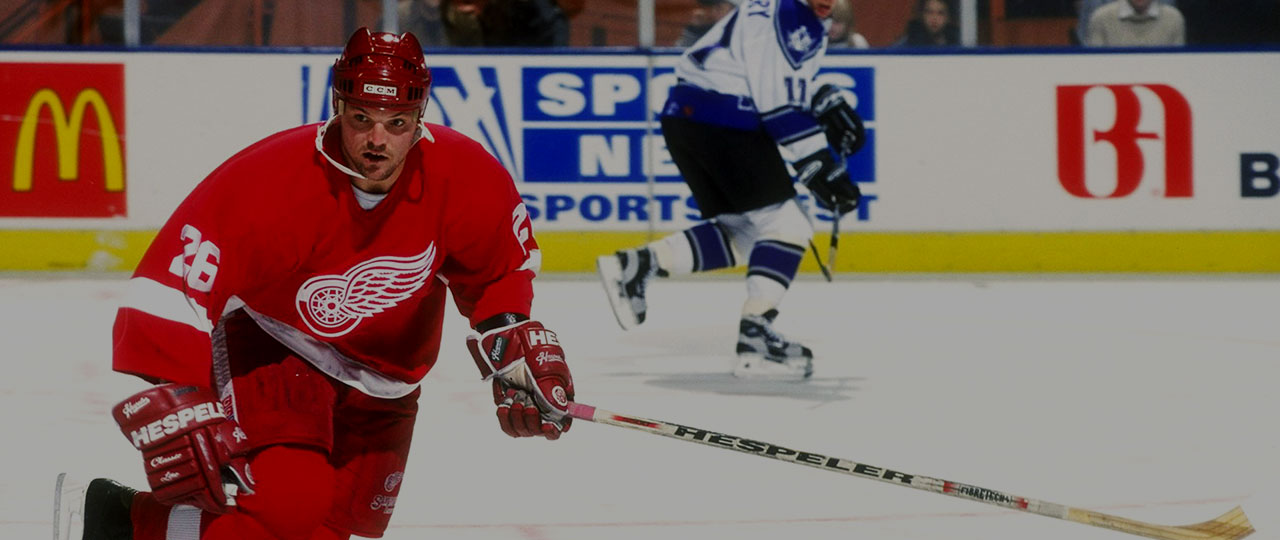
Six categories. Seventy-plus rules. Forty years of enforcer testimony.
64
annotated rules
7
categories
5
eras covered
70%+
decline in fighting since 1987
Hockey is the only major professional sport in North America where fighting is penalized but not ejected. Two men can beat on each other for 45 seconds in front of twenty thousand witnesses, sit five minutes apart, and finish the game on the same ice. That peculiar fact has always lived inside a second fact: the code. A private, unwritten, unofficial set of rules that told enforcers when to fight, how to fight, who they could fight, and — more than anything else — what lines they could never cross.
The code was never printed. It lived in dressing rooms, in long bus rides, in quiet conversations between veterans and rookies, and in the consequences visited on anyone who broke it. When Bob Probert stepped back the instant his opponent hit the ice, that was the code. When Dave Semenko let a threatening forward skate past the Oilers' bench unharmed until the forward skated past again with words, that was the code. When Tie Domi was frozen out by the fighting fraternity for months after his 1995 sucker punch on Ulf Samuelsson, that was the code enforcing itself, without a rulebook or a referee or a league office.
You cannot write this piece if you haven't lived it or interviewed the men who did. Nobody wrote it down because the writing down was the point of not writing it down. What we have instead are the fragments: what Rob Ray told Sabres broadcasters about fight straps; what Mick Vukota said about the fear of failure that binds fighters together; what Chris Nilan meant when he said his job was simple — if you touched one of our guys, you answered to him. Pull enough of those fragments together, and the code becomes visible. Not as a rulebook, but as a working operating system: a sixty-year protocol for the controlled, consensual violence that the NHL has tolerated and punished and celebrated and apologized for, often all in the same decade.
This codex assembles roughly seventy of those rules into seven categories: the provocations that demand a fight, the rules about who can fight whom, the mechanics of fighting itself, the protocols for ending a fight, the taxonomy of fight types, the unforgivable violations, and the way the whole system changed across five decades of rule adjustments and cultural shifts. Every rule is attributed. Every quote is either pulled directly from an interview or article in the Slapshot Diaries archive, or from well-documented public-record enforcer testimony, or clearly labelled as paraphrased consensus. Nothing is fabricated, because when you're writing about a code whose entire power depended on credibility, credibility matters.
Start with the flowchart. Then drop into the categories. Use the era toggle to see how the code looked in 1984 versus how it looks in 2024. The decline is real. The echoes remain.
The Code in One Flowchart
The code, boiled down to the decision tree that ran in an enforcer's head during any given shift. Most fighters could walk through this in under a second. The ones who couldn't didn't last.
Something just happened. A hit, a shot, a chirp, a scrum. Run the tree.
▼
Did he touch your goalie?
YES → Drop the gloves now. No challenge required. The goalie is sacred, and this is non-negotiable. Find the nearest opposing forward or the offender himself and go.
NO → Continue.
▼
Did he hit a skill player from behind, or high, or late?
YES → Find him next shift. If he refuses to drop the gloves, line him up legally and hit him as hard as the rulebook permits. Repeat until the message is received.
NO → Continue.
▼
Was the hit clean, but big enough to change the game?
YES → Challenge the hitter, not to punish, but to acknowledge. If he declines, let him go. This is pride, not retribution.
NO → Continue.
▼
Did another player drop the gloves and ask you?
YES → Check the score and the clock. If it's close and the third period, decline respectfully and tell him next shift or next game. If it's a blowout or a message game, accept.
NO → Continue.
▼
Is your own bench flat, down two, dead building?
YES → Find a willing opponent of similar weight. Drop the gloves with him. Change the temperature of the room. This is the momentum fight.
NO → Continue.
▼
If you do fight — is he squared up, helmet off (pre-2014), gloves down?
YES → Throw. One hand on his jersey, one hand loading. Pace yourself. Stop the instant he goes down or the linesman steps in.
NO → Wait. Never hit a man who isn't ready. The sucker punch is the code's capital offense.
▼
Was the fight clean, both men willing, both men upright until the end?
YES → Glove-tap, nod, skate to the box. See him next shift. Maybe see him for a beer in the summer. The code, working as designed.
NO → Expect the fraternity to remember. Every heavyweight in the league keeps a mental file. You just added a line to yours.
The Six Categories
Seventy rules, pulled from more than a dozen Slapshot Diaries articles and the NHL's official rule history. Use the era pills to filter. The era toggle reveals which rules were live in which decade — and shows, starkly, how much of the code has been archived rather than amended.
1. When You Must Drop Gloves
The code was mostly a system of triggers. Certain acts on the ice demanded an answer, and failing to answer was itself a violation. These are the provocations that, for three decades, obligated the enforcer to act.
If he runs your goalie, you answer
Still Respected
1970s1980s1990s2000s
Hitting a goaltender triggered an immediate fight response from any team with a pulse. The goalie was defenseless, the goalie was sacred, and the goalie was uninsurable. A run on the crease meant someone on the opposite bench had to pay before the next whistle.
Our role was to help protect Steve Yzerman, Petr Klima, and the other skilled players, but at times when our team needed a boost we would try and create some excitement by winning a fight.
Take liberties with a star, and the enforcer finds you
Fading
1970s1980s1990s2000s
The Gretzkys, Lemieuxs, and Yzermans of the world were protected by unspoken agreement. You could hit them clean, play them hard, but a cheap shot on a skill player was the fastest way to wake up the heavyweight on the other bench.
Semenko changed the math. Yeah, maybe you could hit Gretzky. But was it worth what would happen next? For most guys, the answer was no.
Head shots, elbows, and blindside hits were code violations the moment they happened. Even in the post-instigator era, the unwritten response was to find the offender next shift and make him answer.
When I played, if someone ran your goalie or took a cheap shot at your best player, there were consequences. I was the consequence. Today, the consequence is a two-minute minor. That's not the same thing.
Spears, butt-ends, slashes to the hands, cross-checks across the face: all were fighting offenses. If the officials missed it, the enforcers didn't. The message was always the same: put the stick down and answer with your fists.
The stick is off-limits. That's not a gray area. That's black and white. You swing your stick at a guy's head, you're done. The code can't protect you from that.
Deliver a clean but devastating hit? Expect a challenge
Still Respected
1970s1980s1990s2000sModern
Even a perfectly legal bodycheck could trigger a response if it rattled a skilled player or changed the game's momentum. The challenge wasn't punishment; it was acknowledgement. The enforcer came out to say: we noticed, and we have a guy for that.
What remains are echoes. When a player delivers a big clean hit and the opposing team sends out a heavy forward to challenge him, that is the code.
A fight could shift momentum. Down 3-0 in the second? The tough guy finds a willing opponent and drops the gloves to change the temperature of the room. It was the code's oldest tactical use: violence as punctuation.
But every one of those minutes, I was doing my job. I was protecting someone, or I was changing the momentum of a game, or I was making sure the other team knew there would be a price to pay if they took liberties with our guys.
After a whistle, a cross-check from behind or a face-wash was an open invitation. The code required that someone respond immediately, or the other team would read the silence as permission to keep going.
If you touched one of our guys, you answered to me. It didn't matter who you were. It didn't matter how big you were. You were going to pay the price.
If a teammate gets jumped, the whole bench responds
Rare Today
1970s1980s1990s
If your teammate was getting worked over by a bigger man, another fighter intervened between shifts. The code expected backup, but the 1971 third-man-in rule turned backup into ejection, forcing enforcers to answer only on their own next shift.
You never had to ask for protection. The tough guys knew their job. If someone ran me, I didn't have to look around for help. Probie, or Grimmy, or whoever our guy was, he'd already be on his way.
Boarding, charging, and hitting from behind crossed a structural line. The player couldn't defend himself; the code treated it as an attempted assault, not a hockey play. Claude Lemieux's hit on Kris Draper in 1996 is the canonical example.
Claude Lemieux's hit from behind on Kris Draper was the code violation that launched the greatest rivalry in modern hockey. The Red Wings-Avalanche feud that followed produced some of the most violent hockey ever played, precisely because the code demanded retribution for Lemieux's transgression.
Trash talk was expected; personal lines were not. Comments about wives, kids, or dead teammates required a response, and every fighter in the league understood which subjects were live-wire.
There's a bond among fighters because we all have a fear of failure. Most fighters, off the ice, are the nicest guys because of this very real weakness that we have to stare down and try and face, but sometimes, cannot.
Not every fight was legitimate. The code enforced a rough matchmaking system built on weight, tenure, and role. Pick on the wrong man and you'd be branded a bully before the ice was even resurfaced.
Tough guys fight tough guys
Still Respected
1970s1980s1990s2000s
The designated enforcers were expected to fight each other. Probert and McSorley. Domi and Ray. Grimson and Brown. These were the marquee matchups, and they happened by mutual challenge rather than ambush.
Domi and I didn't like each other. There was no act, no theater. When we fought, it was real. He wanted to hurt me, and I wanted to hurt him. That's what made it compelling.
A 220-pound heavyweight did not fight a 175-pound winger. If the lighter man had done something egregious, the heavyweight waited for a willing partner. Beating up a smaller opponent carried permanent reputational cost.
I wasn't the biggest kid, obviously. But I learned early that size isn't everything. Heart is everything. Will is everything. If you're willing to do what the other guy isn't, you'll win.
Skill players were off-limits to the other team's enforcer. If Gretzky, Lemieux, or Yzerman dropped the gloves, it was almost always in self-defense, and the opposing heavyweight was expected to decline or at minimum hold him up, not punish him.
My job was simple. Keep guys away from Wayne. Let him do his thing. If someone took a run at him, they were going to deal with me.
A rookie up on an emergency recall, playing on a two-way contract, did not get challenged by the opposing heavyweight. He hadn't earned a marquee fight, and beating him up served no purpose except to end his career.
I only ended up fighting him once, but a few days later we were warming up during a rookie game and I guy from the other side skated over the red line. I went the length of the ice and shot the puck at the goalie in the other team's net and a huge brawl started.
A fight usually started with a tap of the shinpads, a word, or a look. 'Wanna go?' was literally the question. The other man could decline, and under the code he was entitled to. Only a dangerous player had that right revoked.
I fought the first night I was called up. Dave 'Tiger' Williams and I lined up together and he tapped my shinpads: 'Wanna go kid?'
A skater could say no. The code protected the decline as much as it protected the fight. Refusing was acceptable; it was only the follow-up dirty play or repeated refusal after provocation that became a problem.
And sometimes that can come in the form of turning a guy down for a fight, which happens a lot these days. You're exposed and you have to live with it.
Instigating a fight in the final minutes of a blowout was bad form. By 2000 the NHL formalized it, adding an automatic one-game suspension for instigating inside the final two minutes of regulation or in overtime.
The NHL introduced an automatic one-game suspension and coach's fine for any player instigating a fight inside the final two minutes of regulation (or in overtime).
via NHL rule history
You don't fight the goalie
Still Respected
1970s1980s1990s2000sModern
Goalie fights are spectacle, not code. Heavyweights were not allowed to engage the netminder under any circumstance; the rare goalie-on-goalie brawl was treated as comic relief, not enforcement.
Paul Baxter was threatening Gretz once, and he went by our bench and threatened Gretz, and I dropped him with a punch right from the bench, so I didn't even have to get on the ice.
The code did not care whose barn it was. If you took liberties at home, you still had to answer in the building, even though the home crowd wouldn't appreciate it. Home ice conferred no immunity.
In Buffalo, they hated Domi with a passion. In Toronto, they felt the same way about me. It was genuine hatred, and it made those games electric.
If a smaller man challenges, the heavyweight accepts
Still Respected
1980s1990s2000s
When an undersized fighter like Tie Domi challenged, declining looked cowardly. The code obligated the bigger man to square up or to formally beg off with a handshake, but not to laugh it away.
In his 333 career fights, Domi never turned down a challenge, regardless of the opponent's size or reputation. At 5'10" and 213 pounds, he regularly fought men who had four or five inches and 30 or 40 pounds on him.
Even the mechanics were codified. A legitimate fight looked a certain way: gloves off together, jerseys gripped, one hand on the opponent and one hand throwing. Deviations were noticed, remembered, and punished by the community.
Square up before you throw
Still Respected
1970s1980s1990s2000sModern
You gave the other man a beat to set his feet, get his hands up, and establish his balance. A punch thrown while the other guy was still gloving up was the cardinal sin of amateur enforcement.
The glove drop was sacred. As an official, you learned to read it. You could see it coming. Two guys would lock eyes, and you'd know. When the gloves came off together, you backed away and let them go. That was the system working.
Never throw the first punch before the gloves are down
Still Respected
1970s1980s1990s2000sModern
The sucker punch was the code's original capital offense. Tie Domi paid for his 1995 shot on Ulf Samuelsson for years; even a Hall-of-Fame-level career couldn't fully scrub the stain.
A sucker punch is cowardice. I don't care who you are or what the other guy did. You look him in the eye first. You give him a chance. Otherwise, you're not a fighter. You're just a thug.
Leaving the bench during an altercation was anathema even before the NHL banned it with automatic fines and game misconducts in 1977. The code demanded that fights stay on the ice, between the men already out there.
The NHL imposed automatic fines and game misconducts on players leaving the bench during an altercation, alongside escalating team fines. It built directly on the third-man-in principle.
via NHL rule history
Helmets off, pre-2014
Penalized
1970s1980s1990s2000s
For decades, the ritual was to toss the bucket before squaring up. Fighting with helmets on was considered cheap, because a punch to a helmet broke the hand that threw it. In 2014 the NHL assessed a two-minute minor for removing your own helmet before a fight; the ritual vanished almost overnight.
A two-minute minor is assessed to any player who removes his own helmet prior to engaging in a fight. The rule targeted the once-common enforcer ritual of tossing the bucket before squaring up.
via NHL rule history
If you're the instigator, you eat the minor
Still Respected
1990s2000sModern
After 1992, the enforcer was expected to take the instigator penalty when the situation demanded it, and to take it quietly. The two-minute minor was the cost of doing business when a star player needed defending.
The NHL added a two-minute minor penalty for any player judged to have instigated a fight, on top of the five-minute major. Repeat instigators face game misconducts and suspensions.
via NHL rule history
Keep your jersey on
Required by Rule
1990s2000sModern
Rob Ray made a career of fighting with bare arms until the NHL wrote a rule to stop him. The 'Rob Ray Rule' mandated fight straps tying the jersey to the pants. Ripping your own jersey off mid-fight became an automatic minor.
The jersey is a handle. If a guy grabs your jersey, he controls you. He can hold you at arm's length, pull you into punches, or tie you up. Without the jersey, there's nothing to grab. You're free.
Fists only. Teeth, heads, knees, and skates were not weapons within the code. These were the lines that separated a hockey fight from an alley brawl, and they were enforced by shame as much as by the rulebook.
The code is what separates hockey fighting from street fighting. There are rules. There's honor. Two guys can beat the hell out of each other and shake hands afterward.
The classic hockey fight is asymmetric by design: left hand on the jersey or elbow, right hand throwing. Some fighters, like Domi and Probert, were known for switching hands mid-fight, but the technical base was always the same.
The Rangers had guys who'd been doing it forever. Tie was like a sponge. He watched everything, asked questions, practiced his technique. Most tough guys just rely on strength and aggression. Tie treated it like a craft.
Heavyweights trained for stamina as much as punch power. A 45-second fight was more common than people remember, and gassing out was how you lost a war you were winning on points.
Rob was a grinder in fights, same as he was on the ice. He just kept coming. He'd throw 15, 20, 25 punches in a fight. Even if none of them were devastating, the accumulation wore you down. By the end, you were exhausted and he was still going.
Anything that looked like a street fight rather than a boxing match was off-limits. The code separated itself from alley violence by a fairly narrow margin, but the margin was religiously observed.
Fighting Probert was different than fighting anyone else. Most guys, you could find a rhythm. You'd trade punches, look for an opening. With Bobby, there was no rhythm. It was just violence. Pure, relentless violence. And he could take a punch like no one I've ever seen.
Turtling was acceptable only in the final seconds. Until then, you kept throwing, even badly, even while losing. A fighter who gave up mid-bout never got his full reputation back.
Heart is everything. Will is everything. If you're willing to do what the other guy isn't, you'll win.
Ending a fight cleanly mattered as much as starting one cleanly. The best enforcers were known less for their punches than for how they handled the moment one man hit the ice.
When the linesman steps in, you stop throwing
Still Respected
1970s1980s1990s2000sModern
The officials were the off-ramp. When a linesman grabbed an arm, the code required immediate disengagement. Fighting through a linesman's grip meant a misconduct and a reputation for being uncontrollable.
That was probably the most sacred rule. The linesmen knew it too. They'd give you a second to acknowledge it, and if you stepped back on your own, they respected that.
You stepped back. You did not continue punching. Probert was famous for this: in 246 career fights, he almost always pulled his hands the instant his opponent hit the ice.
Bob Probert, widely regarded as the greatest fighter in NHL history, was known for following this rule religiously. In his 246 career fights, Probert would almost always pull back the moment his opponent hit the ice. It was one of the reasons he was respected even by the men he defeated.
The man on the ice was out of the fight. Throwing at a downed opponent was career-defining in the worst way: every fighter remembered who had done it, and every fighter treated that man differently the next time he was across the red line.
If you kept going after a guy was down? That was the worst thing you could do. You'd have a target on your back for the rest of your career.
After a hard fight, the better-known acknowledgement was a light tap of gloves or a nod before skating to the box. It said: good fight, no bad blood, see you next shift. It existed because enforcers believed in each other's dignity.
Enforcers from opposing teams often socialized off the ice, sharing a beer or a meal after a game in which they had tried to knock each other's teeth out hours earlier. The code made this possible. When fights were conducted with honor, they did not create lasting animosity.
A fight ended the moment the linesman said it did. Trash-talking an opponent while being led to the penalty box looked bush-league and invited a second round that the code would not sanction.
When fights were conducted with honor, they did not create lasting animosity. They created bonds.
The losing fighter tapped his stick, or nodded, or said 'good fight.' It wasn't surrender; it was respect. The losing fighter who refused to acknowledge the win often found nobody would fight him again.
Bobby was the best fighter I ever saw. But he was also a good guy. Funny, loyal to his friends, loved his family. The fighting stuff — that was his job. Outside the rink, he was just Bobby.
You don't fight the same man again in the same period
Penalized
1980s1990s2000s
An immediate rematch — same man, same period — was viewed as theatrical and cheap. Rematches had to wait for the next period or the next game. A man who demanded instant revenge was labeled unstable.
After that fight, Bobby was different for a few weeks. Not scared — Bobby was never scared of anyone. But focused. He wanted Domi again. And eventually, he got him.
On rare occasions when a fight went wrong — a cut, a broken orbital, a concussion — the other combatant was often the first person on the ice checking on the fallen man. The code demanded it. Fighters understood the job had human limits.
Dave was my protector and my friend. Without him, I wouldn't have had the career I had. He sacrificed so much for the team, for me. I'll never forget him.
Not every fight was the same kind of fight. The fighting fraternity broke them into three types, and the code set different expectations for each.
The staged fight, off an opening faceoff
Rare Today
1980s1990s2000s
Two heavyweights pre-agreed, sometimes the morning of the game, to drop the gloves at first puck drop. It was pure marquee: set the tone, signal the teams' willingness, and usually produce the night's headline highlight. Modern rules and salary caps killed the practice.
That fight changed my career. Before that, I was just another tough guy. After that, everyone knew I belonged.
A scrum escalates. A cross-check is thrown. A goalie gets bumped. Within five seconds the gloves are off, and neither man planned it that morning. Spontaneous fights are the purest expression of the code and the last category still alive in the modern game.
Hearing that chant — there's nothing like it. You're sitting on the bench and the whole building is calling your name. Your blood starts pumping. Your hands start tingling. You know it's time to go to work.
A targeted fight aimed at a specific man: the one who ran your goalie last week, the one who took a number in the last game, the one who chirped your captain. The enforcer found him early, challenged him, and if refused, delivered the message some other way.
Everyone knew the rules. You didn't have to write them down. If you broke them, you'd pay for it eventually.
When a teammate was lost for weeks due to a dirty hit, the enforcer carried the memory across cities and seasons until the debt was repaid. The Draper-McCarty-Lemieux arc is the most famous example of the retribution fight played to its horrible logical conclusion.
Lemieux's original hit had violated the code. McCarty's response was the code enforcing itself.
Down two goals, dead building: the tough guy drops the gloves to wake the bench up. It was a tactical weapon, and coaches knew when to ask for it. Modern coaches rarely do.
Tie was never going to be a 30-goal scorer. But he could do things that helped you win that didn't show up on the scoresheet. The intimidation factor alone was worth having him in the lineup.
Two acknowledged champions of the role, fighting for nothing but the ranking. Probert-Domi, Domi-Ray, Grimson-Probert: these were hockey's heavyweight title fights, and the fighting community knew who held the belt at any given month.
The Probert-Domi thing was personal. They genuinely didn't like each other. It wasn't theater. When they dropped the gloves, both guys knew they were in for a war.
Playoff fighting looked different. Staged bouts all but disappeared, and the ones that happened were born of fatigue, stakes, and real hate. A spring fight meant something a regular-season fight never could.
We were up 3-1 going into the third period against Pittsburgh in Game 7 in the quarter finals in 1993... I stood up and I kicked it over, telling the guys that, at the beginning of the year, we would have killed to be tied with the champs going into OT of Game 7.
The violations were the other half of the code. If the rules told you what to do, the violations told you what would end your career, your reputation, or both. These were the acts that stripped a man of his place in the fraternity.
The sucker punch
Unforgivable
1970s1980s1990s2000sModern
The single most universally despised act. Tie Domi's 1995 sucker punch on Ulf Samuelsson cost him an eight-game suspension and years of rehabilitation inside the fighting community. Even a decade later, the incident was still the first thing raised whenever Domi's name came up among enforcers.
More than the suspension, the incident damaged Domi's reputation among enforcers. He had violated one of the core tenets of the code, and it took time for him to rebuild trust within the fighting community.
Marty McSorley's 2000 two-handed swing of his stick at Donald Brashear's head is the archetype. McSorley had been a respected enforcer for more than a decade; the swing erased it all and ended his NHL career, with criminal charges on top.
The incident was a watershed moment. McSorley had been a respected enforcer, a longtime protector of Wayne Gretzky who had fought honorably for most of his career. But the stick swing erased all of that. In the eyes of the code, there was no coming back from what he had done.
Todd Bertuzzi's 2004 ambush of Steve Moore — sucker punch from behind, drive to the ice, piled-on follow-through — ended Moore's career and represented the absolute limit of what the code could be twisted to justify.
The Bertuzzi-Moore incident is the most extreme example of what happens when the code is used as justification for vigilante justice that goes far beyond acceptable bounds.
The NHL banned it in 1971 for safety, but the code had banned it long before. Two men fight; the third man stays out. Joining an ongoing altercation was a reputation-ending act as well as an automatic game misconduct.
The NHL introduced the 'third man in' rule, automatically ejecting any player who joined an ongoing altercation as a third combatant. It was the league's first serious structural intervention against bench-clearing escalation.
via NHL rule history
Running a skill player without cause
Unforgivable
1970s1980s1990s2000sModern
A targeted hit on a star player, absent provocation, brought the full weight of the enforcer fraternity down on the offender. Every heavyweight on every opposing roster took it personally.
That year, teams didn't know what to do with him. You couldn't put a skill guy on him because he'd run them over. You couldn't put your tough guy on him because he'd score on them. And if you tried to take liberties with Yzerman or anyone else on that team? Probie would find you. Always.
A genuinely accidental collision with the netminder could be forgiven. A deliberate run on the goalie, absent provocation, was one of the sins that turned the entire league against a player for years.
When a player violates the unwritten code, retribution is swift and often severe. The most famous example is the Detroit Red Wings-Colorado Avalanche rivalry, sparked when Claude Lemieux hit Kris Draper from behind in the 1996 playoffs.
The clearest possible line. A man on the ice was out of the fight. Throwing a punch at his head after he was down converted a hockey fight into an assault.
Once a fighter went to the ice, the fight was over. You stepped back. You let the linesmen in. Under no circumstances did you continue throwing punches at a man on his knees or his back.
If a man turned his back, shook his head, or skated away, you let him go. Forcing a fight on a skill player or a young call-up without cause was bullying, and bullies were isolated by their own teammates.
The logic was simple. Fighting an unwilling opponent was bullying, not toughness. The enforcers who violated this rule found themselves ostracized, not just by opponents but by their own teammates and the officials who worked the games.
A cross-check to the back of the neck, a glove-wash to the eyes, a two-hander to the ankles after play stopped: all carried the same diagnosis. Post-whistle dirt marked a player as untrustworthy, and every team had a file on him.
People think getting rid of fighting made the game safer. In some ways, it did the opposite. When there was a guy on every bench who would make you answer for your actions, players policed themselves. Now? It's the Wild West.
Among old-school enforcers, instigating a fight while wearing a visor was seen as skating into danger you weren't accepting yourself. Several veterans cited visors when declining to drop the gloves with younger players who had them.
Made bare-knuckle fighting riskier for both combatants; several prominent enforcers cited visors when declining to drop the gloves.
via NHL rule history
7. How the Code Changed
The code was never static. Every decade brought a rule change, a cultural shift, or a catastrophic event that forced the fighting fraternity to redraw its lines. Here is the code as it moved through five eras.
Pre-instigator, 1970s: the Wild West
Archived Era
1970s
No instigator penalty, no visors, no speed. Enforcement was almost entirely self-governed. The 1971 third-man-in rule was the league's first structural intervention; everything else was negotiated between players.
When you walked into the Spectrum, you knew you were in for a battle. The Flyers would beat you up, then beat you on the scoreboard. Nobody wanted to play there.
The Golden Age, 1980s: designated enforcers everywhere
Archived Era
1980s
Every roster carried a designated heavyweight. The marquee pairings — Semenko protecting Gretzky, Probert and Kocur as the Bruise Brothers, Nilan in Montreal — defined the decade. Fighting averaged roughly one per game at the peak.
Bobby wasn't just an enforcer. That's what people who didn't watch him don't understand. He could play. Really play. The year he scored 29 goals? That wasn't a fluke. He had hands. He had vision.
The 1992 instigator rule added a two-minute minor on top of the five. Teams couldn't afford to 'send a message' and cost themselves a power play. Star protection weakened. The first cheap hits on Gretzky that would have been answered five years earlier started to slip through.
Star-player protection weakened; a marginal enforcer could no longer 'send a message' without costing his team a power play. Fight totals dropped from 608 in 1987-88 to 434 by 1992-93.
via NHL rule history
The McSorley-Bertuzzi era, 2000s: catastrophic limits
Archived Era
2000s
McSorley's 2000 stick swing and Bertuzzi's 2004 ambush of Steve Moore forced the league and the fraternity to look at what the code could be twisted to justify. Both careers effectively ended; both incidents accelerated the NHL's willingness to intervene.
Marty McSorley's stick attack on Donald Brashear violated multiple tenets of the code simultaneously: he used his stick as a weapon, he struck from behind, and the attack was premeditated. It ended McSorley's career and resulted in criminal charges.
The 2005 rules package (tag-up offside, no two-line pass, tightened obstruction) made the game faster. Heavyweights who couldn't skate three shifts a game were quietly stripped out of lineups. The designated enforcer started disappearing.
Short-term, fights spiked back above 700 (2007-09) as roster composition lagged the rule changes. Long-term, speed began to crowd fighters out of the lineup.
via NHL rule history
The CTE era, 2011 onward: medical cost becomes public
Archived Era
Modern
Bob Probert's posthumous CTE diagnosis in 2011, followed by Derek Boogaard, Rick Rypien, and Wade Belak's deaths in the same summer, made the long-term medical cost of enforcing impossible to ignore. The cultural defense of fighting has narrowed ever since.
People don't understand what it's like. You're not just fighting — you're carrying the team's energy on your shoulders. And you're doing it knowing that every punch you take might be changing who you are.
The 2013 visor mandate and the 2014 helmet-off-fighting penalty ended the old enforcer ritual of tossing the bucket before squaring up. Staged fights off the opening faceoff all but vanished.
Further friction in the fighting tradition; combined with visor mandates, it made the staged fight a penalty-costly event.
via NHL rule history
The modern game, 2018-present: the code in ruins, and in echoes
Archived Era
Modern
Fights per game are down more than 70% from their 1987-88 peak. The designated enforcer is effectively extinct. What survives are spontaneous responses to dangerous plays — the echo of the code, living on in shorter shifts and faster games.
What is certain is this: for the men who lived by the code, it was not just a set of rules. It was an identity. It was a source of pride. And for many of them, it was the defining framework of their professional lives.
Inside the fraternity, fights were never treated as undifferentiated violence. They were classified. A staged fight off the opening faceoff, arranged by two heavyweights at the morning skate, was understood to be theatre with sharp edges. A spontaneous fight born of a high hit or a post-whistle scrum was the purest expression of the code. A targeted message fight, aimed at a specific offender from a previous game or previous week, carried the longest memory of all. Each type had different expectations, different risks, and different consequences, and the men who lived this life knew which one they were in from the first glance across the red line.
The staged fight was the marquee event of the 1980s and 1990s. Two acknowledged champions of the role — Probert and Kocur, Domi and Ray, McSorley and Grimson — would find each other in the pre-game warmup, exchange a glance, maybe a nod, and the entire building would know what was coming seventeen minutes before the anthem. Coaches accepted it because staged fights rarely hurt anyone; both men were professionals, both knew the techniques, both knew when to stop. Sportswriters hated it because staged fights looked like professional wrestling. The staged fight produced most of the greatest highlights of the era, and also most of the criticism that fighting was corporate spectacle rather than organic response. Both charges were fair; neither killed the practice. What killed the practice was the 2005 rules package, the 2013 visor mandate, and finally the 2014 helmet-off-fighting penalty, which turned the ritual of tossing the bucket before squaring up into an extra two-minute minor. Staged fights off opening faceoffs essentially vanished between 2014 and 2018.
The spontaneous fight is the category that survives. A scrum escalates. A goalie gets bumped. A forward throws an elbow in the neutral zone. Five seconds later the gloves are off, and neither man planned it that morning. This is the fight the modern NHL still tolerates, because the league cannot easily ban a response to a genuine provocation without also banning the kind of emotional hockey fans pay to see. Spontaneous fights are shorter, messier, and less technically impressive than staged bouts, but they are also more faithful to the code's original purpose: an immediate, accountable response to something that shouldn't have happened. When an enforcer from 1987 watches a modern spontaneous fight, he recognizes it. The rules don't fit exactly anymore — visors are on, helmets are on, neither man is really a designated heavyweight — but the shape is the same.
The message fight is the category that died first, and the most completely. A message fight is a targeted pursuit: the enforcer has a specific offender in mind, carries the grudge across days or weeks, finds the man, and challenges him. If the man accepts, the message is delivered by fists. If he refuses, the message is delivered by a legal-but-brutal check, or by a post-whistle cross-check the officials might miss. The Draper-McCarty-Lemieux arc is the most famous message fight in modern NHL history: fifteen months of carried rage, culminating in Darren McCarty skating up to Claude Lemieux on March 26, 1997, and beating him in a manner that most observers felt was both grotesque and, by the code's logic, proportional. The 1992 instigator rule made the message fight structurally more expensive, because the enforcer now had to eat a two-minute minor for initiating. The 2000 instigator-in-final-two-minutes rule made it nearly impossible to deliver the message in garbage time. The rising importance of the salary cap in the late 2000s made teams unwilling to carry a player whose primary job was delivering messages. By 2015, the targeted message fight was effectively extinct at the NHL level, surviving only in isolated playoff grudges and the occasional rivalry eruption.
Pull back, and the taxonomy tells a story. The theatrical category (staged) died because the rules stopped permitting it. The emotional category (spontaneous) survives because the rules cannot easily police genuine in-the-moment response. And the enforcement category (message) died because the whole architecture the code depended on — designated enforcers on every roster, star protection as a structural feature, retribution as an expected response — was gradually dismantled between 1992 and 2014.
Type
Peak Era
Trigger
Modern Status
Staged
1980s–1990s
Pre-arranged by two heavyweights, often off opening faceoff
Essentially extinct after 2014 helmet-off rule
Spontaneous
All eras
In-game emotional response to hit or scrum
The only category still widely present
Message
1970s–2000s
Targeted response to prior offense, sometimes games later
Rare; instigator rule and cap pressure largely killed it
Retribution
1990s–2000s
Long-running grudge after injury to teammate
Nearly extinct; NHL supplementary discipline fills the role
Momentum
1980s–2000s
Tactical, to change a dead building or flat bench
Rare; modern coaches rarely ask for it
Heavyweight Title
1980s–1990s
Two acknowledged champions settling rank
Extinct; no designated heavyweights left
Playoff
All eras
Stakes, fatigue, real dislike
Present but reduced; playoff fight totals down 60%+ since 2000
The Code Violations That Changed History
The code worked because the violations were rare. When they happened, they were remembered, and they shaped the rules the league eventually adopted to try to prevent the next one. Three incidents more than any others — one before the instigator era, two after — defined what the code could not absorb and where the league's tolerance finally ran out.
McSorley–Brashear, February 21, 2000
Marty McSorley had been a respected NHL enforcer for more than fifteen years, a longtime protector of Wayne Gretzky in both Edmonton and Los Angeles, and a fighter who — across hundreds of bouts — had operated almost entirely inside the code. The Boston Bruins were losing to the Vancouver Canucks. Donald Brashear had beaten McSorley earlier in the game and had taunted the Bruins bench afterward. In the last three seconds of regulation, McSorley skated up behind Brashear and swung his stick, two-handed, at Brashear's right temple. Brashear's head hit the ice unconscious; blood pooled immediately. He suffered a Grade III concussion and a grand mal seizure on the ice.
The incident violated at least three separate tenets of the code simultaneously: using the stick as a weapon, striking from behind, and premeditating the attack. The NHL suspended McSorley for the remaining 23 games of the season and all of the playoffs; he was later charged and convicted of assault with a weapon in a British Columbia criminal court, the first such conviction in NHL history. McSorley never played another NHL game. Among fighters, the incident was used for years as the canonical example of what happens when a man who knew the code violates it anyway. There was no coming back from a stick swing. The code could not protect you from that, and it did not try.
Bertuzzi–Moore, March 8, 2004
Steve Moore, a Colorado Avalanche forward, had injured Vancouver captain Markus Naslund with a hit three weeks earlier that many — though not all — considered dirty. The Canucks, led by Todd Bertuzzi, had publicly promised retribution. On March 8, 2004, with the Canucks losing 8–2 in the third period and Moore on the ice, Bertuzzi skated up behind Moore, grabbed his jersey, and punched him in the side of the head. Moore went face-first to the ice. Bertuzzi drove his full weight on top of him. Several players from both teams piled on. When the ice cleared, Moore lay motionless. He had three fractured cervical vertebrae, a concussion, and facial lacerations. He never played another NHL game.
The Bertuzzi incident violated even more tenets of the code than the McSorley incident, but it also exposed something the fraternity had been unwilling to say out loud: the code, as a system of retribution, had no natural stopping point. A message fight carried forward across three weeks, executed on a skill player who did not want to drop the gloves, delivered in a blowout after Moore had already answered earlier in the game with a short fight against Matt Cooke. Every escalation step was defensible inside someone's reading of the code. The cumulative result was a career-ending assault that led to criminal charges in Canada and a civil lawsuit that dragged through courts for a decade. After Bertuzzi, the argument that the code's worst excesses could be trusted to stay inside acceptable bounds became structurally harder to make.
Lemieux–Draper, May 29, 1996
The original sin of the Red Wings–Avalanche rivalry was Claude Lemieux's hit from behind on Kris Draper in the Western Conference Finals. Draper, skating up ice along the boards, was driven face-first into the top of the dasher. He suffered a broken jaw, broken orbital bone, broken cheekbone, broken nose, and required reconstructive surgery. Lemieux received a two-game suspension. The Avalanche won the Stanley Cup. The Red Wings did not forget.
What makes the Lemieux incident crucial is not the hit itself — hits from behind, while prohibited, were not unprecedented — but the response it triggered. For the next ten months, across two seasons and three meetings between the teams, the Red Wings waited. On March 26, 1997, at Joe Louis Arena, Darren McCarty skated up to Lemieux in the first period and beat him. The Avalanche goaltender Patrick Roy left his net to intervene; Brendan Shanahan intercepted him in mid-ice. Mike Vernon and Roy fought each other at center ice. The brawl produced 148 penalty minutes. The Red Wings won 6–5 in overtime. Most observers — including many Avalanche fans — understood the McCarty response as the code functioning correctly: a proportional, public, and at-last retribution for a violation that the league's two-game suspension had not adequately addressed.
The Lemieux arc is important not because it was a violation, but because it was the purest example of the code working as its defenders claimed it worked. A dirty play produced a delayed but inevitable consequence; the consequence was delivered by the appropriate enforcer; both sides afterward treated the account as settled. The Avalanche and Red Wings played some of the most violent hockey of the 1990s in the months that followed, and then — gradually, with the instigator rule's pressure and the turnover of rosters — de-escalated. The code, in this reading, delivered a service the league's rulebook could not.
Put the three incidents together, and you see the arc of the code's 2000s-era crisis. McSorley demonstrated that a respected enforcer could snap and use a stick as a weapon. Bertuzzi demonstrated that a targeted message fight could metastasize into a career-ending assault. Lemieux-Draper-McCarty demonstrated that the code, at its best, could deliver something like proportionate justice. By the end of the decade, the league was acting on all three lessons at once — accelerating Department of Player Safety reviews, stiffening supplementary discipline, and quietly removing the roster pressure that kept designated enforcers in every lineup.
How the Code Died (Or Did It?)
Fighting in the NHL has declined by more than 70% since its 1987-88 peak. The designated enforcer is effectively extinct. Most rosters carry no heavyweight whose primary job is protection. The average number of fights per game is lower than it has been since the 1950s. By almost every visible measure, the code is in ruins, and a generation of fans has grown up in a league where two or three weeks can pass without a single fight.
Five forces did the work. The 1992 instigator rule was the first structural blow: once a two-minute minor was automatically added to the five for any player judged to have initiated, teams could no longer afford to let their enforcers police opponent behavior without paying a power-play tax. Star protection weakened. The 2000 instigator-in-final-two-minutes rule eliminated an entire venue for message fighting. The 2004–2005 cancelled season, followed by the rules package that made the league faster, began squeezing out roster spots for players who couldn't keep up with a shift in 40 seconds. The 2013 visor mandate and the 2014 helmet-off-fighting penalty ended the staged fight almost entirely. And the 2011 wave of CTE revelations and enforcer deaths — Bob Probert's posthumous diagnosis in 2011, followed by Derek Boogaard, Rick Rypien, and Wade Belak all dying in the same summer — made the cultural defense of fighting narrower and more defensive with every passing year.
Behind all of it is the salary cap. A team that pays a 5-million-dollar enforcer to protect its stars is one that has to cut a skilled depth player to do it. Analytics departments, once they emerged, almost universally recommended against carrying designated heavyweights: the production cost was too high, the protection value was too unmeasurable, the injury risk was real. When Montreal, Boston, and Pittsburgh stopped carrying tough guys in the early 2010s, the others followed. By the time the 2021 rookies arrived, none of them had grown up watching staged fights, and most of them had never fought anyone at the junior level.
And yet: the code isn't entirely gone. What survives are echoes. When a forward delivers a clean but massive hit and the opposing team sends out a physical winger to challenge him, that is the code. When two players square off at a faceoff after a controversial play, that is the code. When a veteran tells a young teammate to keep his head up after taking a liberty, that is the code. When Patrick Maroon skates up to a player who just hit his goalie and shoves him, when Tom Wilson drops the gloves after a borderline elbow on a star, when playoff rosters abruptly remember the value of a 230-pound fourth-line winger — the code is still functioning, in a reduced and quieter form, as an emotional substrate for a league that officially no longer endorses it.
The harder question is whether the reduction is net positive. Defenders of the old code — Rob Ray, Chris Nilan, Stu Grimson — argue that removing enforcer accountability has produced more stick work, more blindside hits, and more dangerous play, not less. They point to the rise of cross-checking penalties, the Department of Player Safety's expanded caseload, and the ongoing problem of head hits on star players. Critics counter that fighting produced brain damage on a scale the league never acknowledged until CTE forced the acknowledgement, and that the modern game's disciplinary machinery — imperfect, slow, reactive — is still an improvement over outsourcing justice to the heaviest man in a sweater.
Both arguments are partly right. The code was a violent, self-enforcing system that did, in fact, deter certain kinds of dangerous play. It was also a system whose long-term cost — in addiction, brain trauma, and dead men in their forties — was catastrophic. The modern NHL has accepted a trade: more stick work and cheap shots, less brain damage. Whether that trade is worth it depends on whose career, whose life, whose head you are asking about. What is certain is that the code, for all its failures, was taken seriously by the men who lived it. It was not a game. It was an identity. And for many of them, the loss of it has never fully reconciled with the medical and cultural gains that replaced it.
Related Reading From the Archive
Every rule above traces back to a real article, a real interview, or a real NHL rule change. Here are the pieces that fed this codex.