
From the Broad Street Bullies to the Bruise Brothers
Hockey has always been a violent game. It was born on frozen ponds where the rules were whatever the biggest kid said they were, and it evolved into a professional sport where men are paid to crash into each other at thirty miles an hour while balancing on quarter-inch steel blades. Violence isn't a bug in hockey. It's a feature.
But some teams took it further than others. Some teams didn't just play physical hockey—they weaponized intimidation. They built rosters designed to terrify, stacked with men whose primary job was to make the other team wish they'd stayed home. These are those teams. The meanest, toughest, most brutally physical rosters ever assembled in professional hockey.
This isn't just a list of penalty minutes, though there are plenty of those. This is a list of teams that changed the way opponents prepared, the way coaches slept the night before a game, and the way an entire sport thought about the relationship between violence and winning.
There's no debate about number one. The Broad Street Bullies weren't just the toughest team in hockey history—they were a phenomenon that forced the entire sport to reckon with what it was willing to tolerate.
Under coach Fred Shero, the Flyers built their identity on a simple premise: if you can't outskate them, outfight them. And if you can outskate them, fight them anyway. Dave "The Hammer" Schultz set the tone with a staggering 472 penalty minutes in 1974-75—a single-season record that still stands and almost certainly always will. But Schultz wasn't alone. Bob Kelly, Don Saleski, Dave Hoyda, and a half-dozen other Flyers were capable of turning any game into a brawl.
"Playing in Philadelphia was like going into a lion's den," recalled one opposing player. "You'd walk into the Spectrum and the fans were screaming before warmups. Then the game would start and Schultz would be staring at you from across the ice, and you'd think: why did I choose this profession?"
The remarkable thing about the Broad Street Bullies was that they didn't just fight—they won. Back-to-back Stanley Cups in 1974 and 1975. Bobby Clarke, Reggie Leach, and Bill Barber provided the skill. The enforcers provided the space for them to use it. It was a formula that changed hockey forever.
The team accumulated over 2,000 penalty minutes that season. Visiting teams often looked defeated during warmups. The Spectrum became the most feared building in professional sports.
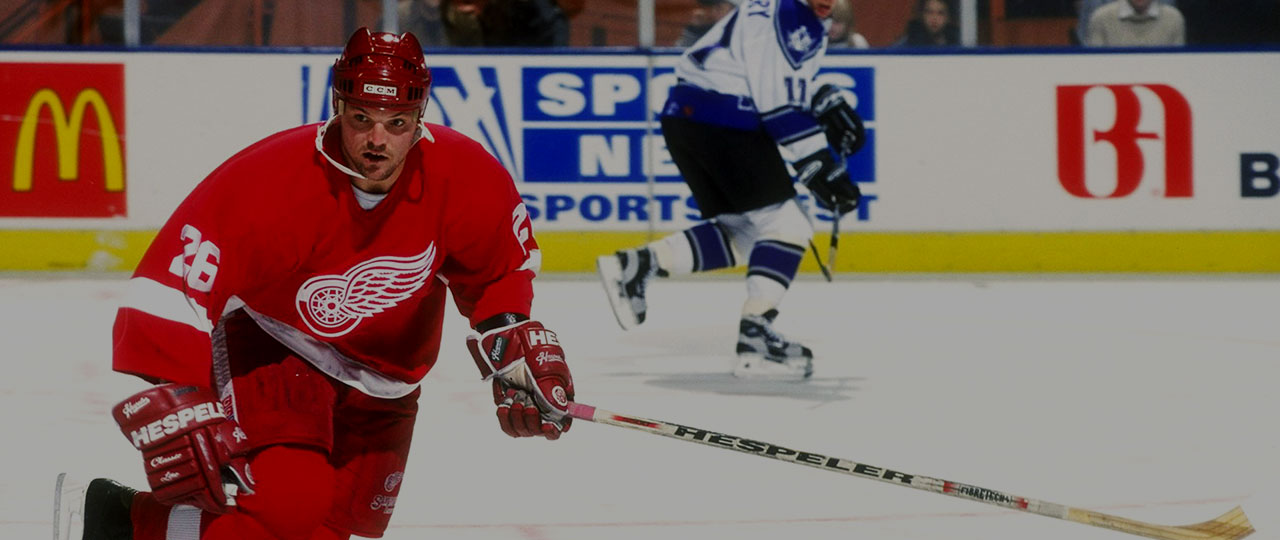
If the Broad Street Bullies were an army, the late-1980s Red Wings were a pair of nuclear warheads named Bob Probert and Joey Kocur.
The Bruise Brothers, as they were known, formed the most feared fighting tandem in NHL history. Probert was the complete package—a man who could score 29 goals and then beat you unconscious. Kocur was the pure puncher, a right hand so devastating that opponents compared it to being hit with a cinder block.
"When Detroit came to town, you'd look at the lineup card and see Probert and Kocur, and your stomach would drop," said a former opponent. "You knew someone was going to get hurt. The only question was who and how badly."
The 1988-89 Wings racked up over 2,100 penalty minutes. But it wasn't just Probert and Kocur. Gerard Gallant, Lee Norwood, and Joe Murphy all contributed to a roster that could fight from the first line to the fourth. Steve Yzerman led the offence while his teammates ensured nobody laid a finger on him.
The Red Wings made the playoffs that year, and opposing coaches spent sleepless nights trying to figure out how to match up against Detroit without losing half their roster to the infirmary.
Don Cherry built the Bruins in his own image: loud, physical, and absolutely unwilling to back down from anyone.
The mid-to-late 1970s Bruins were a machine built for violence. Terry O'Reilly was the heartbeat—a man who played every shift like it was his last and fought like he had nothing to lose. Stan Jonathan, at just 5'8", was perhaps the most feared pound-for-pound fighter in league history. John Wensink once challenged an entire opposing bench to fight. Nobody stood up.
"Cherry's Bruins were different because the toughness wasn't just from the enforcers," explained a hockey historian. "It was top to bottom. Your third-line centre would fight you. Your defencemen would fight you. Even the guys with skill would drop the gloves if they had to. It was a culture."
The 1976-77 Bruins piled up over 1,800 penalty minutes while simultaneously finishing with one of the best records in the Eastern Conference. They reached the Stanley Cup Finals that year, losing to Montreal, but they left a trail of bruised bodies and broken faces across the league.
Philadelphia clearly had a type. Nearly three decades after the original Broad Street Bullies, the Flyers were at it again.
The early 2000s Flyers featured Donald Brashear, one of the most feared heavyweights of his era. At 6'3" and 235 pounds, Brashear hit like a freight train and fought like he'd been personally insulted by your entire bloodline. Alongside him, Todd Fedoruk, Chris Neil (briefly), and a rotating cast of tough guys ensured that the Flyers' reputation for violence never wavered.
"The Philly mystique was real," said one player from the era. "Other teams had tough guys. Philly was tough guys. It was in the DNA of the franchise. You put on that orange jersey and you were expected to hit, fight, and make the other team miserable."
The 2002-03 Flyers accumulated over 1,900 penalty minutes and were involved in some of the most memorable brawls of the decade. They carried on a tradition that stretched back to Bobby Clarke and Dave Schultz, proving that in Philadelphia, toughness wasn't a strategy—it was an identity.
When Tie Domi arrived in New York, the Rangers already had an edge. With Domi, they had a weapon.
The early 1990s Rangers combined legitimate toughness with genuine skill. Domi was the headliner, a perpetual motion machine of aggression who sought out fights the way most players sought out scoring chances. But the roster ran deep with physical players: Kris King, Joe Kocur (after his Detroit days), Jeff Beukeboom, and Adam Graves, who combined offensive production with a willingness to drop the gloves that made him one of the most complete power forwards of his era.
"Domi changed the energy of the whole team," recalled a former Rangers teammate. "Before he got there, we were a good team. After he got there, we were a good team that nobody wanted to mess with. There's a big difference."
The Rangers of this era weren't just brawlers—they were building toward the 1994 Stanley Cup championship. The toughness they cultivated in the early '90s created a foundation that, combined with the brilliance of Mark Messier and Brian Leetch, eventually ended a 54-year championship drought.
The Oilers dynasty is remembered for Wayne Gretzky, Mark Messier, and some of the most beautiful offensive hockey ever played. What gets forgotten is how tough they were.
Dave Semenko was the original bodyguard—a man whose sole purpose, by his own cheerful admission, was to make sure nobody touched Gretzky. At 6'3" and 215 pounds, Semenko could fight anyone in the league, and the knowledge that he would kept most opponents from even thinking about taking liberties with number 99.
But it wasn't just Semenko. Marty McSorley took over the bodyguard role in later years. Messier himself was one of the most physically intimidating players in hockey history—a man who could score a hat trick and then flatten you with an elbow that would show up on your dental X-rays. Kevin Lowe, Lee Fogolin, and Dave Hunter all contributed to a team that could match anyone's physicality.
"People forget how tough those Oiler teams were," said one contemporary. "Everyone remembers the goals. Nobody remembers the beatings they handed out on the way to scoring them."
Yes, the Flyers again. The year after their second Cup, they were somehow even meaner.
The 1975-76 Flyers set an NHL record that may never be broken: a 35-game unbeaten streak to start the season (25-0-10). They played with a ferocity that made even the Broad Street Bullies' championship teams seem restrained. Schultz was still hammering away. Dupont was still patrolling the blue line with bad intentions. And a young Mel Bridgman was adding another dimension of violence to a team that was already drowning in it.
They didn't win the Cup that year—swept in the Finals by the Montreal Canadiens, whose speed and skill finally proved that you couldn't just punch your way to a championship every time. But the '75-76 Flyers remain one of the most physically dominant teams in hockey history, a squad that went nearly half a season without losing a game through sheer force of will and fist.
The early 2000s Ottawa Senators were a paradox: a team loaded with offensive talent that also happened to be one of the most physically punishing squads in the league.
Rob Ray and Chris Neil anchored the toughness. Neil, in particular, was a revelation—a player who could fight anyone in the league but also contribute legitimate bottom-six minutes. The Senators complemented their enforcers with physical defencemen like Zdeno Chara, whose 6'9" frame made him the most physically imposing player in the NHL, and Wade Redden, who played a harder game than his smooth skating suggested.
"Ottawa was sneaky tough," said one player from the era. "You'd go in there thinking about Daniel Alfredsson and Marian Hossa, and then Chris Neil would put his fist through your face. They had everything."
The Senators accumulated significant penalty minutes while simultaneously posting one of the best records in the Eastern Conference, proving that a team could be both skilled and terrifying.
The 1989 Stanley Cup champions were built to survive the brutality of the old Smythe Division, and they were loaded for bear.
Tim Hunter was the enforcer—a man who spent 375 minutes in the penalty box that season while simultaneously being one of the most reliable locker room presences on the team. Jamie Macoun was a stay-at-home defenceman who played a ruthlessly physical game. Neil Sheehy added another layer of grit. And then there was Joel Otto, the 6'4" centre who was equal parts scorer and fighter, a mismatch for almost anyone in the league.
"Playing in the Smythe Division in the late '80s was survival of the fittest," recalled a former Flame. "You had Edmonton, you had us, you had Vancouver with their guys, you had Winnipeg. Every night was a war. If you weren't tough enough, you got eaten alive."
The Flames won the Cup that year, defeating the Montreal Canadiens in the Finals. Their toughness was essential to navigating a playoff gauntlet that required them to go through some of the most physical teams in hockey.
The Avalanche weren't a traditional "tough" team. They didn't have an army of enforcers or a roster stacked with career fighters. What they had was Claude Lemieux, and that was worse.
Lemieux was the most hated player in hockey—a man who played with a viciousness that transcended ordinary toughness. His hit on Kris Draper in the 1996 Western Conference Finals, which shattered Draper's face, ignited the Red Wings-Avalanche rivalry—the most intense and violent rivalry in modern hockey history.
But the '96-97 Avs weren't just Lemieux. They had Scott Parker and Jeff Odgers as legitimate heavyweights. Adam Deadmarsh played a fearless, physical game. Even their stars—Peter Forsberg, in particular—were willing to get dirty. Forsberg was one of the toughest superstars ever to play, a man who delivered and absorbed punishment with equal indifference.
"Colorado was tough in a different way," observed a hockey writer. "They weren't going to out-fight you with a dozen enforcers. They were going to out-hate you. Every game felt personal. Every hit was payback for something. It was exhausting to play against."
The Avalanche won the Stanley Cup that year, and the March 26, 1997 brawl against Detroit—featuring the legendary Darren McCarty-Claude Lemieux fight—remains one of the most iconic moments in NHL history.
| Rank | Team | Season | PIMs (approx.) | Notable Fighters |
|---|---|---|---|---|
| 1 | Philadelphia Flyers | 1974-75 | 2,000+ | Dave Schultz, Bob Kelly, Don Saleski |
| 2 | Detroit Red Wings | 1988-89 | 2,100+ | Bob Probert, Joey Kocur, Gerard Gallant |
| 3 | Boston Bruins | 1976-77 | 1,800+ | Terry O'Reilly, Stan Jonathan, John Wensink |
| 4 | Philadelphia Flyers | 2002-03 | 1,900+ | Donald Brashear, Todd Fedoruk |
| 5 | New York Rangers | 1992-93 | 1,700+ | Tie Domi, Kris King, Jeff Beukeboom |
| 6 | Edmonton Oilers | 1985-86 | 1,600+ | Dave Semenko, Marty McSorley, Mark Messier |
| 7 | Philadelphia Flyers | 1975-76 | 2,000+ | Dave Schultz, Mel Bridgman, Bob Kelly |
| 8 | Ottawa Senators | 2001-02 | 1,500+ | Chris Neil, Rob Ray, Zdeno Chara |
| 9 | Calgary Flames | 1988-89 | 1,800+ | Tim Hunter, Joel Otto, Neil Sheehy |
| 10 | Colorado Avalanche | 1996-97 | 1,500+ | Claude Lemieux, Scott Parker, Adam Deadmarsh |
The 1974-75 Philadelphia Flyers, known as the Broad Street Bullies, are widely considered the toughest hockey team ever assembled. Led by Dave "The Hammer" Schultz, who set the all-time single-season record with 472 penalty minutes, the Flyers used physical intimidation as a core strategy and won back-to-back Stanley Cups in 1974 and 1975.
The 1991-92 Buffalo Sabres hold the NHL record for most team penalty minutes in a single season with 2,713. However, the Broad Street Bullies-era Flyers are more famously associated with extreme physicality, and their approach was more strategically built around intimidation than raw penalty totals alone.
The Broad Street Bullies were the Philadelphia Flyers of the mid-1970s, named after Broad Street, the location of their home arena, the Spectrum. Coached by Fred Shero and featuring enforcers like Dave Schultz, Bob Kelly, and Don Saleski alongside skilled players like Bobby Clarke and Reggie Leach, they used fighting and intimidation to win back-to-back Stanley Cups.
The Bruise Brothers were Bob Probert and Joey Kocur of the Detroit Red Wings in the late 1980s. Together, they formed the most feared fighting tandem in NHL history. Probert was the more skilled player who could also fight; Kocur was a pure puncher with one of the most devastating right hands in hockey.
The NHL still has physical teams, but the era of rosters built around fighting is over. Modern tough teams emphasize hard hitting, physical forechecking, and aggressive play rather than staged fights. Rule changes and concussion awareness have dramatically reduced fighting across the league, and the role of the traditional enforcer has largely disappeared.
Think you know the game better than the oddsmakers? Put your hockey knowledge to work with Canada's best sportsbooks.