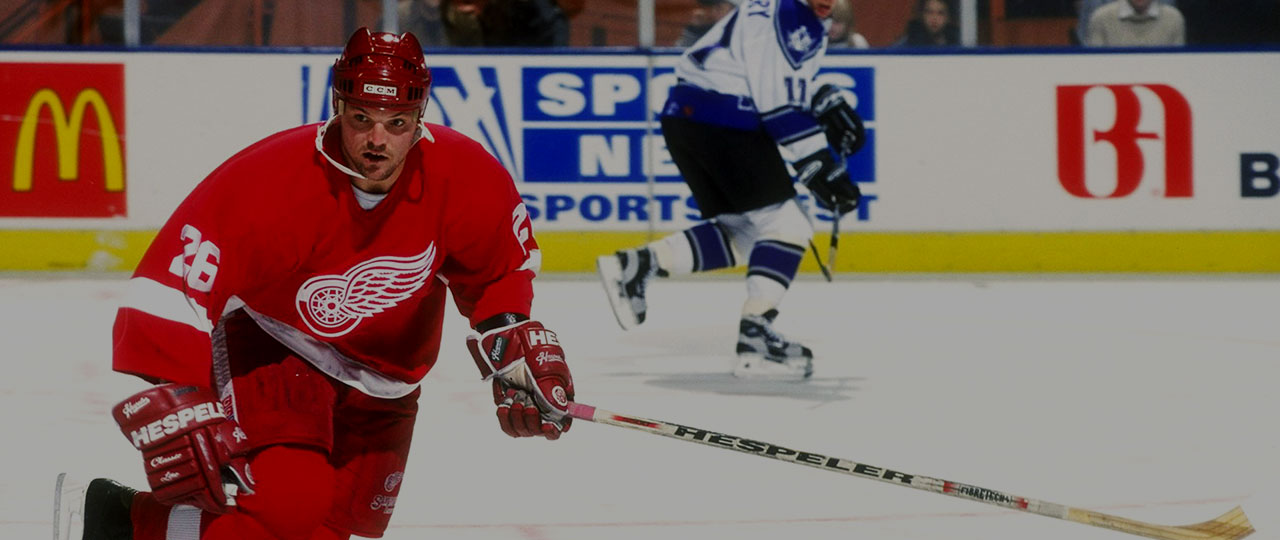

Bruins vs. Rangers
An Original Six Feud, A Century of Bad Blood, and a Night When Players Went Into the Stands
The Boston Bruins and the New York Rangers have played each other more than 750 times in regular-season and playoff hockey. That is not a rivalry in the modern, three-year, one-playoff-series sense. That is a hundred-year argument, conducted on ice, through four different buildings in each city, across every era of NHL hockey that has existed. When these two teams play, the echoes are not just of last spring. They are of Eddie Shore, of the 1939 semifinals, of a December night in 1979 when the Bruins went into the MSG stands, of Ron Duguay and Terry O'Reilly, of the 2013 playoff series that reminded a new generation what this was supposed to feel like.
This is the story of one of the oldest rivalries in North American professional sports - part of the Original Six pantheon, but darker and weirder than the Canadiens-Bruins feud that usually gets top billing.
The Origin: Two Expansion Teams That Refused to Get Along
The Boston Bruins joined the NHL in 1924 as the league's first American franchise. The New York Rangers followed two years later, in 1926, created by Madison Square Garden president Tex Rickard after the first New York NHL team - the Americans - proved so popular that Rickard wanted a second team for himself. (This is why Rangers fans still occasionally get called "Tex's Rangers" in deep-cut hockey history writing. Rickard's team. His Rangers.)
Both teams were in the league's American Division, which meant they played each other constantly. The first Bruins-Rangers game was in November 1926. The first nastiness arrived almost immediately. By the end of the 1927-28 season, the Rangers had won the Stanley Cup and the two teams had developed the sort of familiarity that produces contempt. By 1929, they were meeting in the Cup Final itself - a five-game series won by Boston, the Bruins' first championship.
"There was never a period where these teams liked each other," a long-retired NHL historian observed. "They were geographically close. They were both expansion teams trying to prove they belonged. They were fighting for the same American audience. The dislike was structural from the start."
The Eddie Shore Era and the Ace Bailey Incident
The defining figure of the early Bruins-Rangers years was Eddie Shore - the Hall of Fame defenceman who played for Boston from 1926 to 1940, won four Hart Trophies, and was the meanest man in hockey in an era full of mean men. Shore's value to Boston in rivalry games against the Rangers was immediate. He was a deterrent. He was also, it turned out, a hazard.
The incident that changed hockey forever actually happened against the Toronto Maple Leafs, not the Rangers. On December 12, 1933, in a game at Boston Garden, Shore hit Leafs forward Ace Bailey from behind with such force that Bailey's head struck the ice and he nearly died. Bailey survived after multiple brain surgeries but never played again. Shore was suspended for 16 games.
The reason the Bailey incident matters to the Rangers story is that it defined the era of violence the Bruins and Rangers fed through each other for the rest of the 1930s. The league's subsequent discussions of head-contact rules and of what constituted acceptable retaliation - all of it traced back through Shore, and Boston's rough reputation was partly built on what he had done in rivalry games against New York that never quite escalated to the Bailey level but that produced their share of stretcher rides.
1939 Stanley Cup Semifinals
In 1939 the Bruins and Rangers met in the Stanley Cup semifinals - a best-of-seven won by Boston in seven games. The series was brutal. Games went into triple overtime. Players went to hospital. Bill Cowley, Boston's Hart Trophy winner that year, played hurt. So did Rangers goaltender Dave Kerr. The Bruins won Game 7 and went on to beat Toronto for the Stanley Cup. That semifinal remains, in the opinion of a lot of old-school hockey writers, one of the most physically draining playoff series in pre-Original Six history.
The 1940s-1950s: Grudge Without Championships
The Rangers won the Stanley Cup in 1940 and then did not win it again for 54 years. The Bruins won in 1941 and then went 29 years without another. The rivalry between the two teams, through the 1940s and 1950s, was therefore a rivalry between two franchises that were often bad, always colliding, and consistently unpleasant to each other.
Games at Madison Square Garden in the 1950s were rough in a particular way - the old MSG (the third one, on 8th Avenue and 50th Street, before the current building opened in 1968) had a notoriously close fan experience. The stands pressed against the ice. Fans spilled beer on visiting players. Every few weeks, somebody got into it with a Bruin walking to the penalty box.
Gordie Howe, despite being a Red Wing, famously called the 1950s MSG "the hardest building in the league to play in, because the fans thought they were part of the team." Bruins players agreed. Rangers players enjoyed it. The rivalry stewed.
The Orr-Esposito Bruins vs. the Early Seventies Rangers
The arrival of Bobby Orr in 1966 changed the Bruins, and with it the Rangers rivalry. Boston won the Stanley Cup in 1970 and 1972. The Rangers, under coach Emile Francis, were a tough, skilled team anchored by Brad Park, Rod Gilbert, Jean Ratelle, Ed Giacomin, and the GAG Line. They were also constantly, painfully, one step behind the Bruins.
The teams met in the 1970 playoff quarter-finals (Boston won in six), the 1972 quarter-finals (Boston won in six), and the 1973 quarter-finals (Boston won in five). Three consecutive springs of Rangers elimination at Bruins hands. New York finally broke through in 1979 - but only against Philadelphia, then the Islanders, before running into Montreal in the Cup Final. The Bruins remained the earlier springtime obstacle.
Mid-1970s rivalry games at MSG and at Boston Garden were the kind of games that made television broadcasters rich. The NHL's "Game of the Week" frequently featured Bruins-Rangers. Ratings were enormous. Fights were frequent. Orr gliding around the ice with the puck while Dale Rolfe tried to knock him off it is now a piece of hockey memory.
December 23, 1979: Into the Stands
The most-replayed moment in Bruins-Rangers history happened on a Sunday night before Christmas, 1979, and it did not actually involve a goal or a fight between two players. It involved a fan, a stolen stick, and Mike Milbury removing a shoe.
Boston had just beaten the Rangers 4-3 at Madison Square Garden. As the Bruins were leaving the ice after the final horn, a Rangers fan in the front row reached over the glass and struck Boston forward Stan Jonathan, took his stick, and began waving it around. What happened next is still the most-watched NHL hockey-goes-wild video of the pre-YouTube era.
Bruins players, led by Terry O'Reilly, climbed into the stands. Peter McNab went over the glass. Mike Milbury followed. The altercation that followed saw Milbury remove the fan's shoe and - according to the most-shared version of the story - hit him with it. Nobody was seriously hurt. The fan, John Kaptain, later filed charges. Three Bruins were suspended (O'Reilly for eight games, McNab for six, Milbury for six). The NHL ordered Madison Square Garden to raise the glass.
"It was a different game back then," Milbury said many years later. "The glass was too low. The fans thought they were part of it. We thought they were part of it. And when somebody grabbed Stan's stick and started swinging, you weren't going to stand there and let it happen. Today, that never happens. Then, that was just a Sunday night."
The Bruins-into-the-stands incident became part of hockey folklore, and it is still the sequence that gets played on every "Most Brutal NHL Moments" compilation. For the Bruins-Rangers rivalry, it crystallised what was at stake: these were not two teams that played nice, and their fans were not spectators in the normal sense. They were participants.
The Eighties: O'Reilly, Duguay, and a Constant Low-Grade War
The post-stands-brawl era of the rivalry was coloured by a running personal feud between Boston captain Terry O'Reilly and Rangers forward Ron Duguay. The two had history going back to the late 1970s. Duguay, with his hair flowing behind him like a Viking's and his willingness to trade words with every Bruin on the ice, irritated O'Reilly specifically and the entire Boston bench generally.
"Ronnie was a good player who played with a swagger that made us crazy," a former Bruin from that era said. "He'd score on you and then he'd look at the bench. And Terry didn't put up with that from anybody. So they found each other. A lot."
The 1988 Bruins-Rangers series of regular-season games was particularly marked by O'Reilly/Duguay confrontations, line brawls, and post-whistle scrums. By this point O'Reilly was the Bruins' head coach, having taken over from Butch Goring mid-season 1986-87. He coached like he had played: hard, edgy, with a constant focus on making sure the Rangers bench heard about it.
Through the late 1980s and into the 1990s, the rivalry's intensity ebbed. The Rangers built toward their 1994 Cup run. The Bruins had their Cam Neely-Ray Bourque core. They met in the playoffs in 1991 (Bruins won in six) and 1992 (Rangers won in six) but the real blood rivalry of the era had shifted elsewhere - Boston was focused on Montreal, New York on the Islanders.
1994-2010: The Drifting Years
The rivalry cooled through the mid-1990s and into the 2000s. Both teams remained competitive for stretches. Neither was consistently elite. They met in the 1997 playoffs - a Rangers sweep that was the Bruins' low point in a generation. They did not meet again in the postseason for 16 years. When the NHL realigned divisions and schedules changed, the old Original Six pattern of multiple matchups per season began to dilute.
The rivalry did not disappear so much as go dormant. When Boston and New York played each other in a regular-season game in, say, 2006, there was a residual tension but no particular narrative. The fans who had watched the stands incident in 1979 were now grandparents. The players who had come through the O'Reilly-Duguay years were long retired. Something was waiting for a new chapter.
2013 Playoffs: The Modern Revival
The 2013 Eastern Conference second round brought the rivalry back to centre stage. Boston, led by Zdeno Chara, Patrice Bergeron, and Tuukka Rask, had just finished dispatching Toronto in the first round in a series that included one of the most dramatic third-period comebacks in playoff history. The Rangers, coached by John Tortorella, had just beaten Washington in seven.
The series itself was a goalie duel. Rask and Henrik Lundqvist both played at elite levels. The games were tight: five of the five games were decided by one or two goals, with overtime required in Game 2. Boston won the series 4-1 and moved on to beat Pittsburgh in the Eastern Final before losing to Chicago in the Stanley Cup Final in six.
What the 2013 series did was re-establish, for a new generation of fans, that Bruins-Rangers still carried weight. Games at TD Garden were loud in a specific way. Games at MSG had a texture that did not exist in Bruins matchups against, say, Florida. The rivalry was not dead. It had just been resting.
The Hall of Fame Crossroads
One of the less-celebrated things about the Bruins-Rangers rivalry is how many Hall of Fame players have worn both uniforms at some point. Mark Messier played for the Rangers but not the Bruins. Phil Esposito played for the Bruins and was traded to the Rangers in November 1975, one of the most shocking trades in NHL history. Jean Ratelle went the other direction - from Rangers legend to Bruins linemate of Bobby Orr. Cam Neely grew up a Bruins fan but played against New York for a decade.
The Esposito trade deserves its own paragraph. On November 7, 1975, the Bruins traded Esposito and Carol Vadnais to the Rangers for Ratelle, Brad Park, and Joe Zanussi. Esposito was a 30-year-old Boston icon, a two-time Cup champion, the beating heart of the team that won in 1970 and 1972. Trading him to the Rangers - of all teams - was, in the words of many Boston writers at the time, "unthinkable." The deal aged well for Boston; Ratelle and Park were brilliant contributors for years. But the emotional cost remained. Bostonians still mention it.
Style and Identity: Two Different Hockey Traditions
Part of what keeps a rivalry alive across generations is that the two franchises have always stood for slightly different versions of the sport. Boston, from the Shore days through the Bruins of O'Reilly, Neely, Chara, and Marchand, has been built around physical, blue-collar, emotionally driven hockey. The Rangers, particularly in the MSG spotlight, have trended toward finesse, star-power, and the kind of glamour that comes with being New York's hockey team.
The contrast is real and it is also, inevitably, mythologised. The Bruins have had plenty of skilled players (Orr, Esposito, Ray Bourque, Bergeron). The Rangers have had plenty of thumpers (Reijo Ruotsalainen was a thumper too in his own way, if you squint). But the identities stick because hockey fans want them to stick. Boston is the lunch-pail team. New York is the team you watch on national television. The rivalry is partly a rivalry of those two identities.
Memorable Regular-Season Nights
Beyond the playoff series and the stands brawl, Bruins-Rangers regular-season hockey has produced dozens of nights that still get discussed in fan forums and in oral histories. A few that come up repeatedly:
- February 11, 1981 - A line brawl at MSG that emptied both benches and produced 67 total penalty minutes.
- December 8, 1988 - Cam Neely's dominant performance at MSG, four goals, and a fight with Rangers defenceman David Shaw.
- October 27, 2007 - The first Bruins-Rangers outdoor game scheduled (later rescheduled) era build-up, cancelled for weather but discussed at length.
- March 2, 2019 - A 6-5 shootout win for the Rangers at Madison Square Garden that featured three lead changes in the third period.
These are not the marquee moments. They are the workday hockey that kept the rivalry humming between the headline events. It is the combined weight of seven hundred regular-season games that makes a rivalry a rivalry.
The Fans
Any honest discussion of Bruins-Rangers has to include the fan bases. Bruins fans are famously loyal, famously loud, and famously unforgiving. Rangers fans are similarly loyal, but with a New York-specific edge - they boo their own players, they celebrate brutally, and they carry grudges for decades. When these two fan bases overlap at MSG or TD Garden, the atmosphere is different from almost any other matchup in the sport.
The cross-border social media trash talk that now accompanies every Bruins-Rangers game is a modern extension of what was happening in newspapers a hundred years ago. The insults have changed. The temperature has not.
Bruins-Rangers Rivalry: Quick Facts
| First Meeting | November 1926 |
| Regular-Season Meetings | 700+ as of 2025-26 |
| Playoff Series | 9 (Boston leads the playoff series count) |
| Stanley Cups (Boston) | 6 (1929, 1939, 1941, 1970, 1972, 2011) |
| Stanley Cups (New York) | 4 (1928, 1933, 1940, 1994) |
| Most Famous Incident | December 23, 1979 - Bruins into the stands at MSG |
| Most Recent Playoff Meeting | 2013 Eastern Conference Semifinals (Boston wins 4-1) |
| Buildings | Boston Garden / TD Garden; MSG (third and current version) |
| Key Era Captains | Eddie Shore, Milt Schmidt, Bobby Orr, Ray Bourque, Zdeno Chara (Boston); Brad Park, Mark Messier, Jaromir Jagr, Ryan McDonagh (New York) |
Frequently Asked Questions
When did the Bruins-Rangers rivalry begin?
The rivalry began in 1926 when the Rangers entered the NHL two years after the Bruins. Both were in the league's American Division and played each other constantly. The first real bad blood traces to the early 1930s and the Eddie Shore era, and it has continued without meaningful interruption for a century.
What happened in the 1979 Rangers-Bruins stands brawl?
On December 23, 1979, at Madison Square Garden, Bruins players climbed into the stands after a Rangers fan reached over the glass and struck Boston forward Stan Jonathan, stealing his stick. Mike Milbury famously removed the fan's shoe and hit him with it. The incident led to suspensions for O'Reilly, McNab, and Milbury, and an NHL mandate to raise the glass in all arenas.
How many times have the Bruins and Rangers met in the playoffs?
They have met nine times in the Stanley Cup playoffs, including the 1929 Stanley Cup Final (Boston won), the 1939 semifinals (Boston won), three consecutive quarter-final series in 1970, 1972, and 1973 (Boston won all three), and most recently the 2013 second round (Boston won 4-1).
Who has won more Stanley Cups, the Bruins or the Rangers?
Boston has won six Stanley Cups (1929, 1939, 1941, 1970, 1972, 2011). The Rangers have won four (1928, 1933, 1940, 1994). Boston's 2011 Cup over Vancouver remains the most recent championship for either franchise.
What was the Terry O'Reilly vs. Ron Duguay altercation?
During the late 1970s and early 1980s, Bruins captain Terry O'Reilly and Rangers forward Ron Duguay had a running feud that spilled into multiple games - line brawls, pre-game confrontations, and post-whistle scrums that typified the physical, personal intensity of the rivalry in that era.
What was the 2013 Bruins-Rangers playoff series?
In the 2013 Stanley Cup Playoffs second round, the Boston Bruins defeated the New York Rangers 4-1 in a goalie-duel series with Tuukka Rask outplaying Henrik Lundqvist. The series reignited the rivalry for a new generation and set up Boston's run to the 2013 Stanley Cup Final, which they lost to Chicago in six games.
The Rivalry in 2026
As of 2025-26, the Bruins and Rangers remain two of the most valuable franchises in professional hockey and two of the most consistently watched. The roster generations continue to turn over. New names get added to the story every winter. But the underlying texture - two Original Six franchises, seven hundred-plus games of history, one night in 1979 when the whole thing spilled over the glass - is not going anywhere. When Boston plays New York at MSG, somewhere in the building is a fan who remembers where he was when the Bruins went into the stands. Somewhere in Boston is a fan with the same memory. The rivalry passes that way, from generation to generation, across a century of Saturday nights.
Related Stories
- The Greatest NHL Rivalries of All Time
- Canadiens vs. Bruins: The Other Original Six Feud
- Red Wings vs. Avalanche: Hockey's Greatest Rivalry
- Terry O'Reilly: The Bruins' Toughest Captain
- Bob Probert: The Toughest Man in Hockey
- The Greatest Hockey Fights in NHL History
- How Enforcers Have Evolved in Hockey
- The 10 Most Brutal Hockey Brawls in NHL History
Love Hockey? Try Hockey Betting
Think you know the game better than the oddsmakers? Put your hockey knowledge to work with Canada's best sportsbooks.